A research team from the Data Science and Intelligent Computing Laboratory at Beihang University's Hangzhou International Innovation Institute has achieved significant progress in light field imaging. Their paper, titled "Pyramid-Angular-Constraint Network for Light Field Super-Resolution," has been published in the prestigious international journal Computational Visual Media (CVMJ).
The first author is Yang Da, a postdoctoral researcher at the institute, with Professor Sheng Hao from both the School of Computer Science and Engineering and the Data Science and Intelligent Computing Laboratory serving as the corresponding author. The work represents a notable advancement in the structured modeling and robust semantic understanding of light fields in diverse real-world scenes.
Light field (LF) cameras record both intensity and directions of light rays in a scene with a single exposure. Due to the trade-off between spatial and angular dimensions, the spatial resolution of LF images is limited, so super-resolution is widely studied. Pixels follow linear coordinate projection across views in LF images. Hence, auxiliary views nearer to the target view are generally more effective for use in super-resolution.
To better exploit this geometric structure, the team introduced an LF-pyramid based on an angular-distance constraint. This approach allows for the discriminative extraction of complementary features from views across different pyramid layers. However, the shape of the LF-pyramid varies depending on the target view's angular position. To fully leverage this dynamic structure, the researchers developed the pyramid-angular-constraint network for LF super-resolution (LF-PACNet).
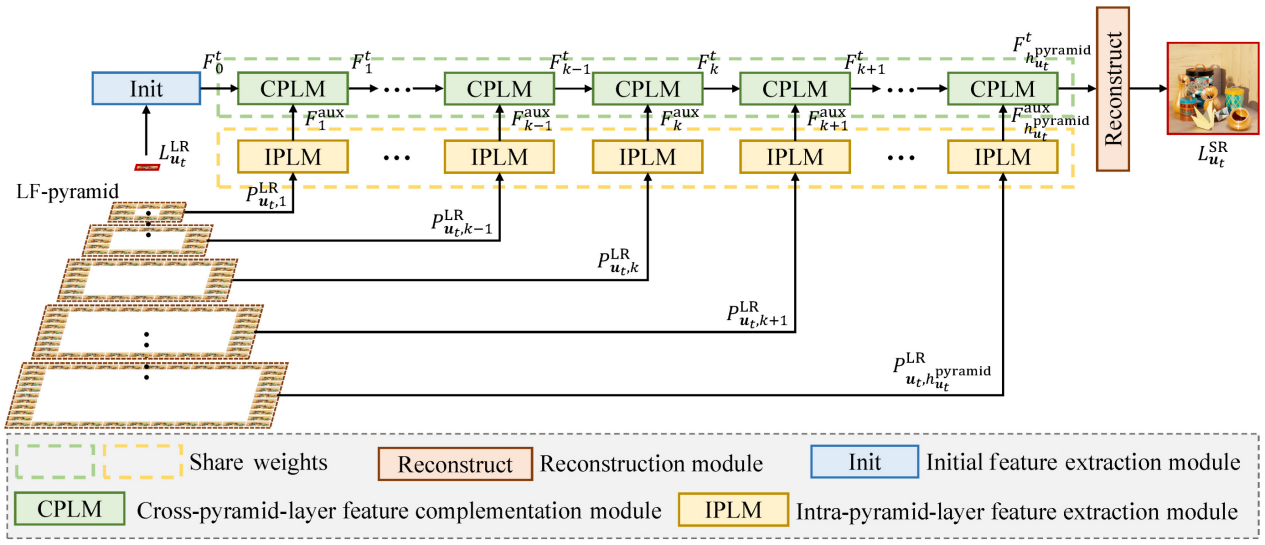
Fig.1 Architecture of LF-PACNet
The network features two key modules: an intra-pyramid-layer feature extraction module that treats all views within a layer equally to extract complementary information, and a recurrent cross-pyramid-layer feature complementation module designed to handle an arbitrary number of layers by discriminatively furnishing the target view with high-frequency details.
Extensive experiments on public datasets show that LF-PACNet significantly outperforms existing methods in both visual quality and numerical metrics, with particularly strong results on challenging datasets featuring large disparities.
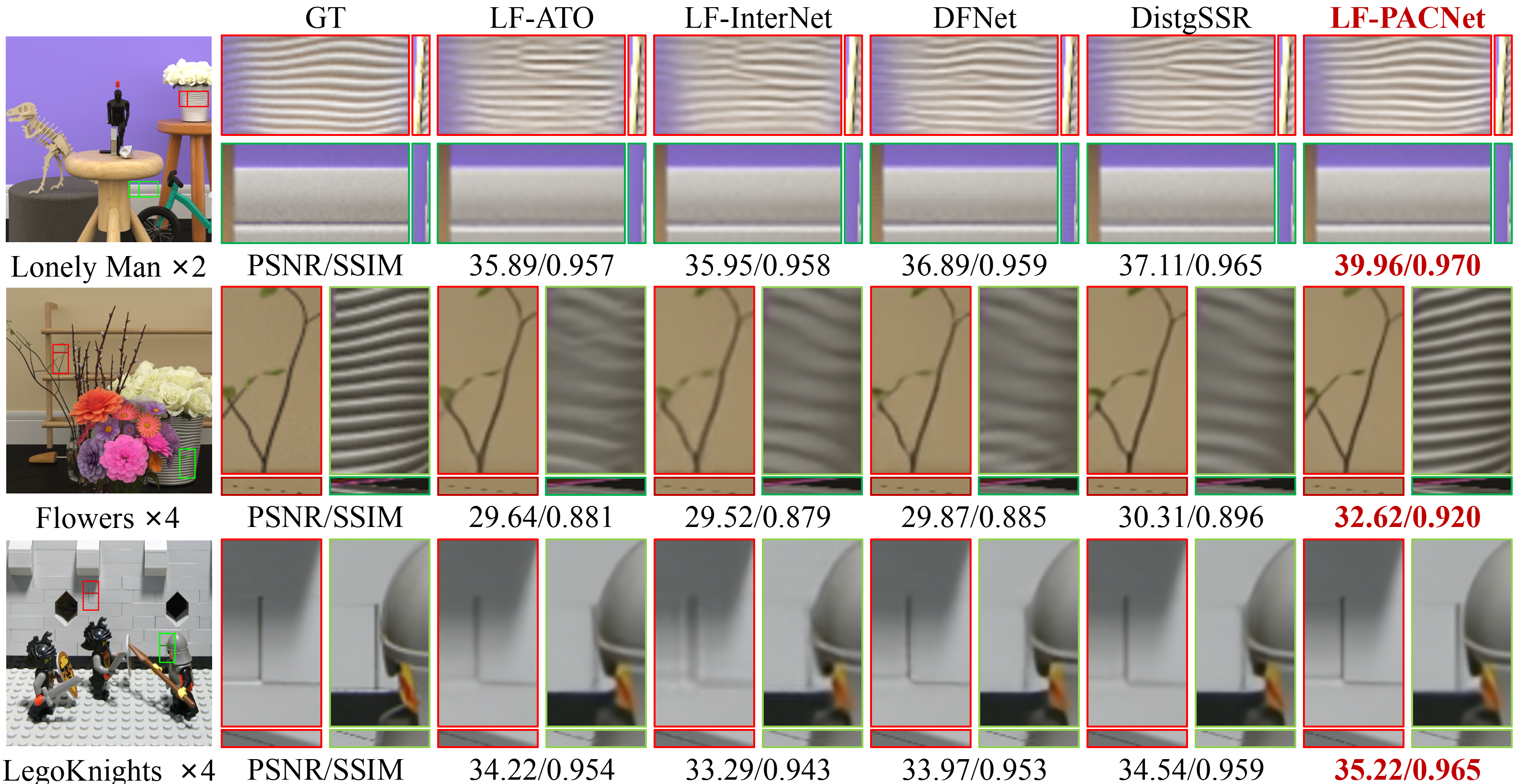
Fig. 2 Comparison of LF-PACNet with other methods
The Data Science and Intelligent Computing Laboratory is dedicated to teaching and research in areas such as IoT sensing, data science, intelligent computing, and information security, cultivating talent for emerging engineering disciplines in the AI era. It is responsible for the development, operation, and maintenance of "XiaoHang," Beihang's foundational AI model, as well as the university's intelligent computing infrastructure.
Computational Visual Media (CVMJ), established in 2015 by Tsinghua University's Visual Media Research Center, is a leading journal in its field. It is edited by a distinguished team including Academician Hu Shimin (Tsinghua University) as Editor-in-Chief, alongside Professors Ralph Martin (Cardiff University) and Ming C. Lin (University of Maryland). The journal is indexed in over 20 databases including SCIE, EI, and Scopus. Its impact factor has seen remarkable growth, rising from 4.127 in 2022 to 18.3 in 2025, ranking first in the "Computer Science, Software Engineering" category (SCI Q1). Its CiteScore of 28.5 also places it first among journals in computer graphics and computer-aided design.
Link to the article: https://ieeexplore.ieee.org/document/11363133
Editor: Lyu Xingyun


 Beihang News2026 Symposium on Excellent Engineer Training held in BeijingMore
 Beihang NewsProfessor Liu Mingjie's team publishes article in Science, revealing high-modulus toughening mechanism in nacreMore
 Beihang NewsWang Yunpeng appointed Secretary of the CPC Beihang University CommitteeMore
 Beihang NewsElsevier Senior Vice President Said Taha visits Beihang UniversityMore
 Beihang NewsPresident Wang Yunpeng visits Hangzhou to advance university-city integration and attends opening ceremony of H3IMore
 Beihang NewsBeihang team wins 2026 Best Paper Award from Proceedings of the IEEEMore