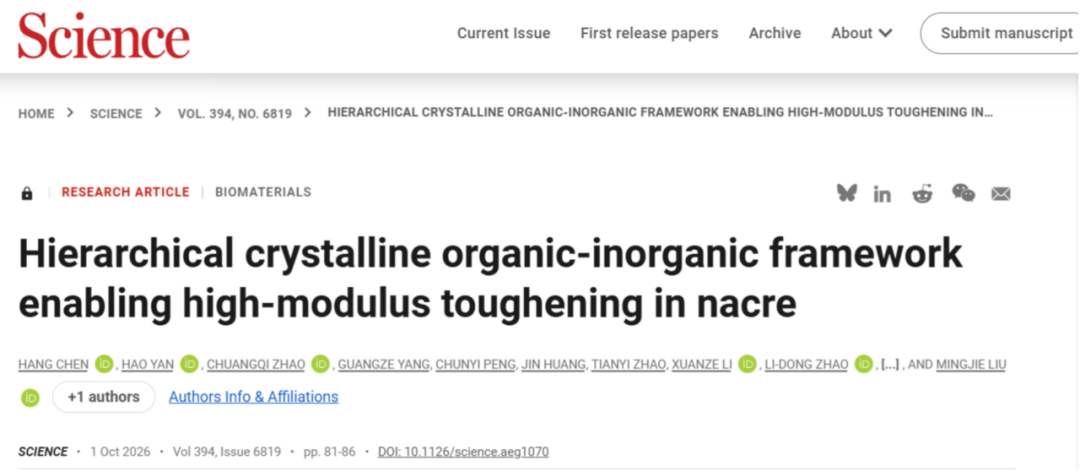
A research team led by Professor Liu Mingjie from Beihang University has published new findings on the high-strength, high-toughness mechanisms of biological materials and their application to biomimetic nanocomposites. The paper, titled "Hierarchical Crystalline Organic-Inorganic Framework Enabling High-Modulus Toughening in Nacre," was published as a Research Article in Science on October 1, 2026. Beihang University is the first affiliation, with postdoctoral researcher Chen Hang as first author and Professor Liu Mingjie as corresponding author.
Nacre, long renowned for its exceptional strength, stiffness, and toughness, has served as the model system for bioinspired structural design. Since the discovery of its classical brick-and-mortar architecture, most research has followed a "nature-to-artificial" path—characterizing its micro- and nanoscale architecture and using those insights to guide the design of synthetic materials. However, the classical model has focused primarily on the organization of micron-scale aragonite platelets and the interlayer organic matrix, leaving the deeper nanoscale organic-inorganic organization and its fine assembly characteristics largely unexplored.
The team's prior work in synthetic systems offered a new perspective for re-examining this classic natural structure. In 2020, the team published findings in Nature showing that 2D inorganic materials can regulate polymer crystallization and structural order through nanoconfinement. This raised a compelling question: if artificial 2D inorganic materials can confine polymer crystallization, could calcium carbonate in nacre—formed through hundreds of millions of years of biomineralization—similarly induce or stabilize biomolecules into crystalline structures through analogous nanoconfinement? This prompted the team to shift from the traditional "nature-to-artificial" approach toward an "artificial-to-nature" perspective, re-examining the nanoscale organization within nacre.
In the research, the team reveals a high-modulus toughening mechanism in the mature nacre of Cristaria plicata driven by a crystalline organic-inorganic framework (COIF). This framework maintains the classical brick-and-mortar architecture while incorporating a hierarchical structure within the tablets, where 29±3.9 nm aragonite nanorods are aligned perpendicular to the tablet plane and separated by 4.9±0.4 nm gaps filled with intratabular biomolecular crystallites. By harnessing the critical slip-length effect, these crystalline units approach the theoretical limits of modulus and strength. The nanoconfined biomolecular crystallites function as nanopins at interlamellar interphases, alleviating stress concentrations and enabling synchronized deformation across multiple length scales.
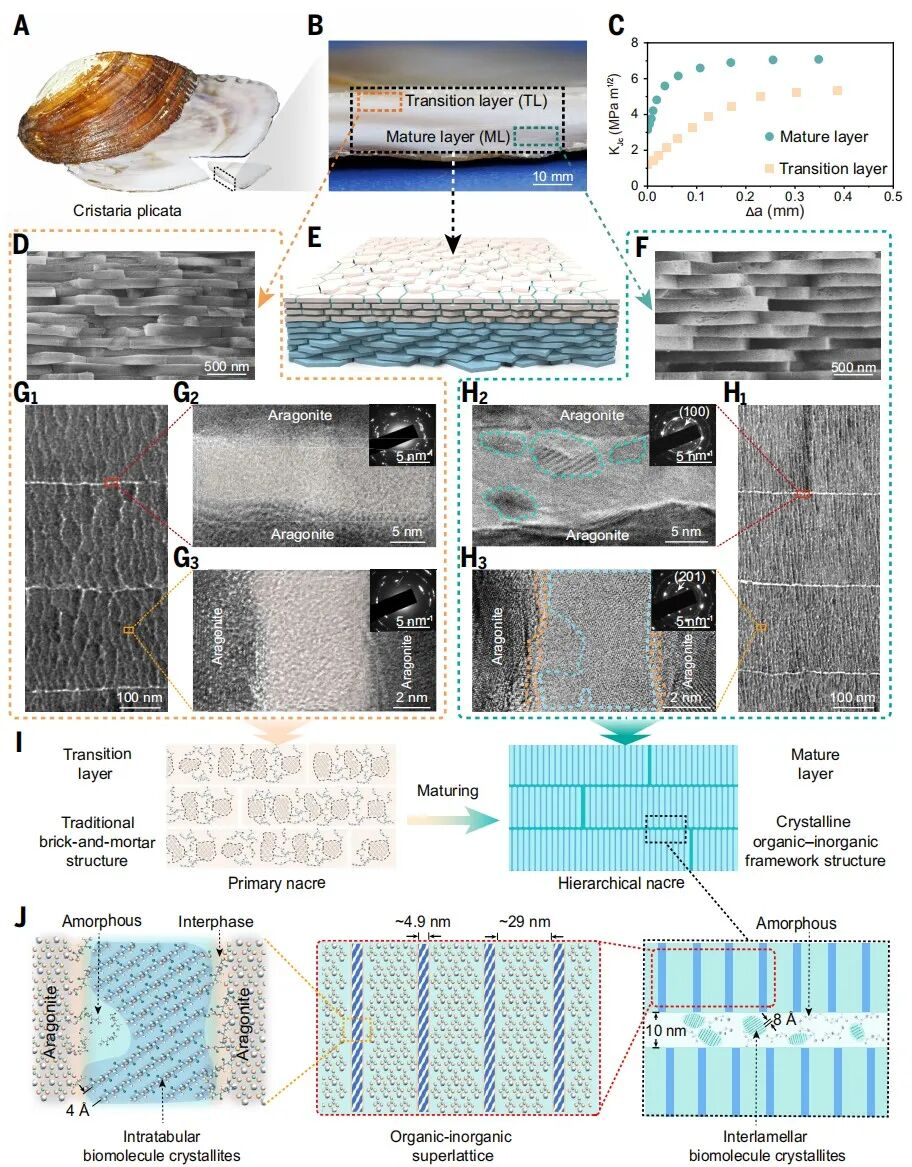
Fig. 1. Structural comparison between the mature layer (ML) and transitional layer (TL) in C. plicata nacre.
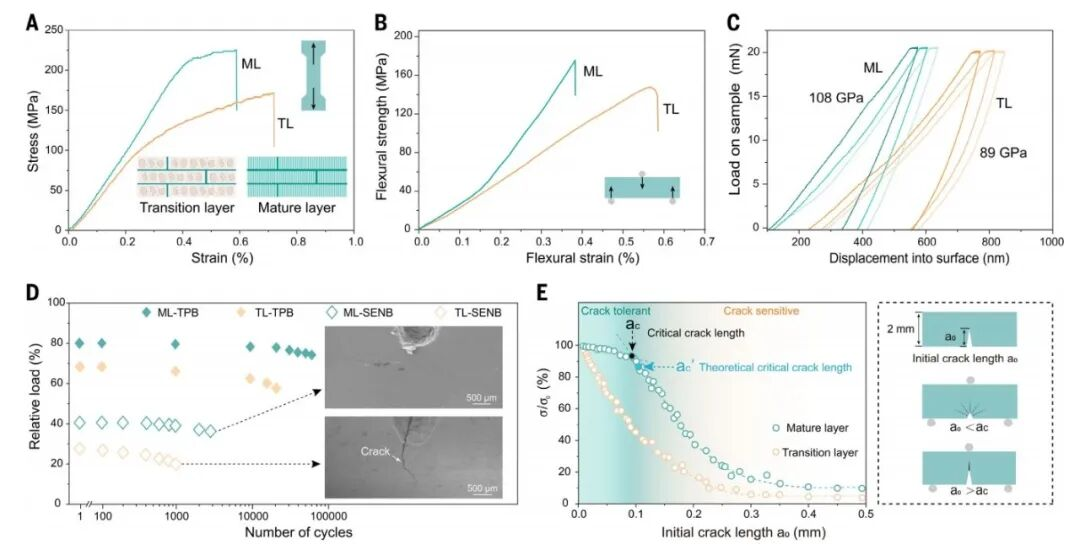
Fig. 2. Comparison of mechanical properties between the ML and TL in C. plicata nacre.
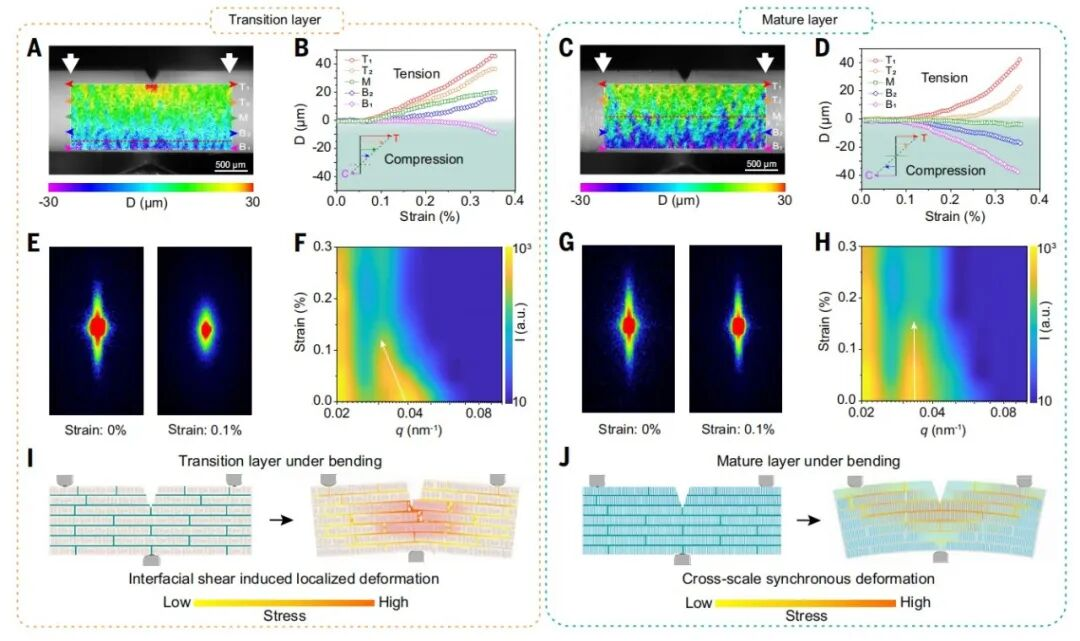
Fig. 3. Deformation mechanisms in the TL and ML of C. plicata nacre.
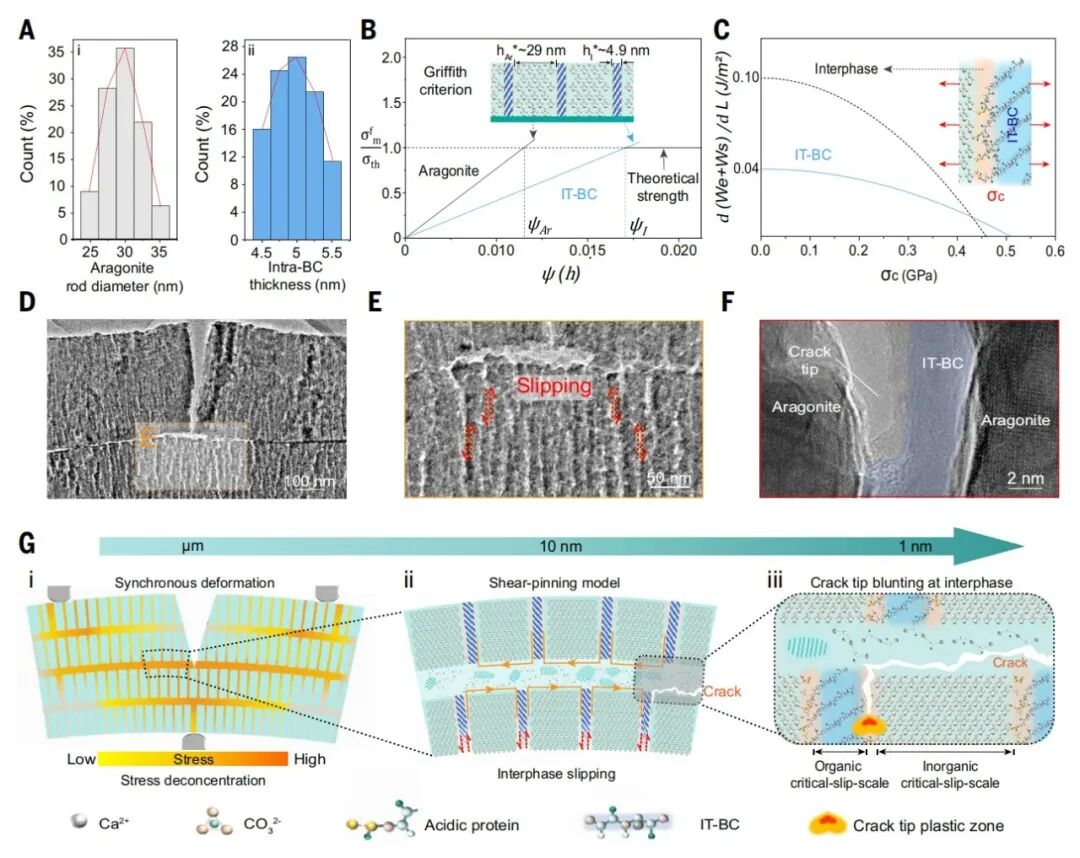
Fig. 4. High-modulus toughening mechanisms in the ML.
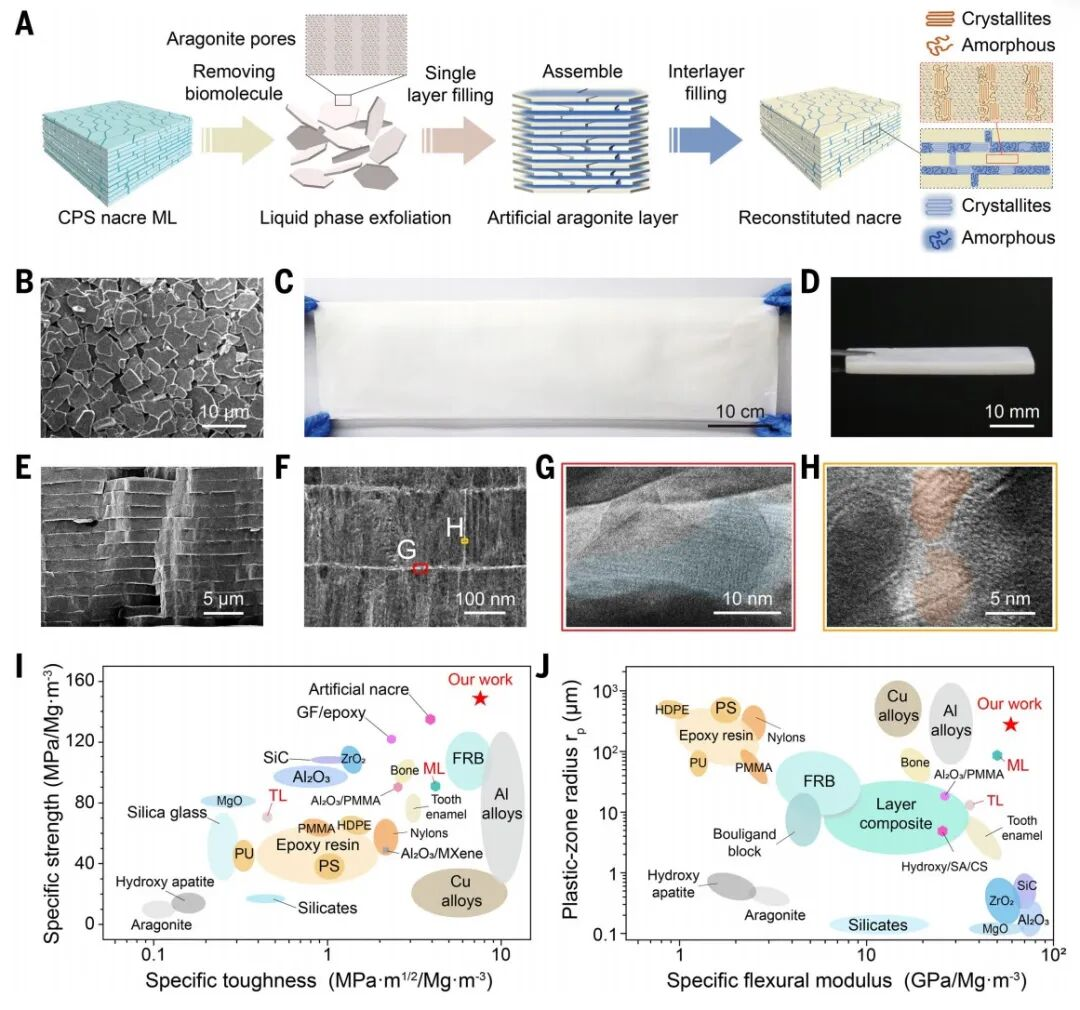
Fig. 5. Fabrication and characterization of reconstituted nacre.
Guided by this principle, the team fabricates reconstituted nacre from regenerated aragonite tablets and resins. The resulting bioinspired material simultaneously achieves high stiffness and crack resistance, with an elastic modulus of 43 GPa, fracture toughness of 12.8 MPa·m1/2, critical crack length of 0.2 mm, and plastic zone size of 112μm—successfully decoupling stiffness and toughness. These findings establish a broader COIF-inspired design principle for robust bioinspired materials that is extendable to various nanomaterials with confined nanoscale architectures.
Article link: https://www.science.org/doi/10.1126/science.aeg1070
Editor: Lyu Xingyun


 Beihang NewsProfessor Liu Mingjie's team publishes article in Science, revealing high-modulus toughening mechanism in nacreMore
 Beihang NewsWang Yunpeng appointed Secretary of the CPC Beihang University CommitteeMore
 Beihang NewsElsevier Senior Vice President Said Taha visits Beihang UniversityMore
 Beihang NewsPresident Wang Yunpeng visits Hangzhou to advance university-city integration and attends opening ceremony of H3IMore
 Beihang NewsBeihang team wins 2026 Best Paper Award from Proceedings of the IEEEMore
 Beihang NewsPresident Wang Yunpeng visits Nanjing to deepen inter-university collaborationMore