A research team led by Professor Zhang Xinghua from the School of Physics at Beihang University has made a significant breakthrough in understanding the physical mechanisms of particle diffusion in two-dimensional disordered media. The findings were published in Physical Review Letters, a premier journal in the field of physics.
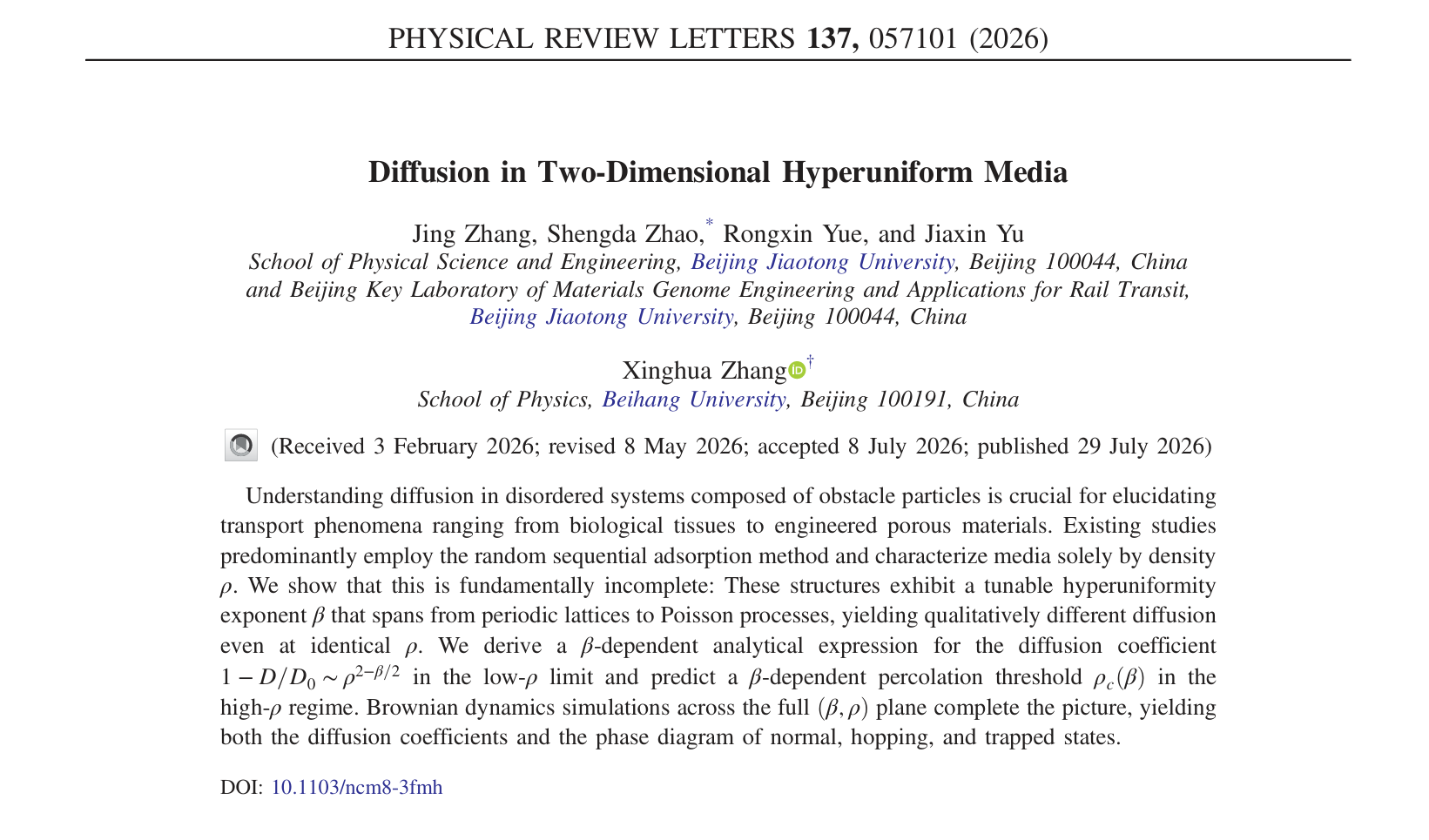
Diffusion in obstacle-free space is a classic problem famously tackled by Einstein in 1905. For diffusion in disordered media, however, researchers have long relied on the random sequential adsorption (RSA) method to generate random obstacle structures and have assumed that the density ρ of obstacle particles is the sole structural parameter controlling the diffusive behavior of Brownian particles.
This study challenges this long-held assumption, demonstrating that it is fundamentally incomplete. Even at identical densities, disordered structures with different degrees of long-range correlation can exhibit qualitatively different diffusion behaviors—a critical degree of freedom that previous studies have completely overlooked.
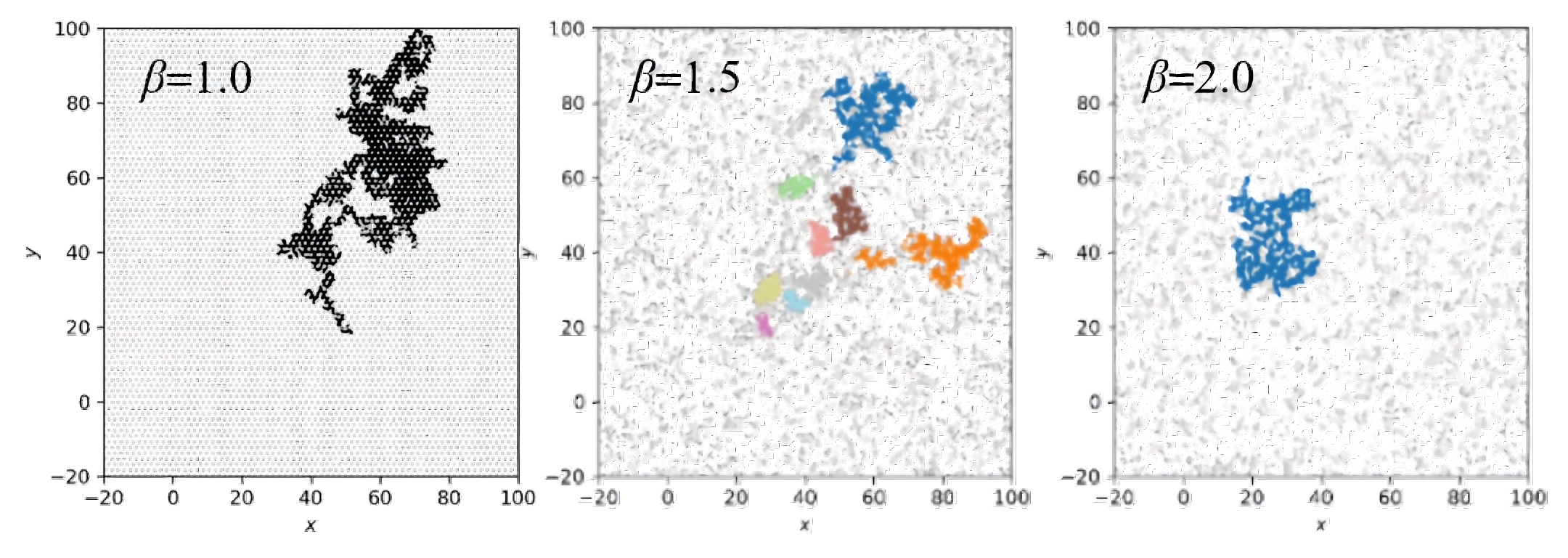
To address this gap, the team introduces the hyperuniformity exponent β as a new structural parameter to characterize the long-range correlations of the obstacle medium. β spans from periodic lattices to Poisson processes, yielding qualitatively different diffusion even at identical ρ. They derive a β-dependent analytical expression for the diffusion coefficient 1− D / D0 ∼ρ2−β/2 in the low-ρlimit and predict a β-dependent percolation threshold ρc(β) in the high-ρregime. Brownian dynamics simulations across the full (β,ρ) plane complete the picture, yielding both the diffusion coefficients and the phase diagram of normal, hopping, and trapped states.
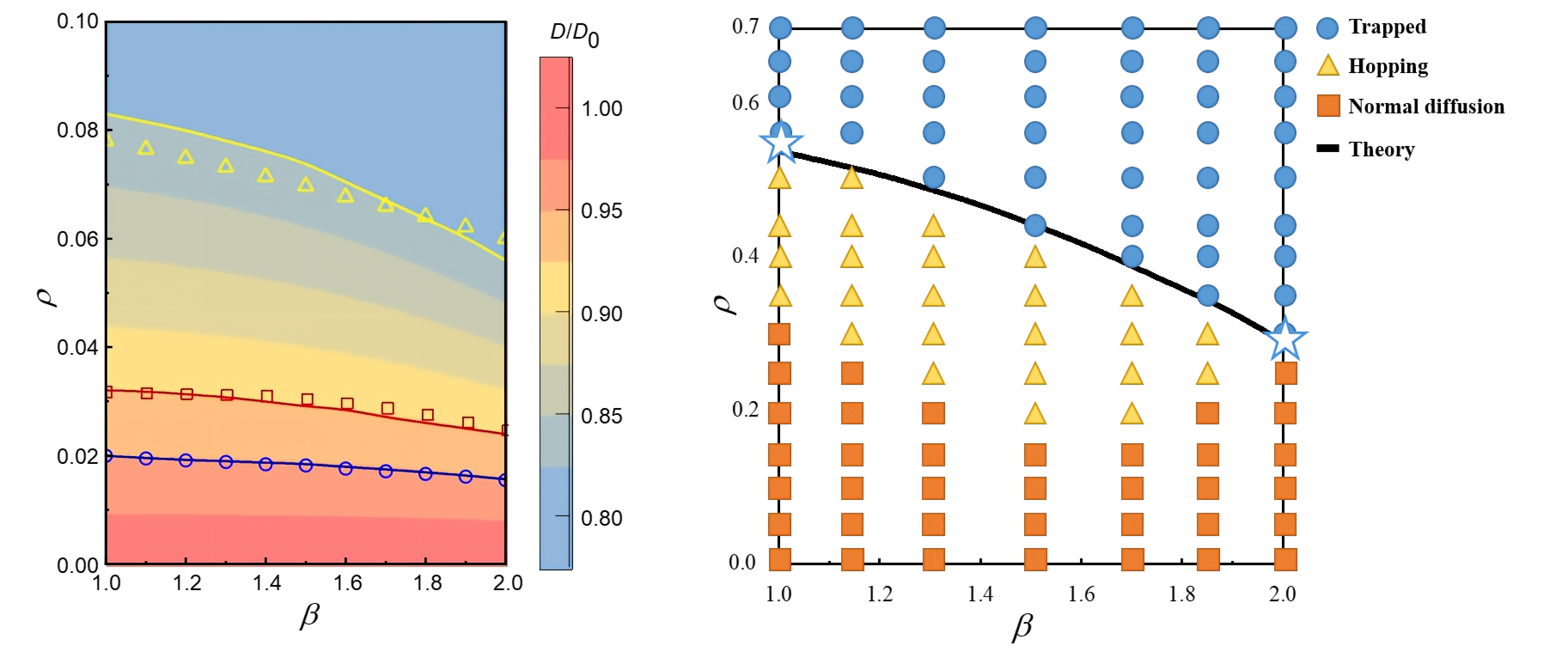
This work provides a complete theoretical description of diffusion in disordered media. It fundamentally corrects the established paradigm that density is the only structural parameter governing diffusion in these systems. The findings offer a new theoretical framework for understanding and predicting transport phenomena in complex media, such as biological tissues, polymers, porous materials, and optoelectronic functional materials.
This research was conducted independently by Professor Zhang's team. The first four authors of the paper—Zhang Jing, Zhao Shengda, Yue Rongxin, and Yu Jiaxin—were Ph.D. students supervised by Professor Zhang during his tenure at Beijing Jiaotong University. Professor Zhang is the corresponding author. The work was supported by the National Natural Science Foundation of China.
Link to the article: https://journals.aps.org/prl/abstract/10.1103/ncm8-3fmh
Editor: Lyu Xingyun


 Beihang NewsProfessor Yu Shui wins Best Screenplay Award at 21st Changchun Film FestivalMore
 Beihang NewsBeihang University welcomes new undergraduatesMore
 Beihang NewsTwo Beihang professors elected 2026 IAPR FellowMore
 Beihang NewsBeihang-initiated DigiTwin 2026 held at University of OxfordMore
 Beihang NewsBeihang University launches "Operation Tufeng": China's first university-level original sci-fi IP integrating Aerospace and AIMore
 Beihang NewsInaugural Brazil-China Future Leaders Program concludes with 400 participants forging a bridge of innovation and friendshipMore