Recently, the Intelligent Detection and Diagnosis Center of the School of Reliability and Systems Engineering at Beihang University has made important progress in the field of wave manipulation and metamaterial design. The related research results, titled "A less-for-more metamaterial paradigm via Laplace-Helmholtz correspondence," were published in the internationally renowned physics journal Reports on Progress in Physics (Impact Factor 20.7). This study established a rigorous correspondence between the Laplace equation and the Helmholtz equation and proposed a new paradigm of wave manipulation characterized by "using statics to control dynamics" and "less-for-more," providing a new theoretical framework for complex wave systems and the design of novel metamaterials.
Dynamic fields such as acoustic waves, electromagnetic waves, and water waves are usually described by the Helmholtz equation, and their manipulation often involves two constitutive parameters. When the wave frequency approaches zero, the Helmholtz equation can degenerate into the Laplace equation describing static fields, and the number of constitutive parameters involved in the system is reduced from two to one. Static field manipulation therefore has the advantages of relative simplicity, high efficiency, and precision. However, because of the essential differences between the Laplace equation and the Helmholtz equation in terms of parameters and physical fields, conventional methods usually require the quasi-static assumption to extend static field manipulation methods to dynamic fields. How to establish a rigorous correspondence between the two is a key challenge for realizing generalized wave manipulation.
To address this issue, the research team established a Laplace-Helmholtz correspondence, linking the equipotential lines/surfaces of static fields with the wavefronts of dynamic fields, and introduced wave invariants characterizing the consistency of propagation time as a design constraint. Within this framework, only a single constitutive parameter in the Laplace equation needs to be designed and the corresponding static field obtained. The two constitutive parameters and dynamic field in the Helmholtz equation can then be derived, enabling less-for-more wave manipulation design. This paradigm can reproduce classical approaches including coordinate transformation and scattering cancellation, while further expanding their manipulation capabilities. For instance, it enables hyperbolic cloaking difficult to construct via transformation theory, overcomes the quasi-static limitation of scattering cancellation methods, realizes three-dimensional conformal design, and avoids geometric constraints and impedance mismatch issues in traditional conformal transformation. The research team also fabricated an acoustic waveguide cloak using a multilayer aluminum-air structure to achieve acoustic cloaking without near-zero parameters, experimentally verifying the proposed scheme.
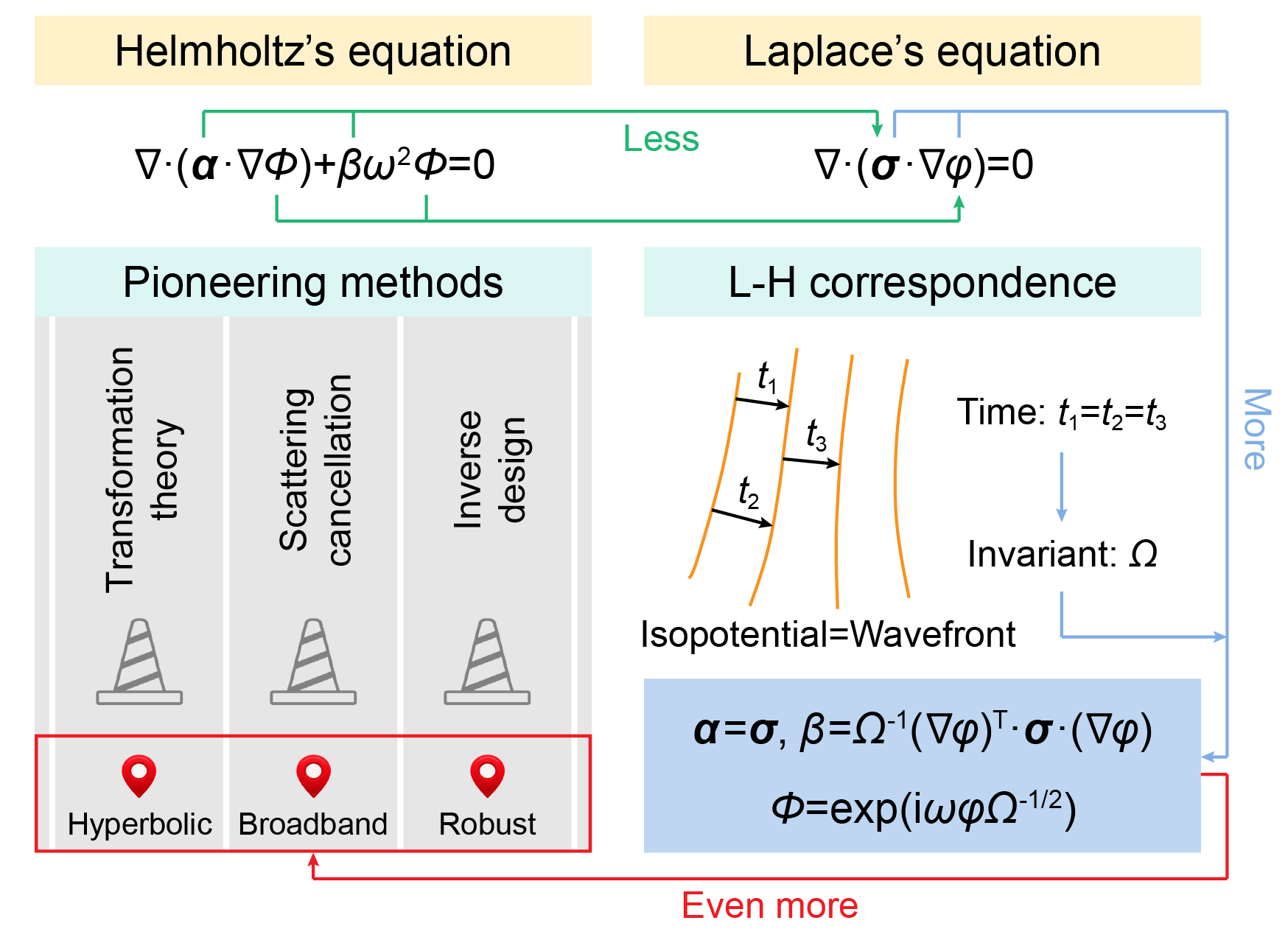
The Laplace-Helmholtz correspondence and the new "less-for-more" paradigm for wave manipulation. The left figure shows typical wave manipulation methods and the challenges they face in hyperbolic, broadband, and robust manipulation; the right figure shows the new paradigm proposed in this paper: starting from a single constitutive parameter and static field in the Laplace equation, the two constitutive parameters and dynamic field in the Helmholtz equation are derived with the aid of wave invariants.
This study realized a rigorous mapping from Laplace static fields to Helmholtz dynamic fields, offering a new design approach for wave manipulation and laying a theoretical foundation for further energy and information transmission manipulation in complex media and environments. By introducing spatially varying wave invariants and mechanisms such as non-Hermitian gain-loss, this framework is expected to be further extended to more complex wave systems and metamaterial design in future work.
The first authoris Guo Zixing, a doctoral student enrolled in 2025 at Beihang University, and the supervisor is Professor He Jingjing. Beihang University is the first completing institution. Collaborators include Associate Researcher Xu Liujun from the Graduate School of China Academy of Engineering Physics, Professor Qiu Chengwei from the National University of Singapore (NUS), Associate Researcher Yang Fubao from the University of Shanghai for Science and Technology, master's student Li Tong from Beihang, and doctoral student Yang Shuihua from NUS. This research was funded by the National Natural Science Foundation of China.
Editor: Liu Tingting


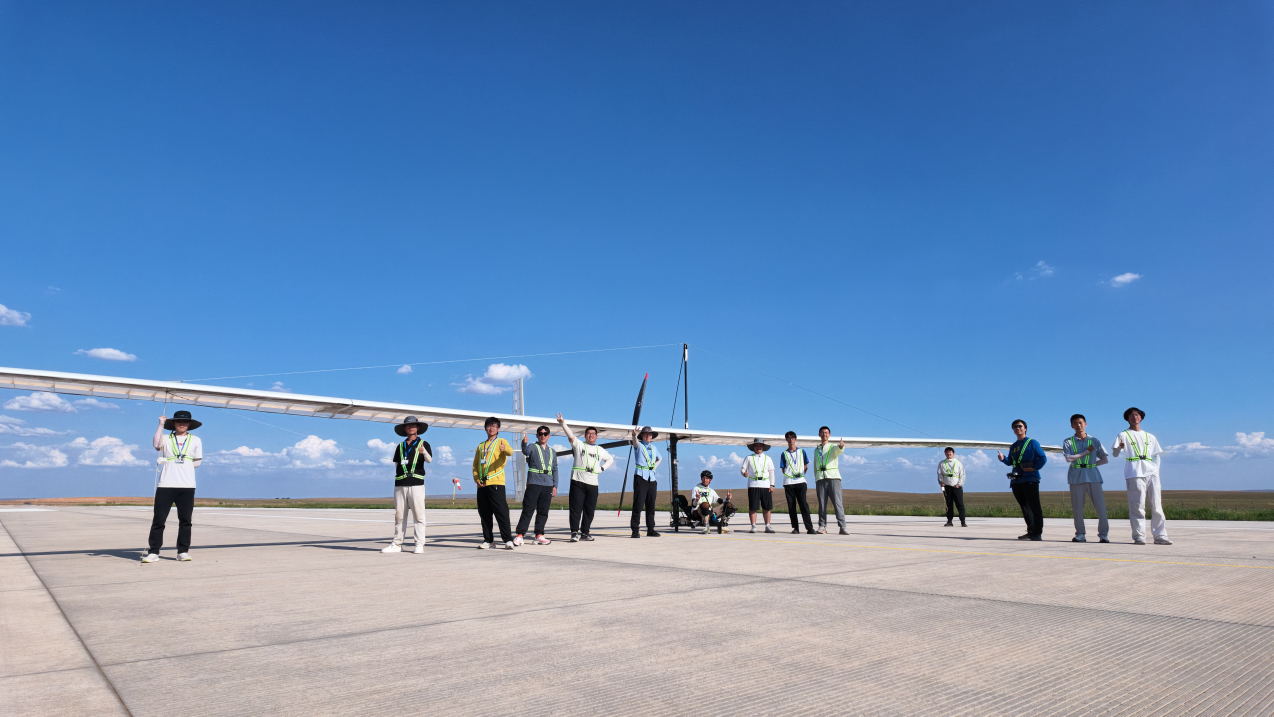 Beihang NewsBeihang's first student-designed human-powered aircraft completes test flightMore
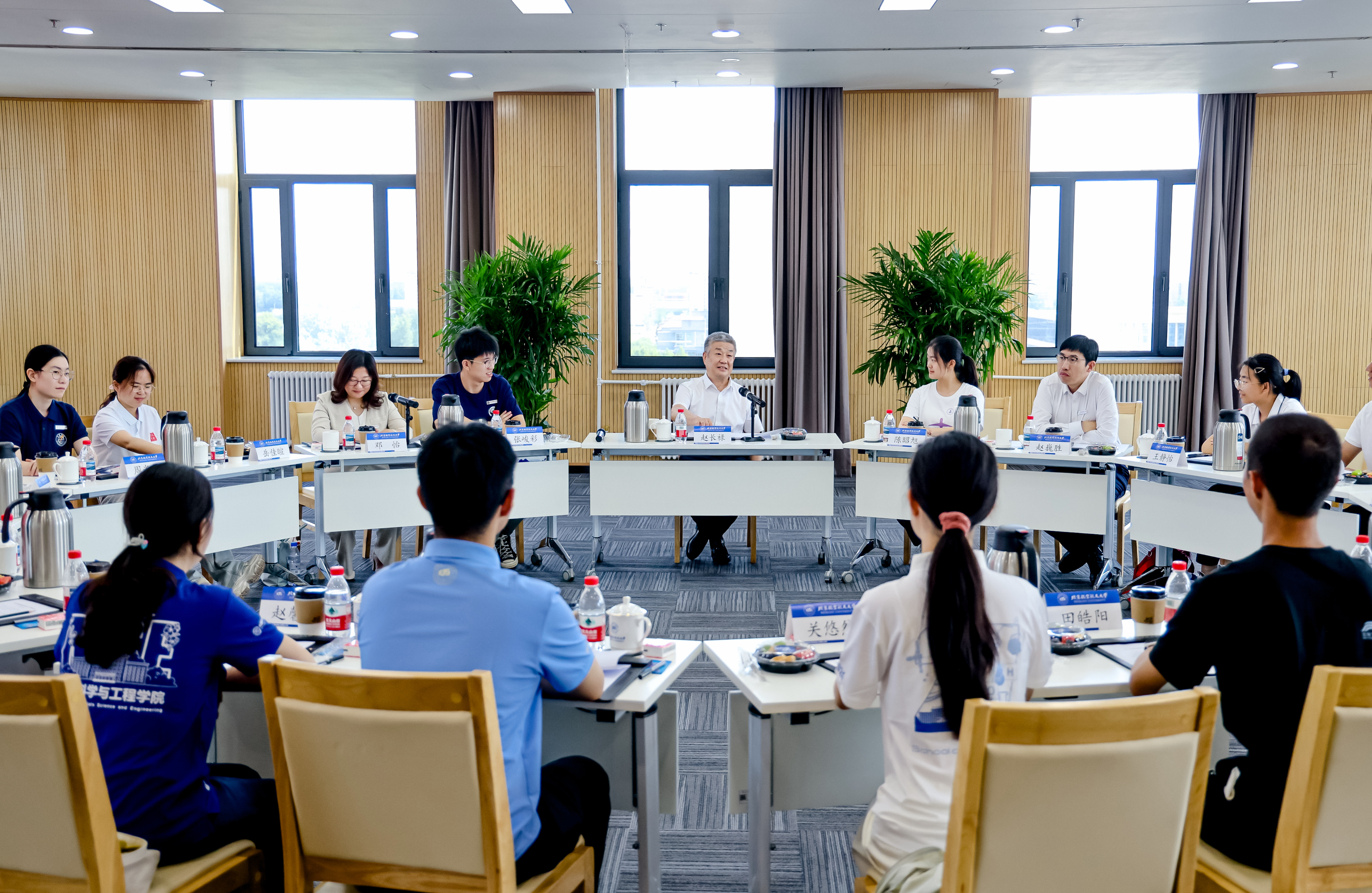 Beihang NewsBeihang leaders engage in dialogue with new undergraduate and graduate student representativesMore
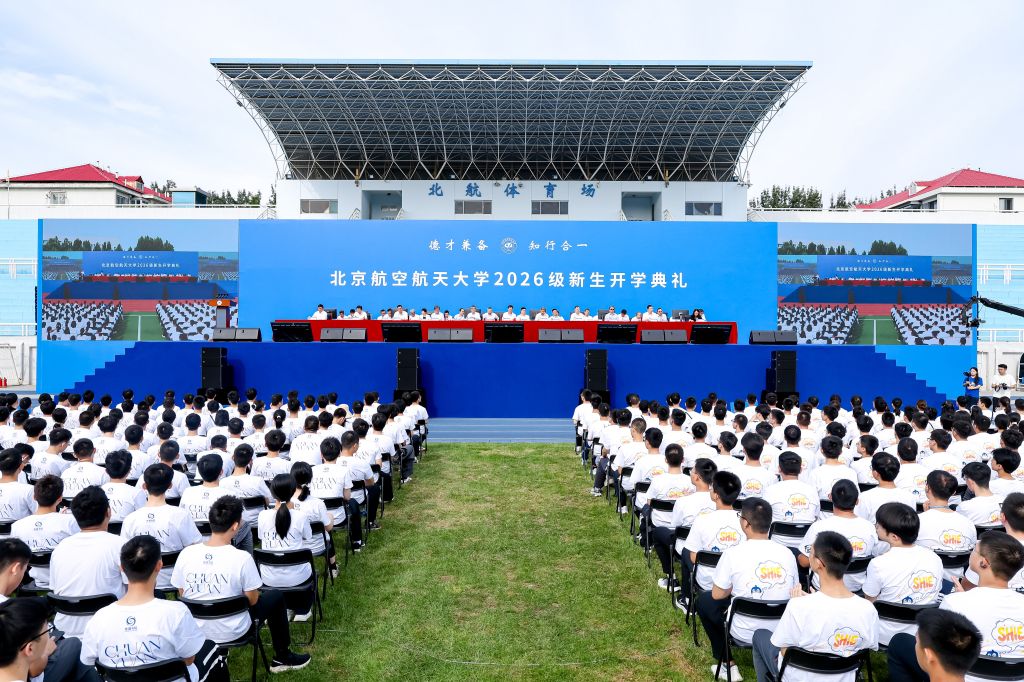 Beihang NewsBeihang University holds 2026 opening convocation to welcome new studentsMore
 Beihang NewsBeihang University welcomes 9,022 new graduate studentsMore
 Beihang NewsProfessor Yu Shui wins Best Screenplay Award at 21st Changchun Film FestivalMore
 Beihang NewsBeihang University welcomes new undergraduatesMore