Lightweight, flexible, and highly efficient energy conversion systems are of great application value for meeting the growing demand for distributed power supply and enabling high-performance sensing. Ion transport is a key process for achieving efficient energy conversion in industrial and biological systems, and it usually needs to be driven by an external electric field or an ion concentration gradient. If mechanical excitation could be used to drive ion transport and convert the widely existing mechanical energy in the environment into electrical energy, it would be a highly adaptable approach to energy harvesting. On the other hand, the flexoelectric effect is a coupling effect between electric polarization and strain gradient, and is a universal physical mechanism for converting mechanical energy into electrical energy; however, the strain gradient that can be generated in macroscopic solid materials is limited, and improving flexoelectric output is a key challenge that needs to be overcome. Using the synergy of the flexoelectricity and ion transport to achieve conversion between mechanical energy and electrical energy is a new and highly adaptable mechano-electrical energy conversion method, which helps break through the existing bottleneck in energy conversion efficiency.
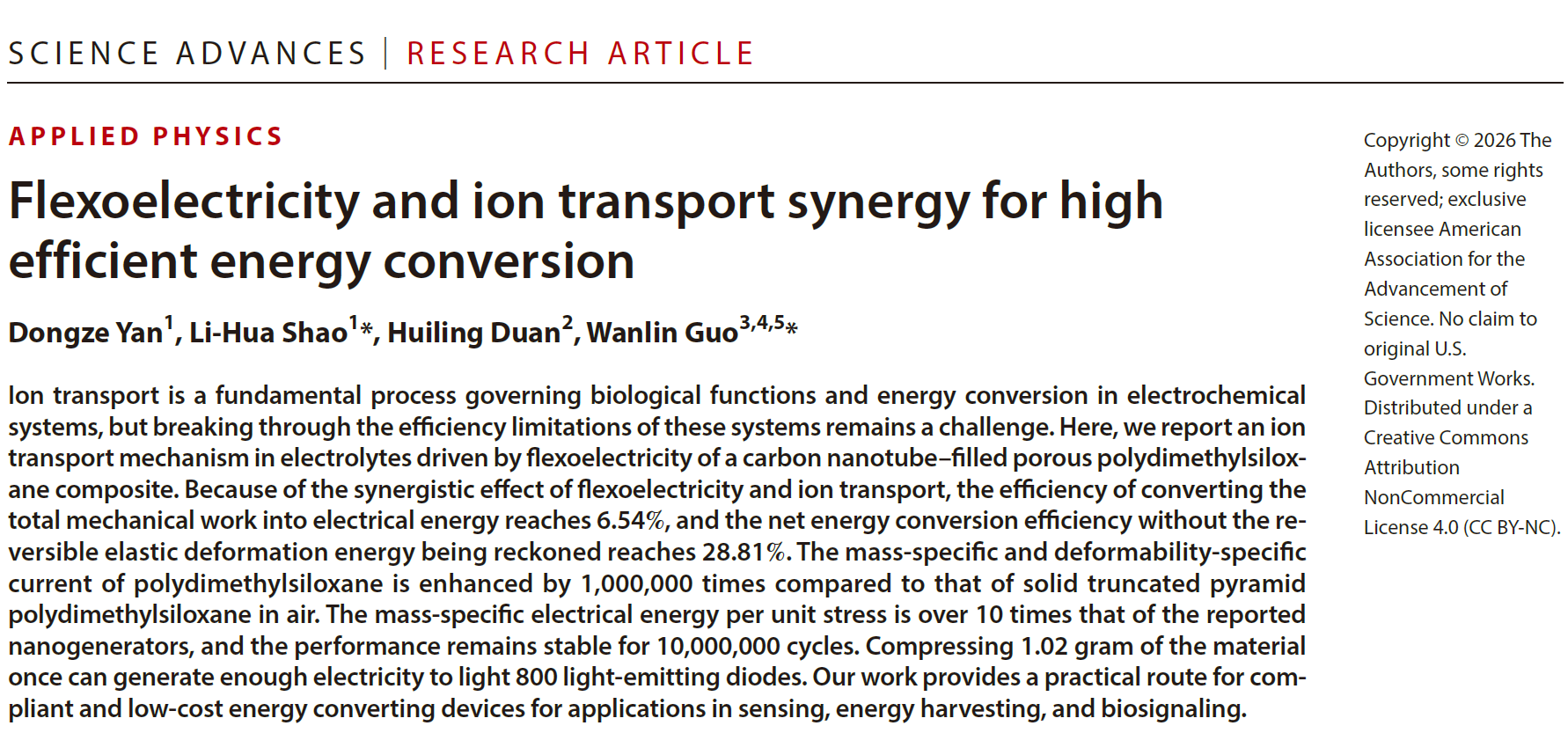
Recently, the team of Professor Shao Lihua from Beihang University, in collaboration with Professor Guo Wanlin from Nanjing University of Aeronautics and Astronautics, Academician of the Chinese Academy of Sciences (CAS), achieved flexoelectricity-driven ion transport and highly efficient mechanical-to-electrical energy conversion in a porous material/electrolyte composite system. The net energy conversion efficiency reached 28.81%. Compressing 1.02 grams of the material once generated enough electricity to light 800 light-emitting diodes. Under up to 10 million loading cycles, the peak current output of the system remained stable, demonstrating the application potential of this type of system in fields such as energy harvesting and high-performance sensing. The achievement, titled "Flexoelectricity and Ion Transport Synergy for High Efficient Energy Conversion," was published in the journal Science Advances (Sci. Adv., 2026, 12(37): eaec6370).
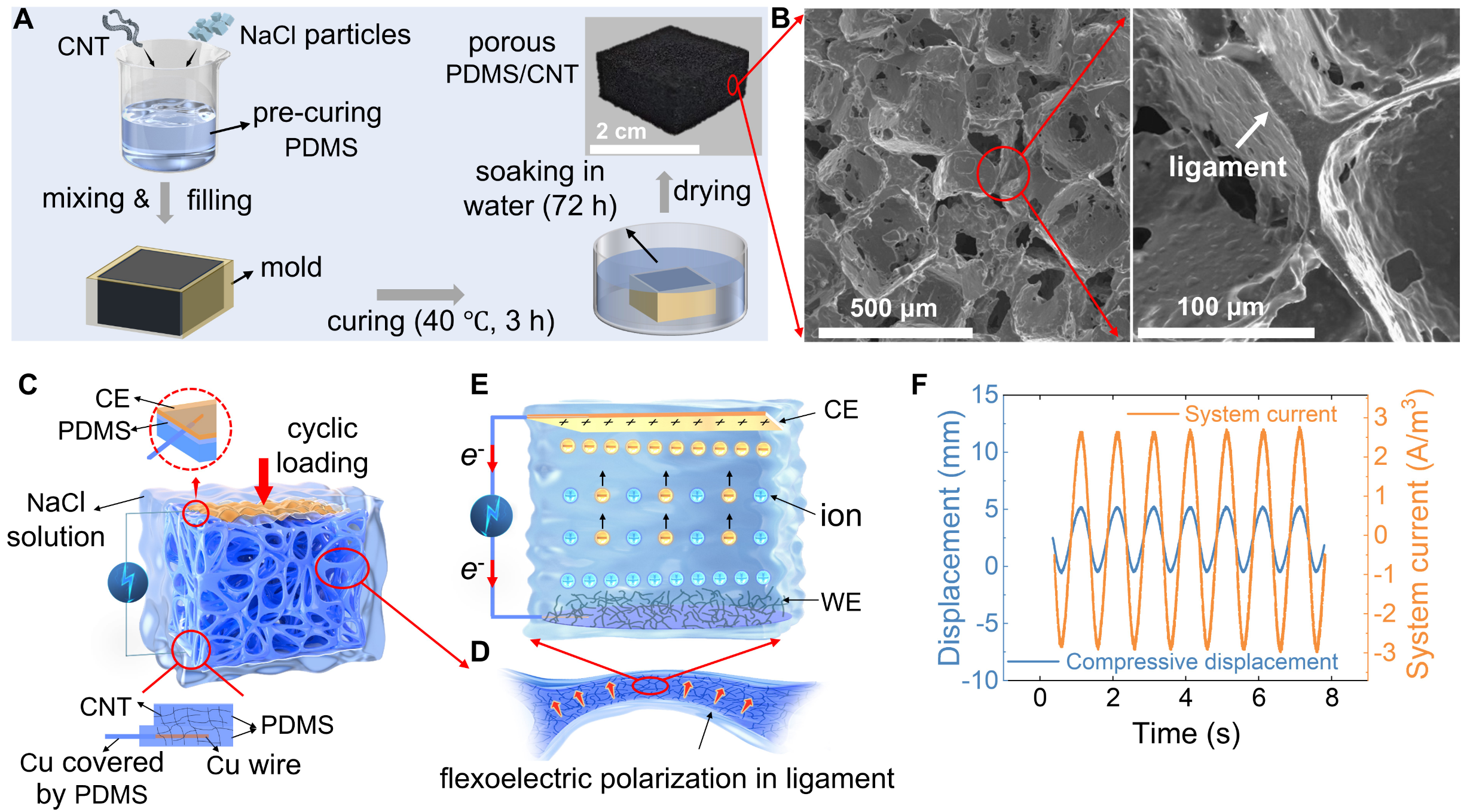
Fig. 1 Fabrication of porous PDMS/CNT composite and working principle of the porous block/electrolyte system
The research team designed a porous polydimethylsiloxane/carbon nanotube (PDMS/CNT) composite with the flexoelectric effect, together with an electrolyte solution system. Loading the porous composite generates a flexoelectric field that drives ion transport in the electrolyte solution, thereby achieving conversion between mechanical energy and electrical energy. In terms of theory, the team established a theoretical model of flexoelectricity-driven ion transport through the physical equations of the flexoelectric effect and the Debye-Falkenhagen equation, revealing the microscopic mechanism of net output current generation. Theoretical analysis shows that under cyclic external loading, the internal ligaments of the porous material undergo non-uniform deformation, generating a time-varying flexoelectric field; this electric field drives ions in the electrolyte solution to migrate directionally toward the surface of the CNT electrodes, forming a migration current; as ions continue to migrate along the direction of the electric field, an ion concentration gradient forms, and this gradient drives ions to diffuse from high-concentration regions to low-concentration regions, resulting in a diffusion current opposite in direction to the migration current and lagging in phase, so that the composite system generates a net output current.
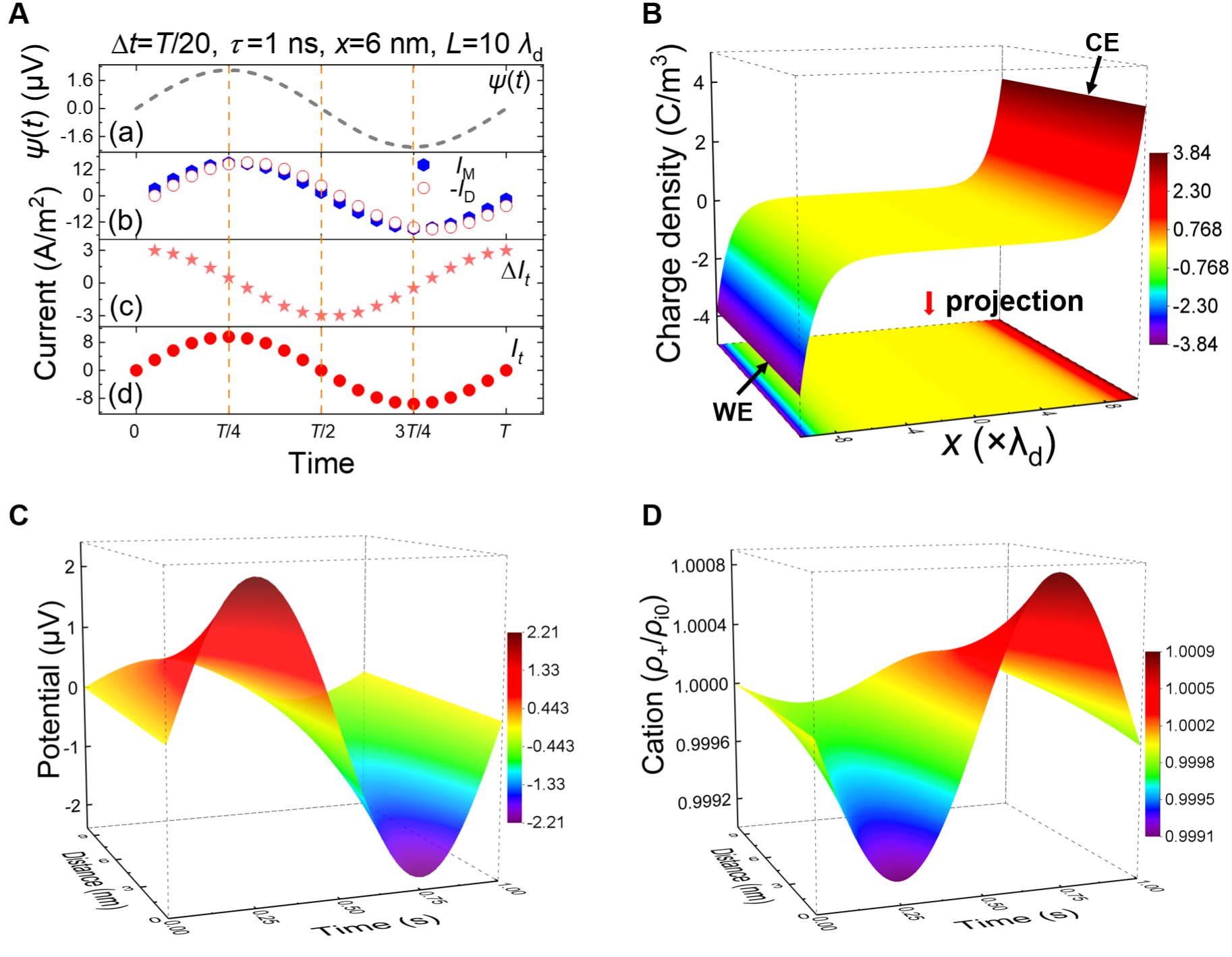
Fig. 2 Mechanism of electrical signals generation of the beam/electrolyte system
Based on this physical mechanism, the research team, combining dimensional analysis and electrical analysis, discovered the scaling relationship between the system's electrical output and material, structural, and loading parameters: the system's output current is proportional to the macroscopic peak load and independent of loading frequency (1–5 Hz). In addition, the output current increases with increasing ligament thickness and working electrode volume fraction, while the specific density output current is inversely proportional to ligament thickness. Based on this scaling relationship, the research team proposed cross-scale design criteria for optimizing the system's electrical output and verified their accuracy through experimental characterization.
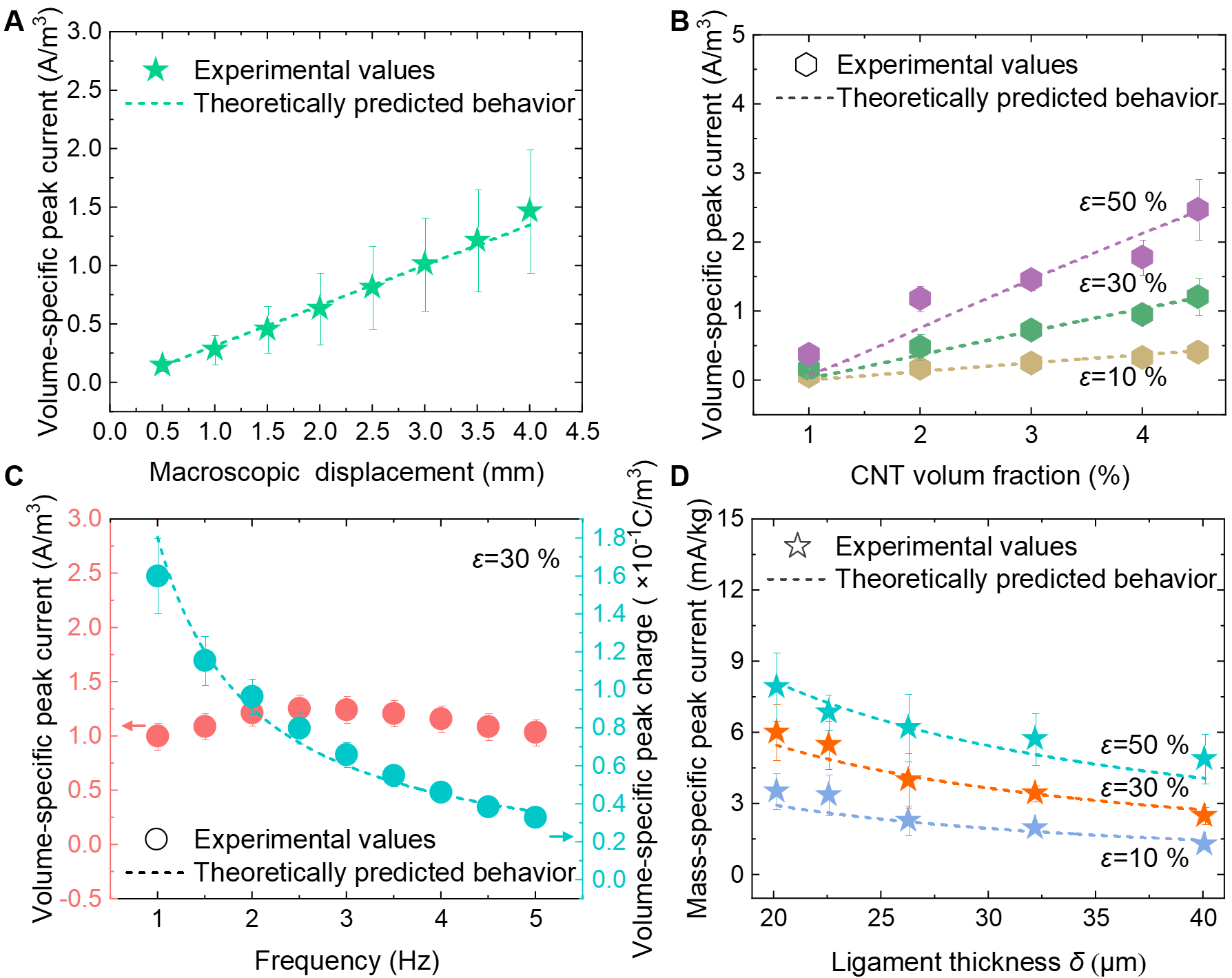
Fig. 3 Key factors influencing the electrical output of the porous block/electrolyte system
In this work, the research team reported a synergistic effect of flexoelectricity and ion transport through a lightweight, flexible CNT-filled porous PDMS composite immersed in an electrolyte, enabling efficient energy conversion. This synergistic mechanism achieves a mechanical-to-electrical energy conversion efficiency of 6.54% of the total input mechanical work, and a net energy conversion efficiency of 28.81% of the input mechanical work minus the reversible elastic deformation energy of the system. The mass-specific and deformability-specific currentis 1,000,000 times greater than the flexoelectricity of solid truncated pyramid PDMS matrix material in air. Moreover, the mass-specific electrical energy of the flexible porous material per unit stress exceeds the values reported for rigid-material nanogenerators by more than an order of magnitude.
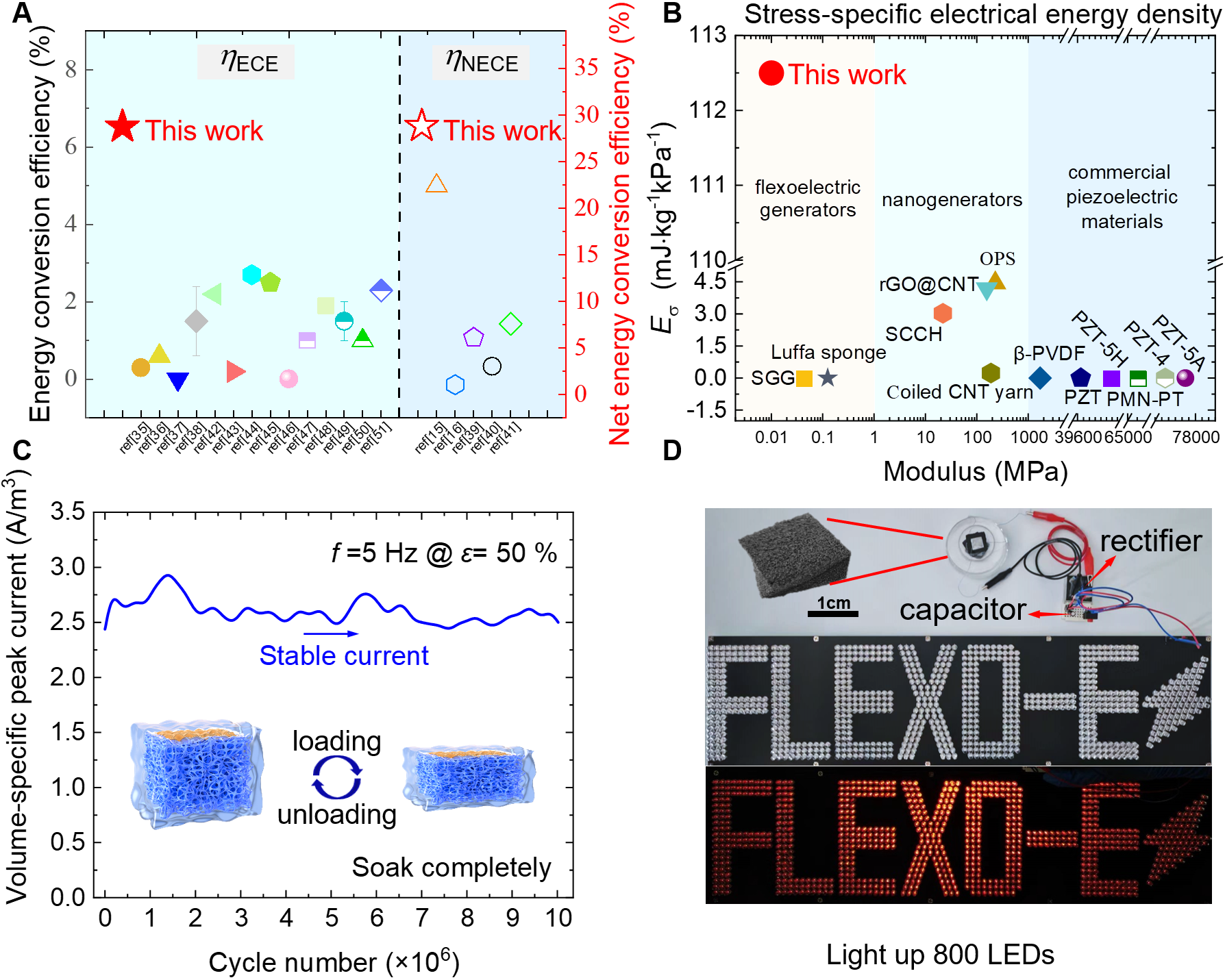
Fig. 4 Electrical performance of the porous block/electrolyte system
Reviewers highly appraised this work as "a novel and compelling approach" and an "impressive device-level demonstration", with "impressive" energy-conversion efficiency and "highly promising" prospects in sensing and blue-energy harvesting.
The first author of the paper is Yan Dongze, a doctoral student at the Institute of Solid Mechanics, School of Aeronautic Science and Engineering, Beihang University. Collaborators include Professor Duan Huiling from Peking University, Academician of CAS. Professor Shao Lihua and Academician Guo Wanlin are the corresponding authors. This research was supported by the National Natural Science Foundation of China and the Fundamental Research Funds for the Central Universities.
Article link: https://www.science.org/doi/10.1126/sciadv.aec6370
Editor: Liu Tingting


 Beihang NewsChen Maozhang honored as "Charity Model" of China Charity AwardsMore
 Beihang NewsBeihang celebrates 42nd Teachers' DayMore
 Beihang NewsAssociate Professor Wang Shitong's team wins second prize at HICOOL 2026 Global Entrepreneurship CompetitionMore
 Beihang NewsBeihang's first student-designed human-powered aircraft completes test flightMore
 Beihang NewsBeihang leaders engage in dialogue with new undergraduate and graduate student representativesMore
 Beihang NewsBeihang University holds 2026 opening convocation to welcome new studentsMore