Recently, Professor Xie Yang from the School of Economics and Management at Beihang University, in collaboration with Professor Chen Bin from Beijing Normal University and Professor Zhang Yuqiang from Shandong University, has made significant progress on how climate goals facilitate achieving global air quality targets. The findings, titled "Accelerated attainment of global air quality standards with disproportional health co-benefits under the 1.5°C target," were published online in the internationally prestigious journal Nature Communications. Professor Xie Yang is the first author, Professor Chen Bin is the corresponding author, and the School of Economics and Management at Beihang University is the primary affiliation.
This research, for the first time, systematically evaluates the impact of achieving the 1.5°C climate target of the Paris Agreement on accelerating global attainment of the 2021 WHO Global Air Quality Guidelines (AQGs), revealing the strong synergistic benefits between climate resilience actions and air quality management. It points out that current national climate commitments are far from sufficient to achieve the temperature control target, and more ambitious carbon emission reduction actions could significantly accelerate progress toward achieving air quality standards, yielding greater health and economic benefits.
Against the backdrop of continuous growth in global greenhouse gas emissions, the inadequacy of existing Nationally Determined Contributions (NDCs) to achieve the 1.5°C temperature control target, and the WHO tightening its PM2.5 and ozone air quality guidelines in 2021, it is necessary to systematically assess the synergistic effects of climate mitigation actions on air quality improvement and health benefits, providing the basis for policy pathways that integrate "emission reduction-pollution control-health."
The research team developed an innovative integrated assessment modeling framework (as shown in Figure 1), enabling a full-chain evaluation from policy to health benefits through three key modules: the AIM|CGE model simulates global economic activities and energy consumption, projecting greenhouse gas and pollutant emission pathways; the CAM-chem model simulates global PM2.5 and ozone concentration distributions based on emission data; and the IMED|HEL model quantifies the health impacts of air pollution and conducts monetary evaluations.
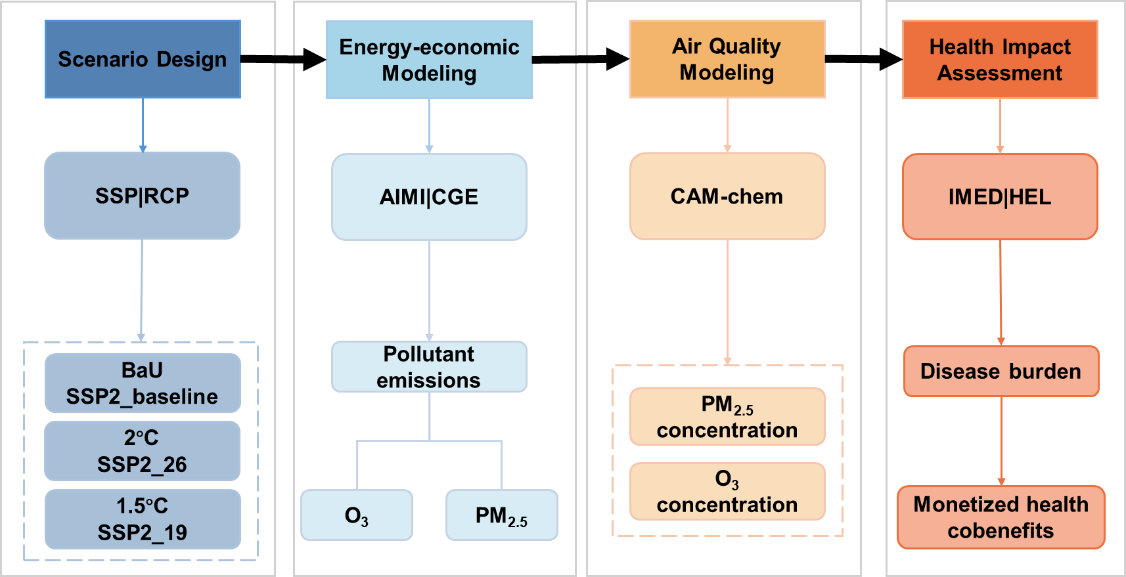
Figure 1. Research framework
The research results show that achieving the 1.5°C climate target would significantly accelerate the process of air quality improvement. As shown in Figure 2, under the baseline scenario, the global population-weighted PM2.5 and ozone concentrations would remain at 13 μg/m³ and 37 ppbv by 2100, far exceeding the WHO air quality guideline standards. However, achieving the 1.5°C climate target could reduce global PM2.5 concentrations to 5 μg/m³ around 2050 and ozone to 30 ppbv by 2060, advancing the timeline by 20–40 years compared to the 2°C target scenario. Regionally, regions such as the United States, Europe, Japan, and China would achieve the standards 15–50 years ahead of schedule, while Africa and Latin America, due to economic structures primarily based on agricultural activities rather than heavy industry, would achieve air quality targets around 2035, earlier than their carbon neutrality timelines.
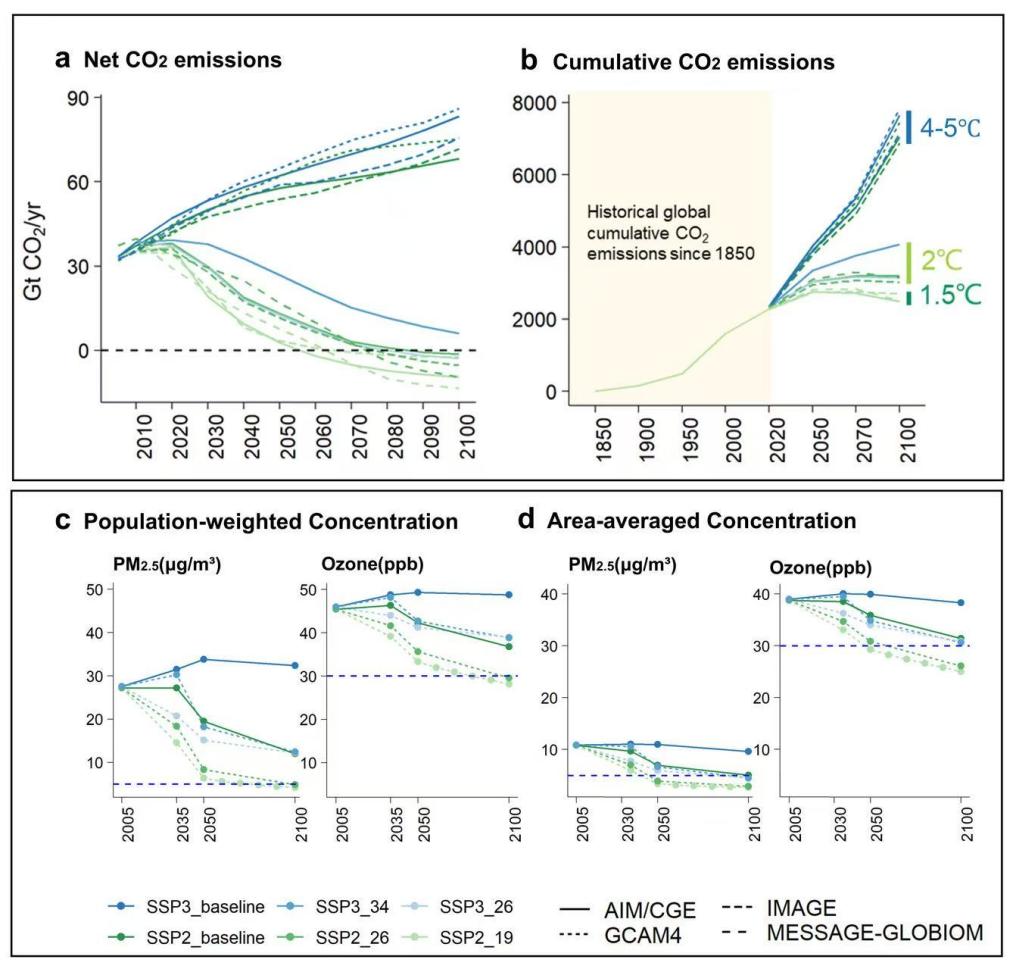
Figure 2. Changes in global CO₂ emissions and pollutant concentrations under different target scenarios
In terms of health benefits, as shown in Figure 3, under the 1.5°C target scenario, 380 million premature deaths related to PM2.5 and ozone could be avoided globally from 2020 to 2100, with PM2.5 accounting for the majority (approximately 303 million cases). India (109 million, 29%), China (97 million, 26%), and Southeast Asia (41 million, 11%) are the primary beneficiaries. The monetized value of health co-benefits would increase from USD 11 trillion in 2050 to USD 22 trillion in 2100, far exceeding climate mitigation costs. In 2050, regional health co-benefits would be concentrated in India (28%), China (23%), Southeast Asia (11%), and the United States (8%).
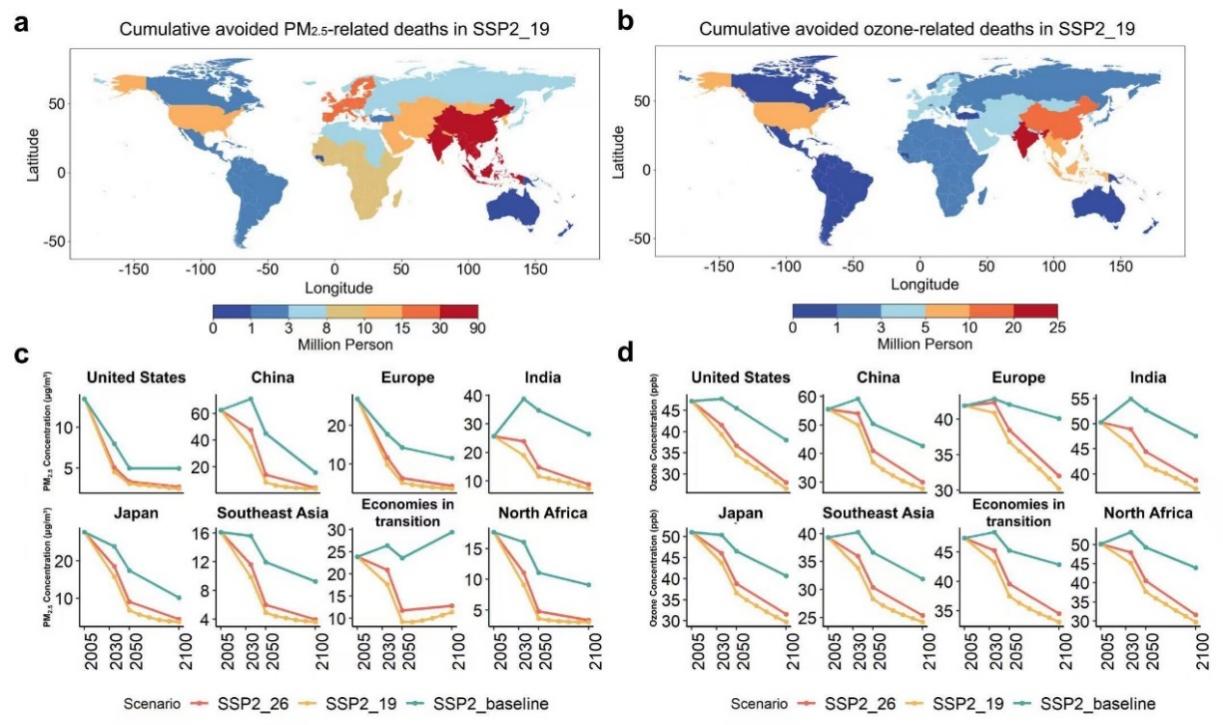
Figure 3. Cumulative avoided pollution-related premature deaths and pollutant concentrations
The research reveals a significant temporal and regional mismatch between climate actions and health co-benefits: the peak of global health co-benefits will occur in 2050. In terms of regional contributions, as shown in Figure 4, in 2050, the United States and China are the main contributors to global carbon emission reductions, while by 2100, contributions from India, transition economies, Western Europe, and Africa will become more balanced. Elevating the target from 2°C to 1.5°C could yield an additional net benefit of USD 9.74–11.04 trillion by 2050, but this additional benefit would slightly decline by 2100, indicating that early climate action yields more significant health returns.
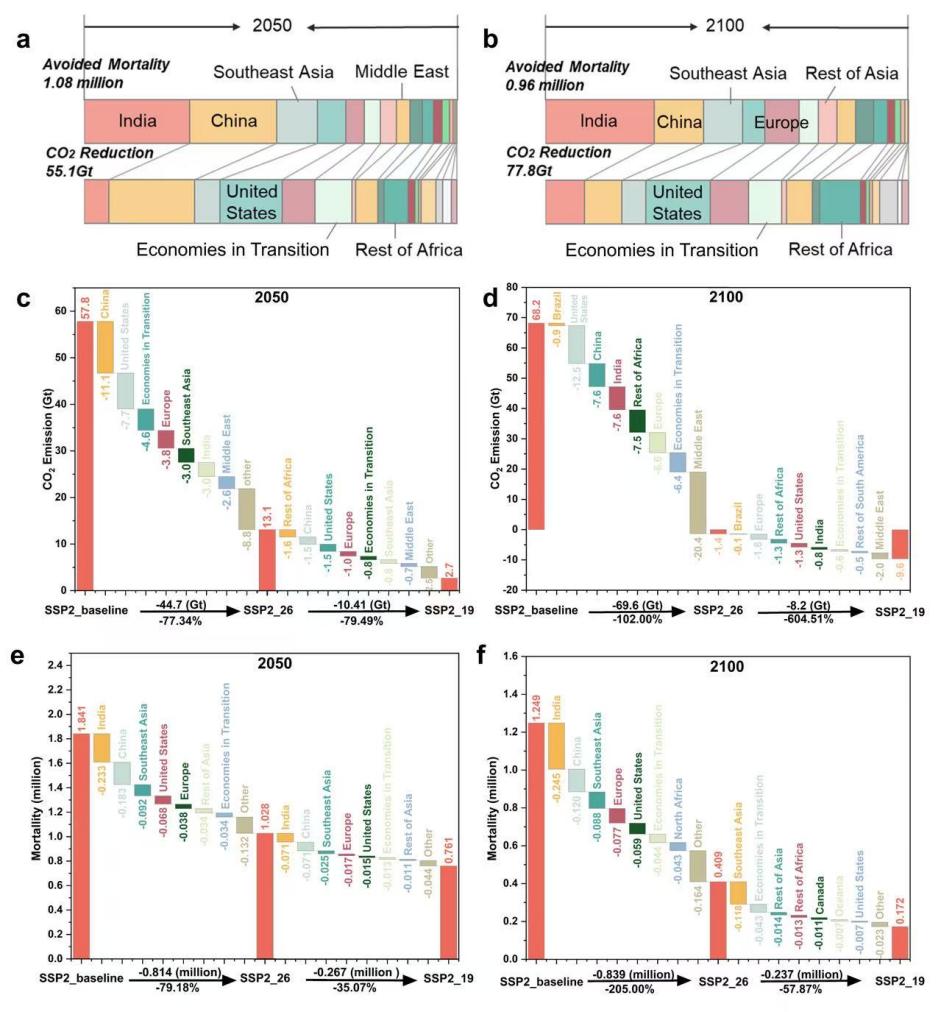
Figure 4. Number of premature deaths and CO₂ emissions in 17 major global regions in 2050 and 2100
The research confirms that ambitious climate action is economically viable, as health co-benefits can offset or even exceed mitigation costs. As shown in Figure 5, the United States, China, India, Europe, and Southeast Asia would capture over 80% of the global net benefits, while net benefits for Canada, Brazil, Oceania, Latin America, and Africa would be close to zero or negative. Compared with data from the World Economic Forum, the avoided health-related economic losses from air pollution mitigation in 2050 are 16.5 times larger (under the 1.5°C scenario) and 14.5 times larger (under the 2°C scenario) than economic losses caused by climate change. Asian regions face both the highest health losses from air pollution and the most severe economic losses from climate change.
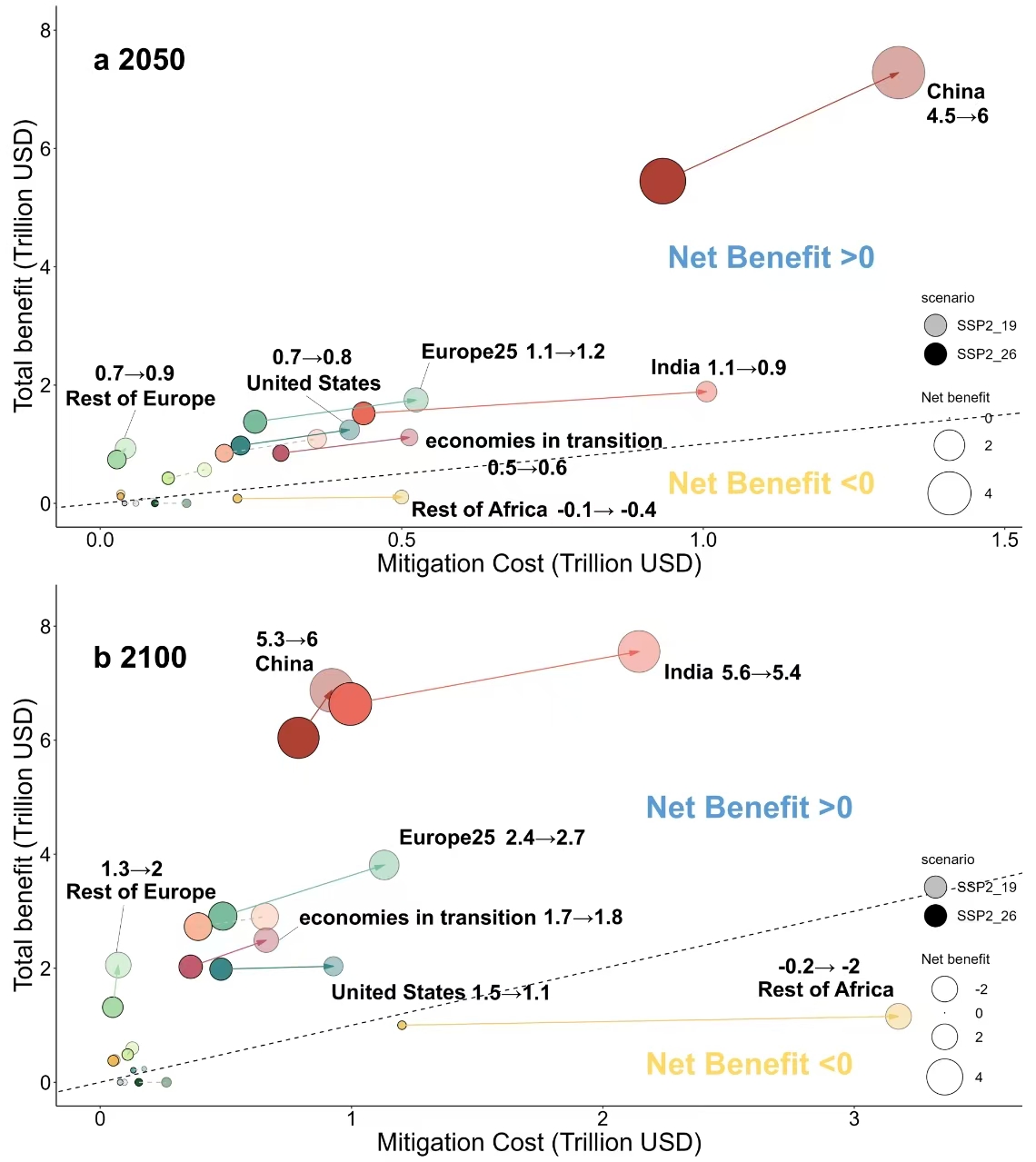
Figure 5. Cost-benefit analysis for 17 regions under the 2°C and 1.5°C target scenarios
The research emphasizes that countries in the rapid industrialization and urbanization phase face a critical decision-making period over the next two decades: whether to continue relying on high-carbon infrastructure or transition to low-carbon development pathways. For certain regions (e.g., the Middle East), while health co-benefits alone may not be sufficient to drive ambitious climate action, it remains a wise choice from the perspective of long-term economic competitiveness to gradually develop alternative industries and reduce dependence on fossil fuels. For Latin America and Africa, the research specifically points out that reducing significant non-CO₂ greenhouse gas emissions from the agriculture, forestry, and land-use sectors in these regions is critical to achieving the 1.5°C target. More international financial and technical support is needed to help these regions reduce hard-to-abate non-CO₂ emissions.
This work was supported by the National Key Research and Development Program of China and the National Natural Science Foundation of China.
Link to the article: https://doi.org/10.1038/s41467-025-67276-5
Editor: Liu Tingting


 Beihang NewsBeihang celebrates 42nd Teachers' DayMore
 Beihang NewsBeihang's first student-designed human-powered aircraft completes test flightMore
 Beihang NewsBeihang leaders engage in dialogue with new undergraduate and graduate student representativesMore
 Beihang NewsBeihang University holds 2026 opening convocation to welcome new studentsMore
 Beihang NewsBeihang University welcomes 9,022 new graduate studentsMore
 Beihang NewsProfessor Yu Shui wins Best Screenplay Award at 21st Changchun Film FestivalMore