Recently, a research team led by Professor Geng Lisheng from the School of Physics, Beihang University, in collaboration with the team of Young Researcher Liu Mingzhu from Lanzhou University, reported their findings in Physical Review Letters (PRL). For the first time, the team has proposed a novel scheme to detect the three-body force using three-hadron systems with definite charge parity. It solves the long-standing challenge of completely separating three-body force effects from those of two-body forces, and offers an original research pathway for in-depth understanding of the non-perturbative nature of quantum chromodynamics (QCD).
Pan Yawen, a postdoctoral researcher at the School of Physics, Beihang University, is the first author of the paper, and Professor Geng Lisheng and Young Researcher Liu Mingzhu serve as co-corresponding authors.
The strong interaction is one of the four fundamental interactions in nature. It acts as the "glue" that tightly binds protons and neutrons within atomic nuclei and forms the core foundation of all visible matter in the universe. QCD is the fundamental theory describing this force. The three-body force is a unique effect of the strong interaction that emerges only in systems composed of three particles, and a central research subject for unraveling the nature of the strong interaction in nuclear physics. As early as the 1950s, Japanese physicists Fujita and Miyazawa proposed the two-pion-exchange three-body force model. Over decades, the academic community has achieved high-precision descriptions of the force between two nucleons (two-body force) through models such as the Argonne v18 (AV18) potential, Bonn potential, and chiral effective field theory (EFT) potentials. However, research on the three-body force has long been stuck at a critical bottleneck: in traditional light nuclear systems, the three-body force contributes only approximately 5% to the binding energy. Much like a faint whisper buried in the "loud dominant signal" dominated by the two-body force, the weak effect of the three-body force is extremely difficult to distinguish from the background and cannot be clearly separated from the main signal. This has made its theoretical characterization and experimental detection a persistent puzzle plaguing the field for years.
To address this challenge, the research team has achieved a key theoretical breakthrough. The team discovered for the first time that the three-nucleon systems conventionally used in research lack definite charge-parity quantum numbers, whereas three-meson systems can be constructed into "pure systems" with definite charge parity (C-parity).
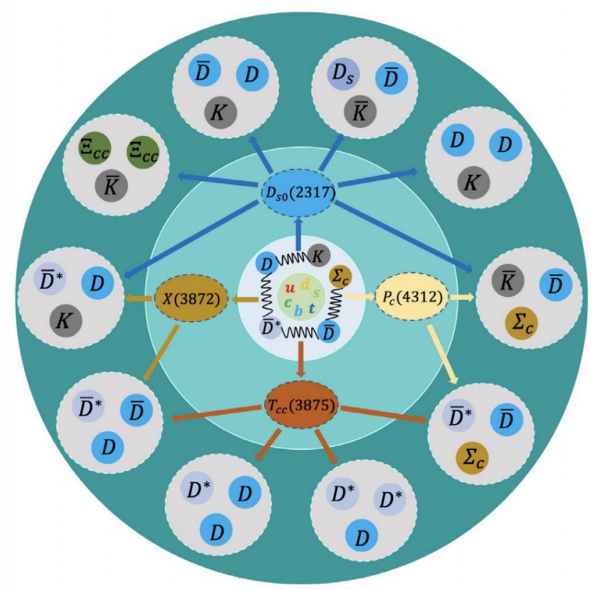
Fig.1 Predicted three-body hadronic molecular states from candidates of partial two-body hadronic molecular states
To verify the feasibility of this scheme, the team parameterized two-body and three-body interactions into contact potentials within the framework of pionless EFT and performed high-precision system calculations using the Gaussian expansion method. The results show that the strength of the three-body force plays a decisive role in the formation of three-body molecular states in this system, contributing up to approximately 20% of the total potential energy—far exceeding the typical value of about 5% in traditional nuclear systems. This fully confirms that this system is a superior platform for studying the three-body force.
This mechanism shares the same origin as the contact-term contribution of the three-nucleon force in chiral effective field theory, providing a brand-new and more direct approach for three-body force research. Meanwhile, the team has identified multi-dimensional experimental observables, including mass measurements, linear momentum correlation functions, and invariant mass distributions, which can impose independent constraints on the physical properties of the three-body force. The work provides clear theoretical predictions and observation targets for world-leading accelerator experiments such as LHCb and Belle II, laying a core theoretical foundation for promoting breakthroughs in the experimental detection of the three-body force.
This achievement represents another important systematic advance by Professor Geng Lisheng's team in the field of three-hadron system research. The team has long been dedicated to theoretical research on exotic hadronic states and strong-interaction many-body systems. In 2018, it pioneered the research paradigm of revealing the internal structure of exotic hadronic states via three-hadron systems internationally and has conducted sustained and systematic original research in this direction, as illustrated in Figure 1.
Over the years, the team's series of achievements have gained high recognition from the international academic community: it has been invited to write topical reviews in authoritative international journals including Science Bulletin and Physics Reports, systematically sorting out and leading the development of the field. In 2025, the team published another paper in PRL, predicting systems with special quantum numbers, which effectively addresses the experimental detection challenges for such particle states.
Article link: https://journals.aps.org/prl/abstract/10.1103/vl2y-8xdn
Related links:
Multi-hadron molecules: status and prospect - ScienceDirect
Three ways to decipher the nature of exotic hadrons: Multiplets, three-body hadronic molecules, and correlation functions - ScienceDirect
https://journals.aps.org/prl/abstract/10.1103/3gbb-ms8c
Editor: Liu Tingting


 Beihang News2026 Symposium on Excellent Engineer Training held in BeijingMore
 Beihang NewsProfessor Liu Mingjie's team publishes article in Science, revealing high-modulus toughening mechanism in nacreMore
 Beihang NewsWang Yunpeng appointed Secretary of the CPC Beihang University CommitteeMore
 Beihang NewsElsevier Senior Vice President Said Taha visits Beihang UniversityMore
 Beihang NewsPresident Wang Yunpeng visits Hangzhou to advance university-city integration and attends opening ceremony of H3IMore
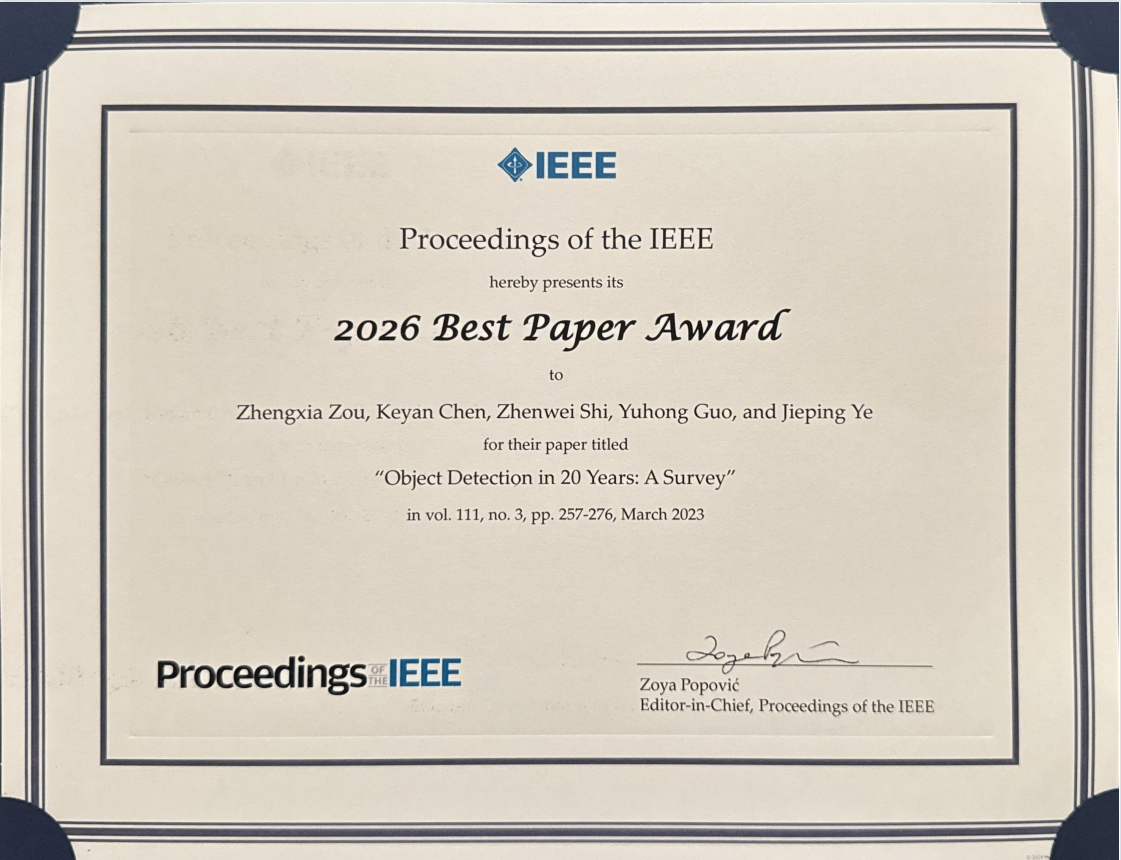 Beihang NewsBeihang team wins 2026 Best Paper Award from Proceedings of the IEEEMore