Geometrically frustrated spin systems serve as ideal platforms for investigating novel states of matter, such as spin liquid and spin ice — exotic quantum states that represent a key frontier in condensed matter physics. A research team led by Professor Zhao Kan and Associate Professor Ma Nvsen from the School of Physics at Beihang University, in collaboration with Researcher Deng Hao from ShanghaiTech University, Professor Philipp Gegenwart from the University of Augsburg, and Professor Hua Chen from Colorado State University, has discovered three-dimensional (3D) XY universality and nonlinear magnetic susceptibility in the spin ice compound HoAgGe via single-crystal neutron diffuse scattering, low-temperature magnetization and thermodynamic measurements, combined with Monte Carlo simulations and symmetry analysis. The findings were published online in Physical Review X under the title "Three-Dimensional XY Universality and Nonlinear Magnetic Susceptibility in a Kagome Ice Compound."
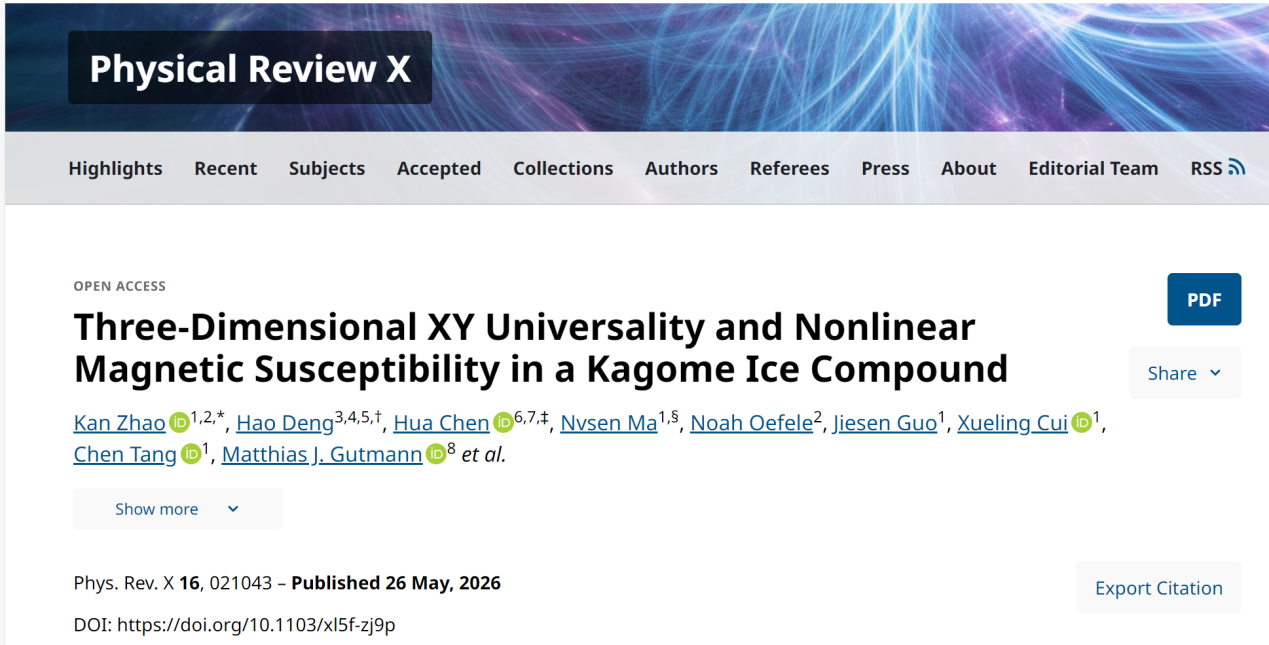
Kagome spin ice is an intriguing class of spin systems constituted by in-plane Ising spins with ferromagnetic interaction residing on the kagome lattice, theoretically predicted to host a plethora of magnetic transitions and excitations. In particular, different variants of kagome spin ice models can exhibit different sequences of symmetry breaking upon cooling from the paramagnetic to the fully ordered ground state. Recently, it has been demonstrated that the frustrated intermetallic HoAgGe stands as a faithful solid-state realization of kagome spin ice. However, whether any of the established symmetry-breaking pathways apply to this material remains unaddressed.
The researchers used single-crystal neutron diffuse scattering to map the spin ordering of HoAgGe at various temperatures more accurately; surprisingly, they found that the ordering sequence appears to be different from previously known scenarios: From the paramagnetic state, the system first enters a partially ordered state with fluctuating magnetic charges, in contrast to a charge-ordered paramagnetic phase, before reaching the fully ordered state. Through Monte Carlo simulations and scaling analyses using an extended 3D spin model for the distorted kagome spin ice in HoAgGe, they elucidate a single 3D XY phase transition into the ground state with broken time-reversal symmetry (TRS). However, the 3D XY transition has a long crossover tail before the fluctuating magnetic charges fully order. More interestingly, they found, both experimentally and theoretically, that the TRS-breaking phase of HoAgGe features an unusual, hysteretic response: Despite their vanishing magnetization, the two time-reversal partners are distinguished and selected by a nonlinear magnetic susceptibility tied to the kagome ice rule. The discovery not only unveils a new symmetry-breaking hierarchy of kagome spin ice but also demonstrates the potential of TRS-breaking frustrated spin systems for information technology applications.
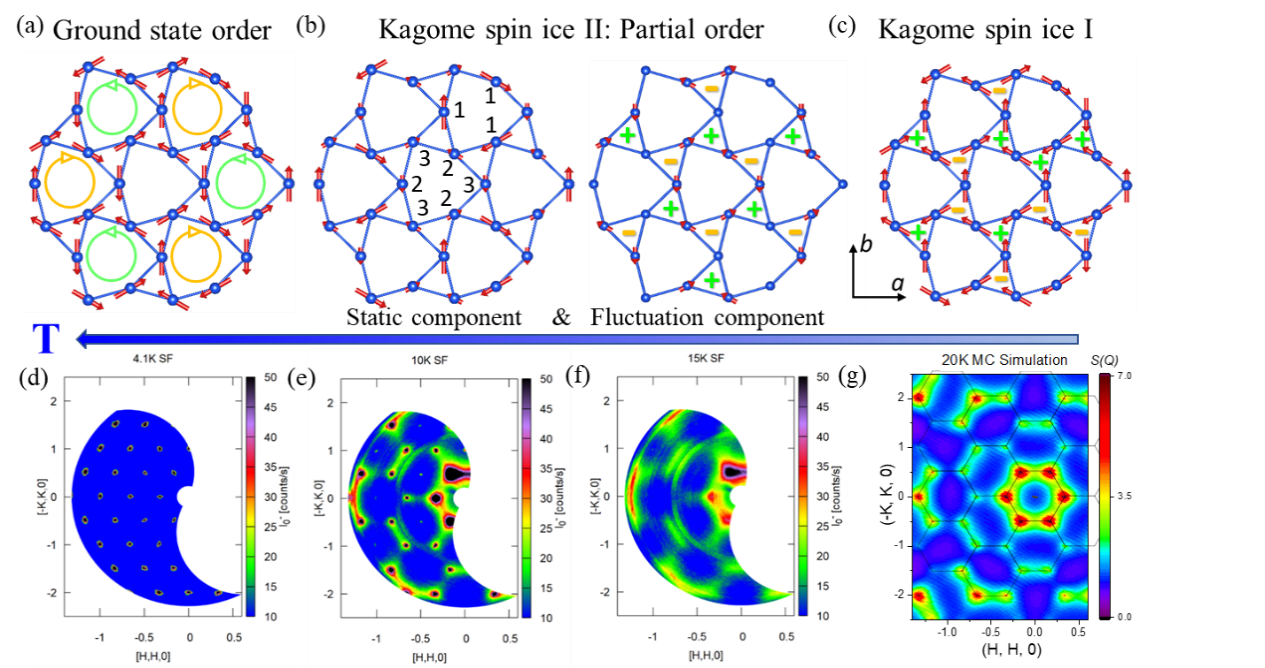
Fig.1 Multistage ordering behavior under changing temperature in kagome spin ice HoAgGe
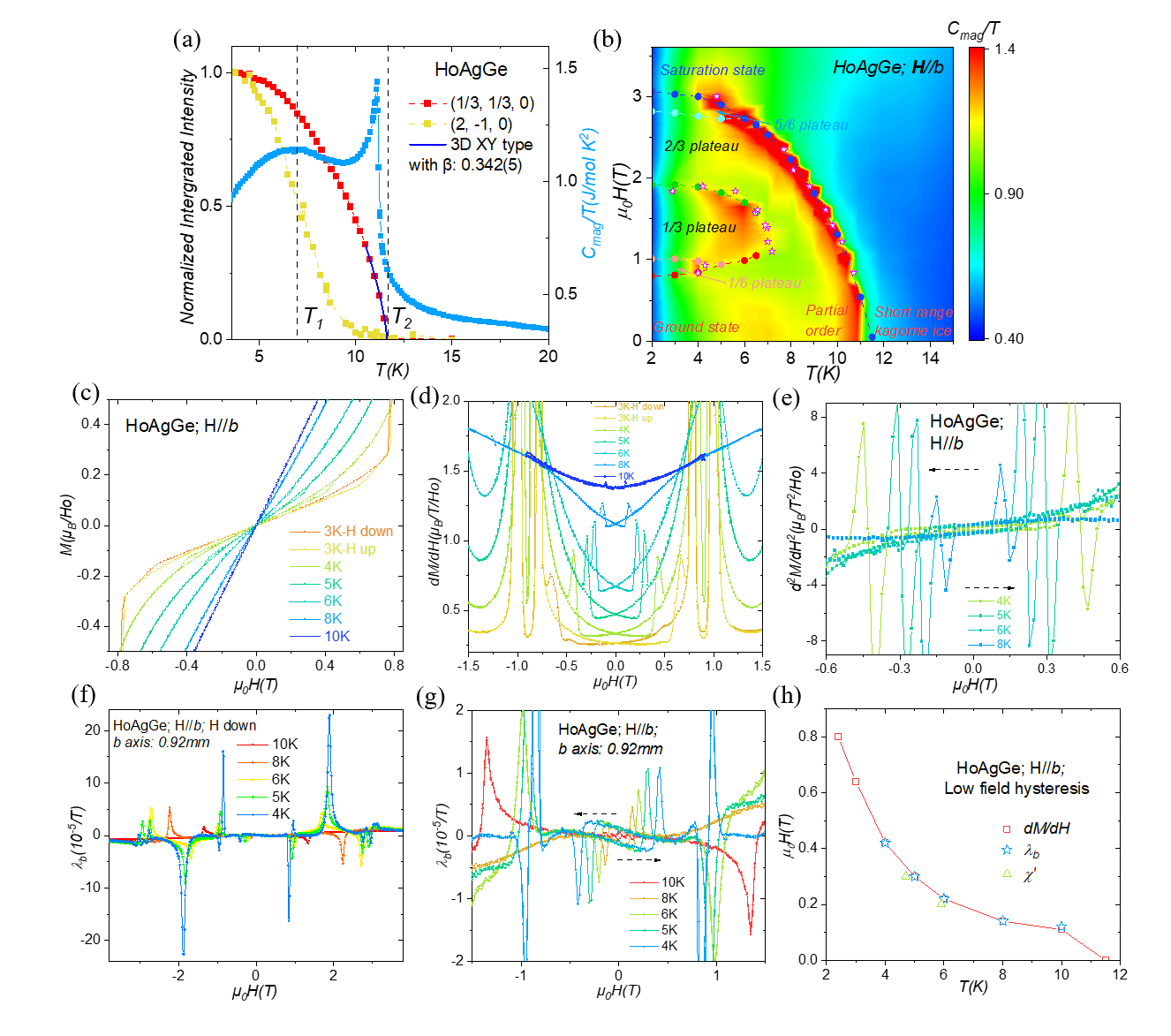
Fig.2 Magnetic specific heat and neutron diffraction results of HoAgGe
As far as is known, HoAgGe is the first spin system that exhibits a 3D XY criticality. The work therefore adds a new member to the family of 3D XY universality, most famously represented by the superfluid transition of 4He at 2.17 K. This study reveals a new symmetry-breaking pathway in Kagome spin ice and demonstrates the potential of TRS-breaking characteristic states in frustrated spin systems for future information technology applications. A reviewer of the journal highly praised this work: "I therefore think that the paper can be seen as a milestone in the study of magnetic materials, so in its revised form I do recommend it for PRX."
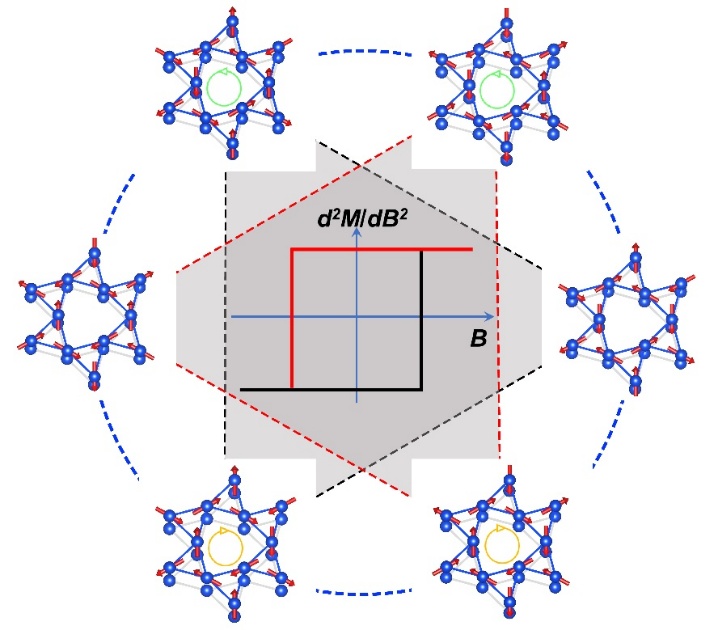
Fig.3 Sixfold degenerate ground state of the Kagome spin ice in HoAgGe
Professor Zhao Kan is the first author of the paper. Professors Zhao Kan, Ma Nvsen, Deng Hao, Hua Chen, and Philipp Gegenwart are co-corresponding authors. The School of Physics of Beihang University is the primary affiliation, with graduate students Guo Jiesen, Cui Xueling, and Tang Chen as co-authors. Collaborating teams include Dr. Su Yixi from the Forschungszentrum Jülich in Germany, Dr. Matthias J. Gutmann from the ISIS Facility in the UK, Dr. Vladimir Hutanu from RWTH Aachen University, and Researcher Jin Changqing from the Institute of Physics, Chinese Academy of Sciences.
This work was supported by the National Key R&D Program of China, the National Natural Science Foundation of China, the Science and Technology Innovation Team Program of Beihang University, the Analytical and Testing Center of Beihang University, and the Synergetic Extreme Condition User Facility (SECUF), as well as other funding sources.
Article link: https://link.aps.org/doi/10.1103/xl5f-zj9p
Editor: Liu Tingting


 Beihang NewsBeihang celebrates 42nd Teachers' DayMore
 Beihang NewsBeihang's first student-designed human-powered aircraft completes test flightMore
 Beihang NewsBeihang leaders engage in dialogue with new undergraduate and graduate student representativesMore
 Beihang NewsBeihang University holds 2026 opening convocation to welcome new studentsMore
 Beihang NewsBeihang University welcomes 9,022 new graduate studentsMore
 Beihang NewsProfessor Yu Shui wins Best Screenplay Award at 21st Changchun Film FestivalMore