A research team led by Professor Yu Haiming from the School of Integrated Circuit Science and Engineering at Beihang University has made a significant breakthrough in antiferromagnetic spintronics and magnonics. The study, titled “Control of spin currents by magnon interference in a canted antiferromagnet,” published in Nature Physics on April 23, 2025, demonstrates the use of antiferromagnetic magnon interference to control spin currents, which substantially extends the horizon for the emerging field of coherent antiferromagnetic spintronics.
Controlling the spin current lies at the heart of spintronics and its applications. In ferromagnets, the sign of spin currents is fixed once the current direction is determined. However, spin currents in antiferromagnets can possess opposite polarizations, but this requires enormous magnetic fields to lift the degeneracy between the two modes. Therefore, controlling spin currents with opposite polarization is still a challenge.
In the research, the authors demonstrate the control of spin currents at room temperature by magnon interference in a canted antiferromagnet, namely, haematite that has recently been classified as an altermagnet. Magneto-optical characterization by Brillouin light scattering reveals that the spatial periodicity of the beating patterns is tunable via the microwave frequency. They further observe that the inverse spin Hall voltage changes sign as the frequency is tuned, evincing a frequency-controlled switching of polarization of pure spin currents.
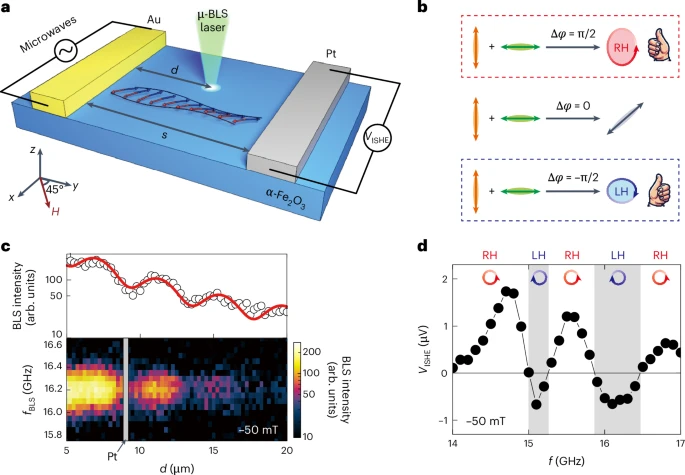
Fig. 1: Antiferromagnetic spin-wave interference in spatial and frequency domains
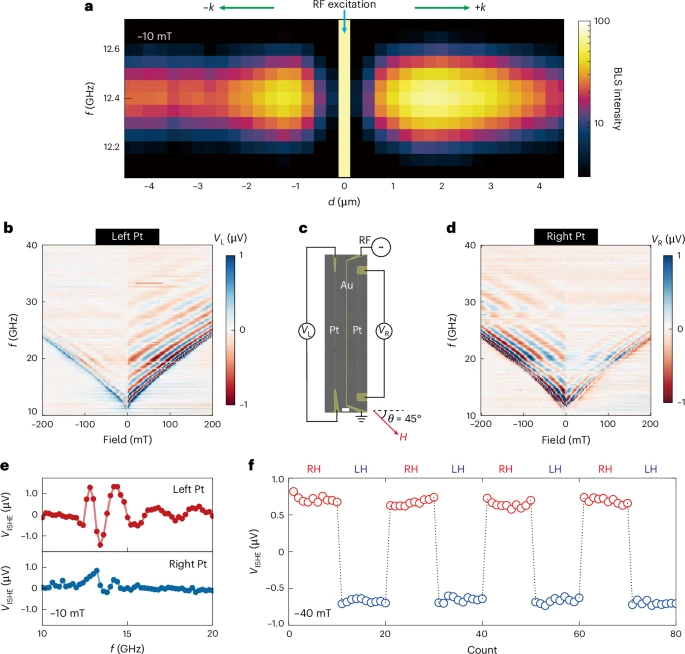
Fig. 2: Non-reciprocal behavior of antiferromagnetic magnon interference
The findings offer a means of controlling spin precession polarization without changing the magnetic field or temperature and, thus, provide new opportunities for coherent antiferromagnetic spintronics with enhanced versatility of magnons as information carriers for next-generation logic and computation.
The co-first authors of the paper include: Sheng Lutong, a 2024 doctoral graduate from Beihang University and currently an assistant researcher at the Shenzhen International Quantum Academy; Anna Duvakina, a doctoral student at the École Polytechnique Fédérale de Lausanne (EPFL), Switzerland; Wang Hanchen, a 2022 master's graduate from Beihang University and now a doctoral student at the ETH Zurich, Switzerland; Kei Yamamoto, a researcher at the Japan RIKEN Center for Emergent Matter Science (CEMS), Japan; and Yuan Runtong, a 2023 undergraduate graduate from Beihang University who is currently pursuing a doctorate at the University of Cambridge, UK. The co-corresponding authors are Professor Dirk Grundler from EPFL and Professor Yu Haiming from Beihang University, with Beihang University being the primary affiliation for the study.
The work was supported by the National Key Research and Development Program of China,China Scholarship Council, Shenzhen Institute for Quantum Science and Engineering, among other sources.
Link to the paper: https://www.nature.com/articles/s41567-025-02819-7


 Beihang NewsBeihang celebrates 42nd Teachers' DayMore
 Beihang NewsBeihang's first student-designed human-powered aircraft completes test flightMore
 Beihang NewsBeihang leaders engage in dialogue with new undergraduate and graduate student representativesMore
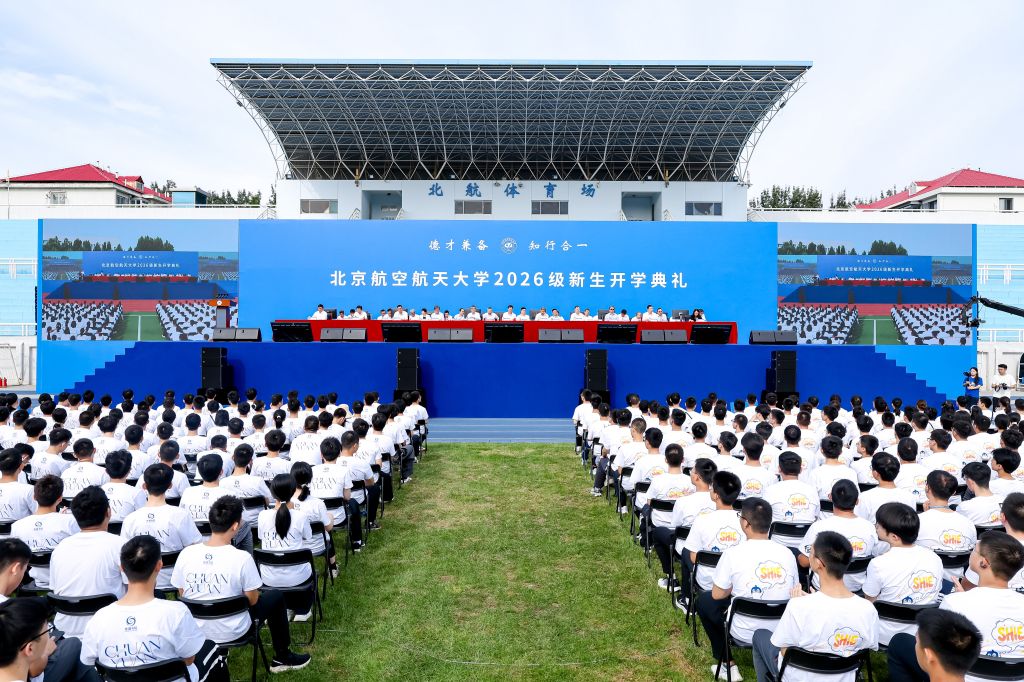 Beihang NewsBeihang University holds 2026 opening convocation to welcome new studentsMore
 Beihang NewsBeihang University welcomes 9,022 new graduate studentsMore
 Beihang NewsProfessor Yu Shui wins Best Screenplay Award at 21st Changchun Film FestivalMore