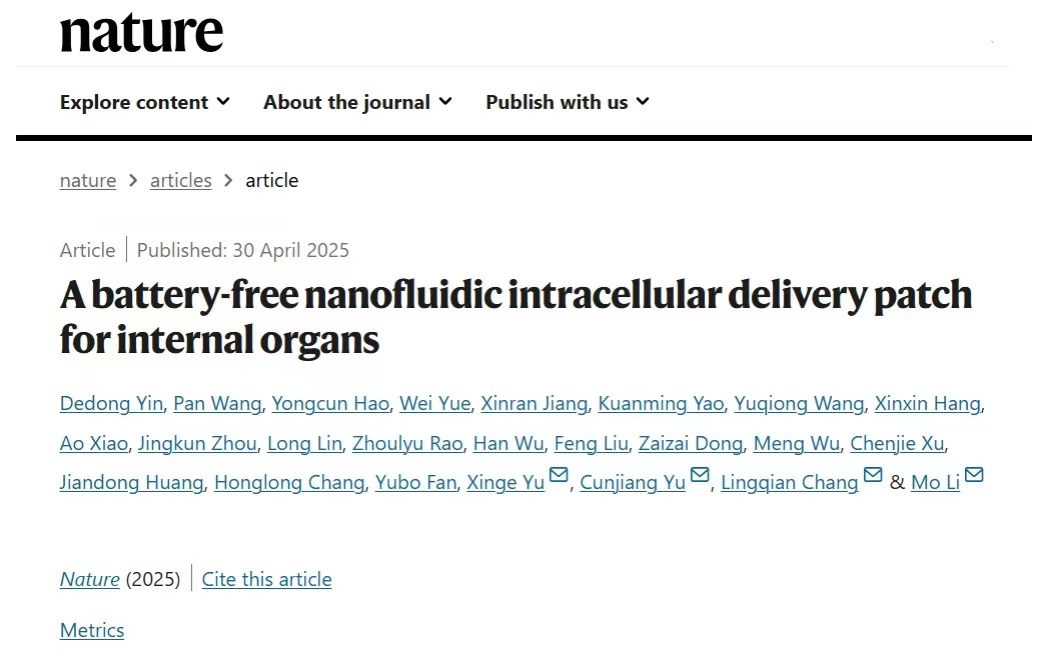
A research team led by Professor Chang Lingqian from the School of Biological Science and Medical Engineering at Beihang University, in collaboration with researchers from Peking University, City University of Hong Kong, the University of Illinois Urbana-Champaign (UIUC), Northwestern Polytechnical University, etc., has developed a battery-free, chipless, soft nanofluidic intracellular delivery (NanoFLUID) patch that provides enhanced and customized delivery of payloads in targeted internal organs.
The groundbreaking study, titled “A battery-free nanofluidic intracellular delivery patch for internal organs,” was published in Nature on April 30, 2025, which addresses long-standing challenges in targeted therapy and offers a transformative solution for treating numerous diseases.
The targeted delivery of therapeutics to internal organs to stimulate healing or apoptosis has potential for treating many challenging diseases, including malignancies and organ injuries. However, current methods relying on blood circulation face major challenges: poor efficiency, safety risks, and lack of control over drug distribution, often causing harmful off-target effects. Physical barriers, such as cell membranes, also block effective delivery, especially for large biomolecules. While newer techniques using lasers, ultrasound, or electrodes show promise, they often require bulky equipment or high power, limiting their practical use for targeted internal organ delivery. Strategies that enable efficient, safe and controllable targeted internal organ delivery have been highly sought after yet remain a long-standing challenge.
In the research, the authors introduce the NanoFLUID patch, a battery-free, chipless, soft, and wirelessly powered device designed for enhanced accumulation and accelerated intracellular delivery of payloads in targeted internal organs. Its thin, flexible structure combines a nanofluid-based delivery module and a wireless powering module, facilitating seamless integration with organs. The patch employs a nanopore–microchannel–microelectrode structure, operating under low-amplitude pulses (20V) to ensure safe, efficient, and spatiotemporally precise electroperforation of the cell membrane. This method accelerates intracellular payload transport by 104–105 times compared to traditional diffusion-based delivery methods.
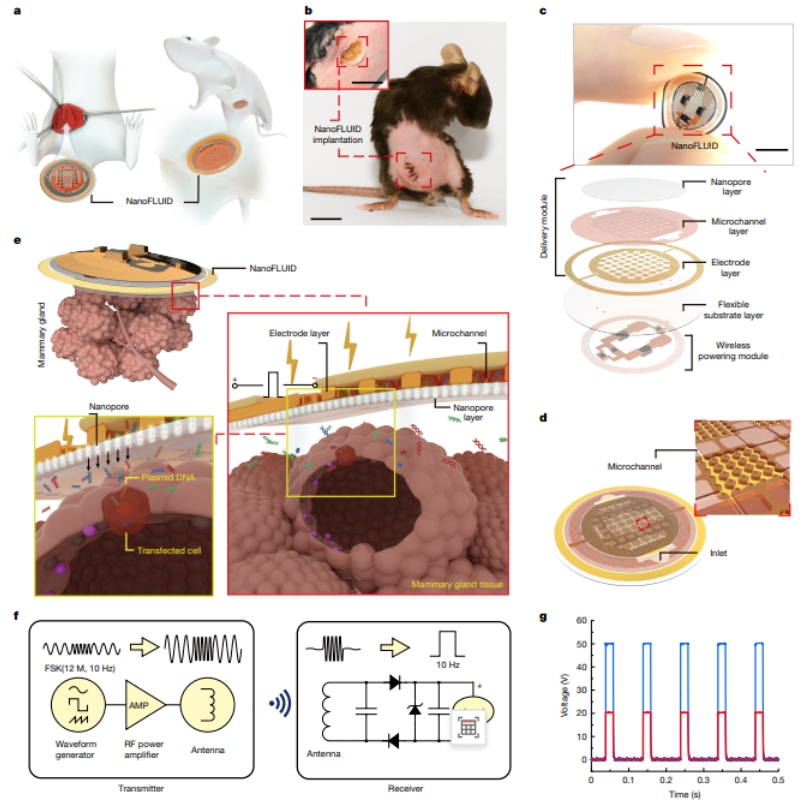
Fig. 1: A battery-free NanoFLUID device for in vivo delivery in internal organs
Through evaluations of the NanoFLUID patch in multiple in vivo scenarios, including treatment of breast tumors and acute injury in the liver and modelling tumor development, the researchers validate its efficiency, safety and controllability for organ-targeted delivery. NanoFLUID-mediated in vivo transfection of a gene library also enables efficient screening of essential drivers of breast cancer metastasis in the lung and liver. Through this approach, DUS2 is identified as a lung-specific metastasis driver.
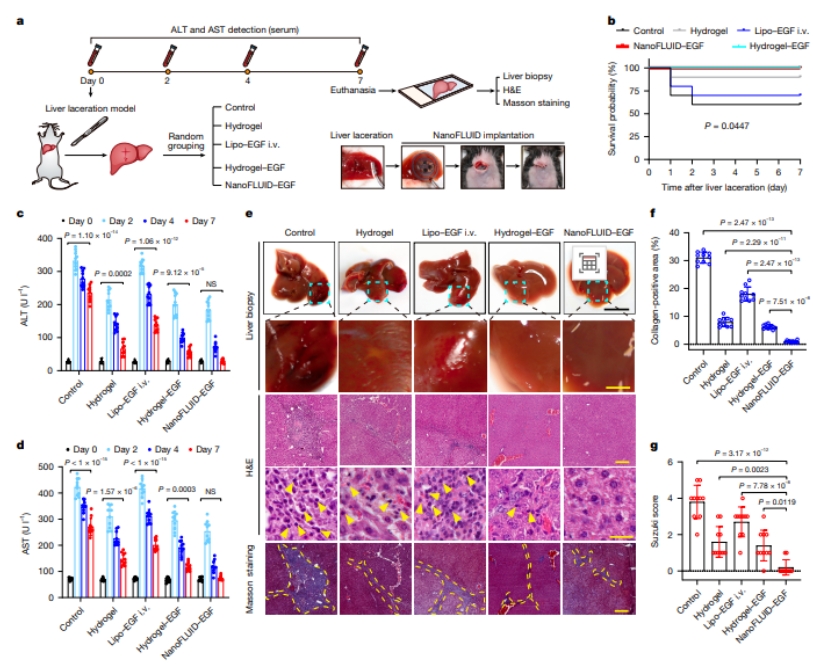
Fig. 2: Application of NanoFLUID in the treatment of acute traumatic liver injury
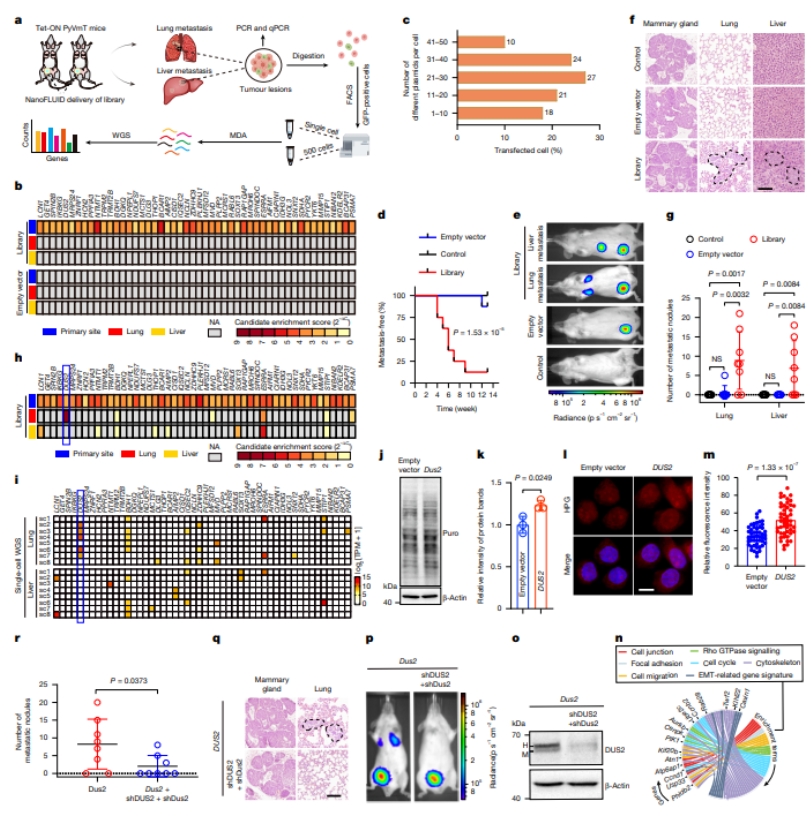
Fig. 3: Screening of breast cancer metastasis-driver genes through NanoFLUID-mediated delivery of a gene library
NanoFLUID represents a valuable bioelectronic platform for internal organ targeted delivery and holds significant potential as a tool for treating diseases and uncovering new information in biology. Its wireless, battery-free design enables precise intervention in deep tissues, while overcoming the cell membrane barrier — dramatically improving delivery efficiency. The platform’s versatility allows both therapeutic applications (e.g., cancer and trauma treatment) and basic medical research.
The technology has already been commercialized at Beihang University, with applications in medical aesthetics and skin trauma repair. An Ultra-NEP transdermal delivery device based on nanoporation has been developed, achieving efficient drug delivery.
Looking ahead, the team is exploring biodegradable materials to enable the patch to degrade after use. They are also working on improving the patch's adherence to complex organ surfaces and developing non-invasive implantation methods, such as using micro-robots or micro-catheters for precise navigation.
Link to the article: https://www.nature.com/articles/s41586-025-08943-x
Editor: Lyu Xingyun


 Beihang NewsBeihang holds 2026 Commencement and Degree Conferral CeremonyMore
 Beihang NewsBeihang hosts 2026 Campus Open Day & Admissions Information Session across three campuses in Beijing and HangzhouMore
 Beihang NewsBeihang University holds graduation gala for Class of 2026More
 Beihang NewsMETU President Ahmet Yozgatlıgil visits Beihang UniversityMore
 Beihang NewsUniversity leaders take group photos with 2026 graduatesMore
 Beihang NewsTrio Hélios Piano Concert staged at BeihangMore