A research team from the School of Physics at Beihang University, as part of the PandaX Collaboration, has made a significant advance in the search for light dark matter. Their achievement titled “Search for Solar Boosted Dark Matter Particles at the PandaX-4T Experiment” was published in the prestigious journal Physical Review Letters. The study presents the most stringent constraints to date on the scattering cross section of solar boosted dark matter (SBDM) particles, marking a key milestone in the direct detection of low-mass dark matter.
The research is led by Shen Guofang, a PhD candidate at Beihang University, with Professors Geng Lisheng, Zhou Xiaopeng, An Haipeng, and Liu Jianglai serving as corresponding authors. The study pioneers the use of dual-phase liquid xenon detectors to perform a dedicated search for SBDM, focusing on dark matter particles in the sub-MeV mass range, a regime previously inaccessible with traditional detection techniques.
Dark Matter: A Major Scientific Challenge
Dark matter is estimated to account for roughly 85% of the universe’s total mass, yet its nature remains elusive. Conventional direct detection experiments have largely focused on weakly interacting massive particles (WIMPs) with masses above a few GeV. However, detecting light dark matter particles (with masses below 1 MeV) is technically challenging due to their limited kinetic energy and low recoil signatures.
Innovative Theoretical Model and Rigorous Data Analysis
The PandaX-4T team addressed this challenge by leveraging a novel theoretical model in which dark matter particles are energized through scatterings with high-energy electrons in the solar interior. These boosted particles can escape the Sun and interact with terrestrial detectors via electron recoil—producing observable signals above the threshold of the PandaX-4T detector. This method significantly reduces model dependencies and opens a new detection channel for low-mass dark matter.
Using 1.54 tonne⋅year of data collected from the PandaX-4T experiment, the researchers conducted a detailed search for SBDM-induced electronic recoils. Through rigorous background modeling, signal efficiency calibration, and global likelihood fitting, the team established a new upper limit on the dark matter–electron scattering cross section: 3.51 × 10⁻³⁹ cm² at a dark matter mass of 0.08 MeV/c², achieving a 23 fold improvement compared with earlier experimental studies. This result places the strongest constraints yet on SBDM in the sub-MeV mass window and provides critical evidence for evaluating dark matter production mechanisms such as freeze-out in the early universe. It also challenges previously allowed parameter spaces for dark matter interactions with electrons under heavy mediator scenarios.
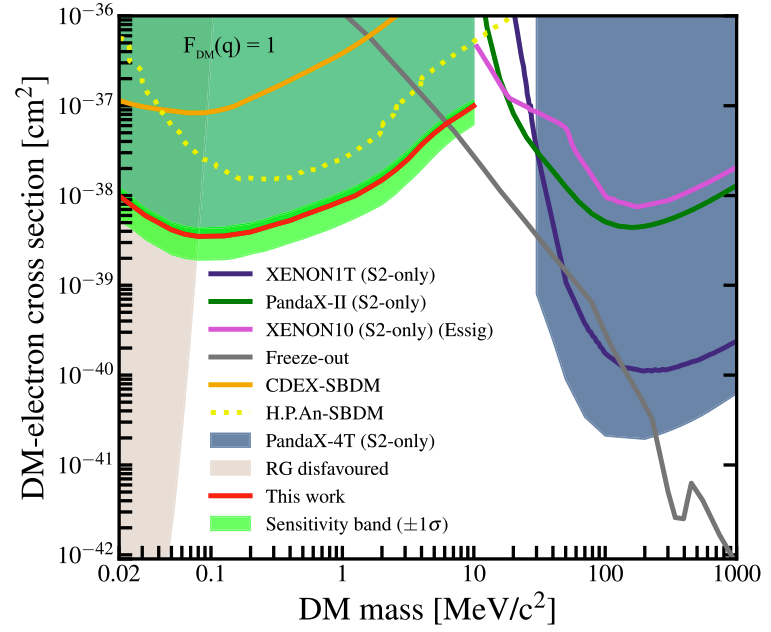
Data from PandaX-4T effectively tests the freeze-out dark matter model by constraining the upper limit of the scattering cross section for low-mass dark matter with electrons
PandaX Collaboration: Expanding Experimental Boundaries
The PandaX Collaboration is an international effort dedicated to the detection and study of dark matter, leveraging state-of-the-art experimental techniques and theoretical models to explore fundamental questions in particle physics and cosmology.
As a vital member of the PandaX Collaboration, the Beihang team continues to push the boundaries of experimental research. In a study published earlier this year, titled "Exploring New Physics with PandaX-4T Low Energy Electronic Recoil Data", the team deeply participated in the search for new physical phenomena, including solar axions, anomalous magnetic moment neutrinos, and axion-like particles.
The research was supported by key funding from the National Natural Science Foundation of China, the Ministry of Science and Technology, and other academic institutions and foundations.
[1] PandaX-4T Collaboration. Search for Solar Boosted Dark Matter Particles at the PandaX-4T Experiment. Physical Review Letters, 134, 161003 (2025). [https://journals.aps.org/prl/pdf/10.1103/PhysRevLett.134.161003]
[2] PandaX-4T Collaboration. Exploring New Physics with PandaX-4T Low Energy Electronic Recoil Data. Physical Review Letters, 134, 041001 (2025). [https://journals.aps.org/prl/abstract/10.1103/PhysRevLett.134.041001]
Editor: Tian Zimo


 Beihang NewsBeihang holds 2026 Commencement and Degree Conferral CeremonyMore
 Beihang NewsABRUEM delegation visits Beihang UniversityMore
 Beihang NewsBeihang University holds graduation gala for Class of 2026More
 Beihang NewsBeihang hosts 2026 Campus Open Day & Admissions Information Session across three campuses in Beijing and HangzhouMore
 Beihang NewsMETU President Ahmet Yozgatlıgil visits Beihang UniversityMore
 Beihang NewsUniversity leaders take group photos with 2026 graduatesMore