A recent study led by researchers from Beihang University has demonstrated a novel strategy for large-scale, highly aligned assembly of one-dimensional nanomaterials, marking a significant advancement in the field of nanomaterial self-assembly. The work, titled "Polymer-Modulated Evaporation Flow Enables Scalable Self-Assembly of Highly Aligned Nanowires," was published in the prestigious journal Advanced Functional Materials.

The research was jointly conducted by the team of Professor Xu Ye from the School of Mechanical Engineering and Automation and the team of Professor Man Xingkun from the School of Physics. Doctoral candidates Tao Liyiming and Jiang Zechao are co-first authors, with Professors Xu Ye and Man Xingkun serving as co-corresponding authors.
One-dimensional nanomaterials, such as nanowires and nanorods, exhibit unique optical, electrical, and magnetic anisotropy due to their high aspect ratios, making them valuable for flexible electronics, solar cells, sensors, and photonic devices. These directional properties can only be exploited at device scale if the nanomaterials are uniformly aligned; otherwise, random orientation in disordered assemblies averages out their anisotropy. Conventional assembly methods often rely on precision fabrication or external fields, which offer limited control over orientation, density, and homogeneity. Achieving a balance among high alignment degree, scalability, and process simplicity has remained a major challenge.

To address this, the collaborative teams proposed a simple and scalable self-assembly strategy that uses a polymer additive to modulate fluid flows during solvent evaporation. The addition of carboxymethylcellulose sodium (CMC-Na) reshapes the evaporation-driven flow field and generates a compressional flow region near the drying edge. Within this region, rotation-inducing velocity gradients progressively align silver nanowires (AgNWs) into highly ordered arrays. This unique mechanism yields uniform AgNW coatings with a high degree of nanowire alignment and tunable areal density across centimeter-scale areas. The resulting films exhibit strong broadband anisotropy, including polarization-dependent transmission in both visible and terahertz (THz) regimes and angle-dependent electrical conductivity. The approach also integrates naturally with dip-coating–based shear alignment, enabling programmable control over alignment direction and spatial patterning.
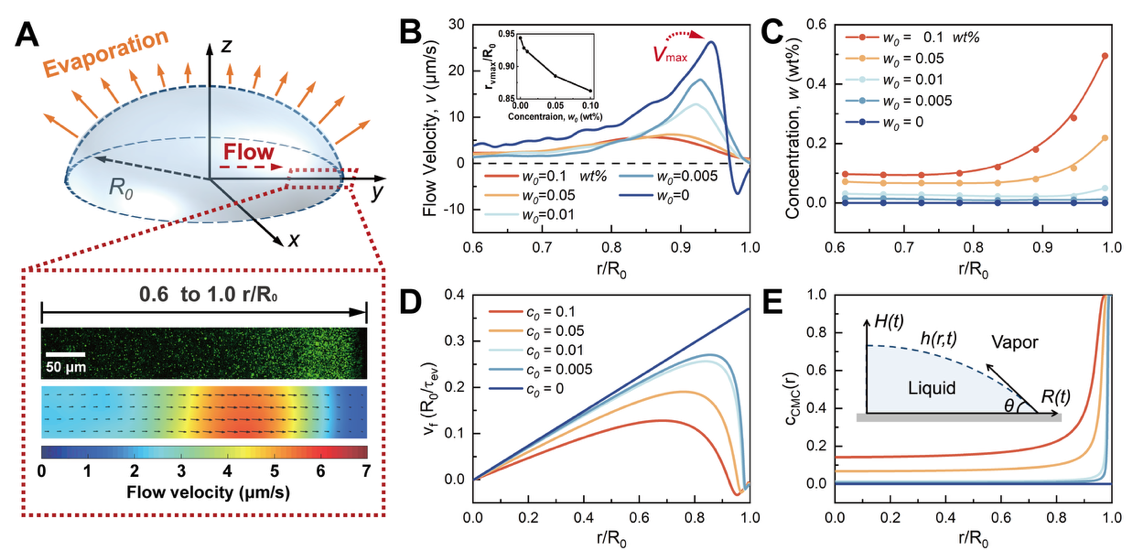
This work establishes a robust, polymer-enabled mechanism for bottom-up nanowire alignment and offers a passive, energy-efficient route for fabricating anisotropic nanostructuredcoatings.
Collaborators also included the research group of Professor Wu Xiaojun from the School of Electronic and Information Engineering, as well as Professor Masao Doi and Associate Professor Hu Shiyuan from the School of Physics at Beihang University, and Professor Zhou Jiajia from South China University of Technology.
Supported by Beihang's interdisciplinary research initiatives, the teams of Professors Xu Ye and Man Xingkun have conducted in-depth collaboration centered on the fundamental scientific question of "the essence of non-equilibrium evolution in soft matter." Combining theoretical and experimental approaches, they have published several high-impact papers in areas including controlled uniform deposition of micro-nano particles and efficient fabrication of cell microspheres.
Link to the article: https://advanced.onlinelibrary.wiley.com/doi/10.1002/adfm.202513053
Editor: Lyu Xingyun


 Beihang NewsBeihang holds 2026 Commencement and Degree Conferral CeremonyMore
 Beihang NewsBeihang hosts 2026 Campus Open Day & Admissions Information Session across three campuses in Beijing and HangzhouMore
 Beihang NewsBeihang University holds graduation gala for Class of 2026More
 Beihang NewsMETU President Ahmet Yozgatlıgil visits Beihang UniversityMore
 Beihang NewsUniversity leaders take group photos with 2026 graduatesMore
 Beihang NewsTrio Hélios Piano Concert staged at BeihangMore