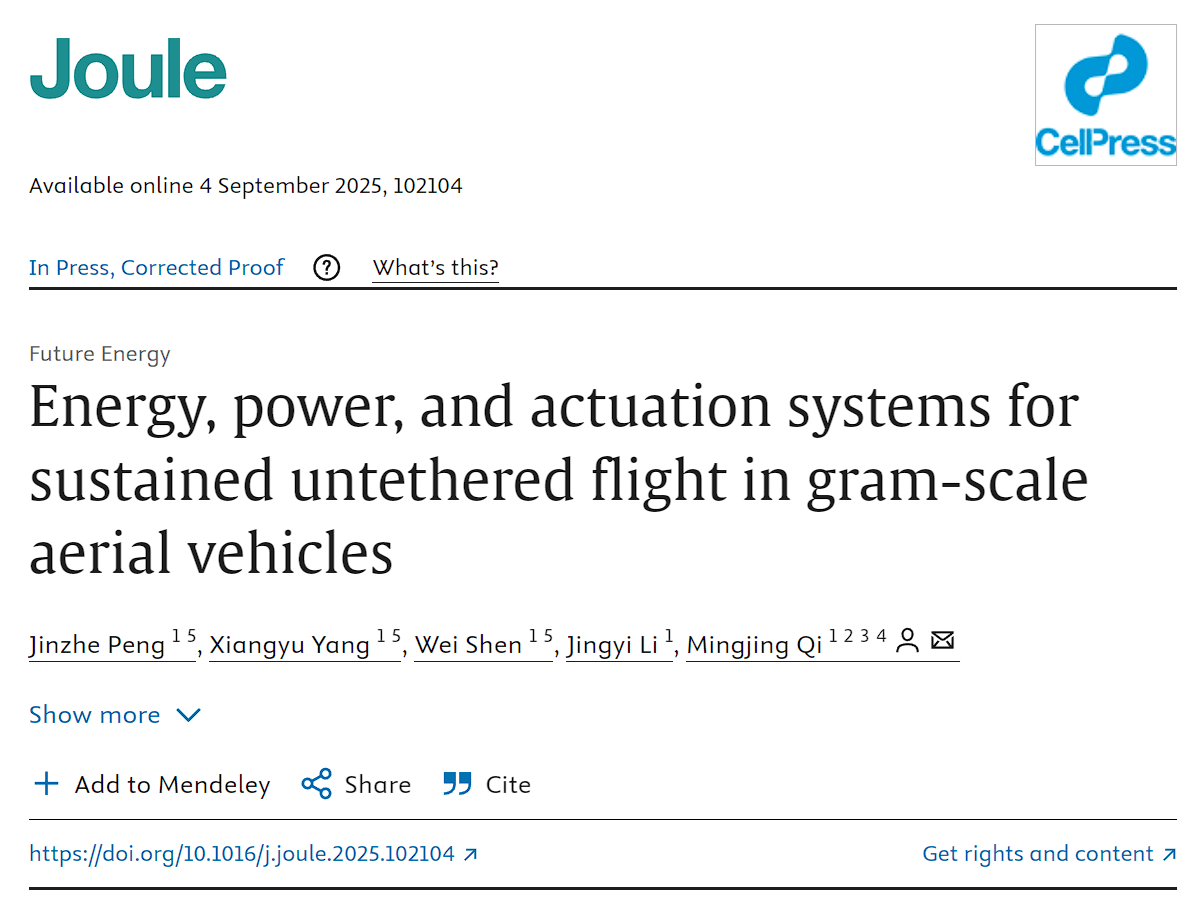
Recently, Professor Qi Mingjing's research team from the School of Energy and Power Engineering at Beihang University published a cutting-edge article titled "Energy, power, and actuation systems for sustained untethered flight in gram-scale aerial vehicles" in the Future Energy column of the prestigious journal Joule.
The paper, with Peng Jinzhe, Yang Xiangyu, and Shen Wei as co-first authors and Professor Qi Mingjing as the corresponding author, is authored entirely by researchers from Beihang University.
With the expanding applications of drones and robots in environmental monitoring, emergency response, and space exploration, there is a growing demand for smaller, lighter, and more agile MAVs. However, gram-scale MAVs have a flight time of less than 10 min, which is far from long-duration or even unlimited endurance, thus significantly constraining their application scenarios.
To address the challenges faced by gram-scale MAVs for sustained untethered flight, this article examines recent advances in energy, power, and actuation systems and outlines environmental energy-harvesting strategies. Major technological limitations are identified, and key design principles are proposed, including the selection of actuators with high lift-to-power ratios, the prioritization of lightweight and efficient energy and power systems, and the integrated structural design.
Looking forward, the research team proposes several key strategies to enhance MAV endurance: advancing energy systems via next-generation chemical batteries such as lithium-sulfur and lithium-air, flexible thin-film solar cells, and integrated micro-supercapacitors to achieve higher energy density at minimal weight; developing lightweight power systems compatible with high-voltage actuators; achieving triple integration of structure, energy storage, and circuitry through flexible and multifunctional composite materials; and harnessing diverse environmental energy sources via multi-modal coupling—including light, thermal gradients, and atmospheric electricity—with emerging technologies like triboelectric nanogenerators (TENGs) to improve endurance and operational reliability across day-night cycles and under harsh weather conditions.
With continued progress in new materials, power systems, and integrated design, gram-scale MAVs —optimized for extreme lift efficiency—are expected to overcome current endurance limitations. They hold great potential for transformative applications in extreme environment rescue, space science, precision logistics, and beyond.
Editor: Lyu Xingyun


 Beihang NewsBeihang celebrates 42nd Teachers' DayMore
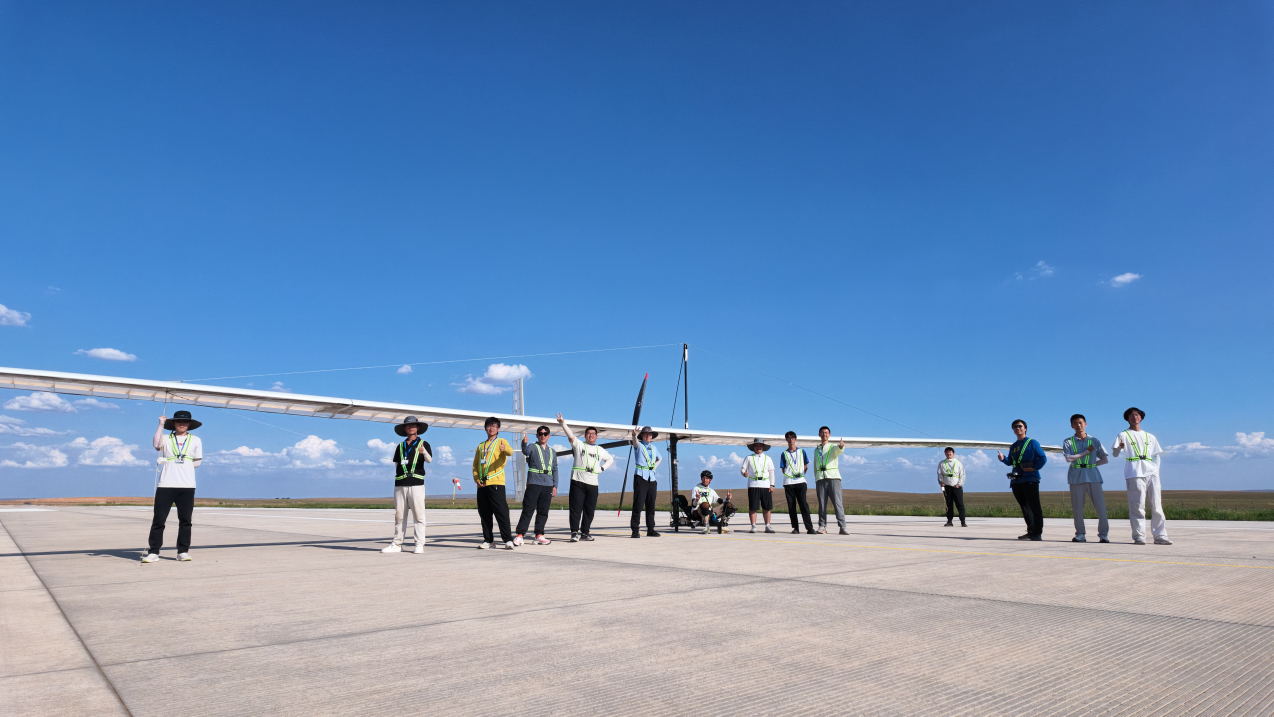 Beihang NewsBeihang's first student-designed human-powered aircraft completes test flightMore
 Beihang NewsBeihang leaders engage in dialogue with new undergraduate and graduate student representativesMore
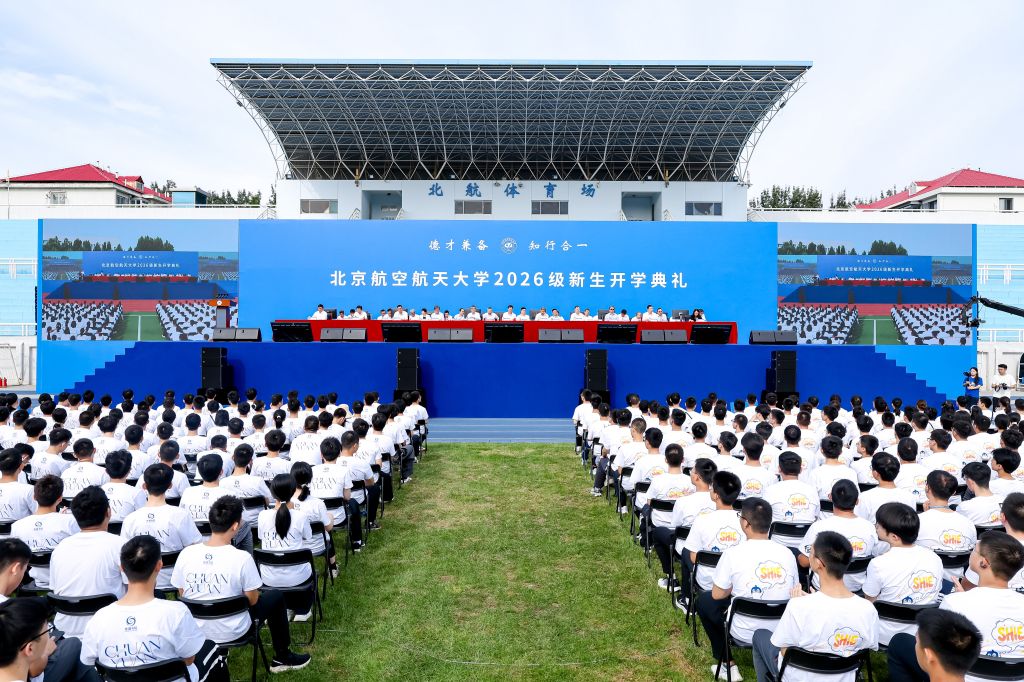 Beihang NewsBeihang University holds 2026 opening convocation to welcome new studentsMore
 Beihang NewsBeihang University welcomes 9,022 new graduate studentsMore
 Beihang NewsProfessor Yu Shui wins Best Screenplay Award at 21st Changchun Film FestivalMore