A research team led by Professor Zhao Weisheng from the School of Integrated Circuit Science and Engineering at Beihang University has made significant progress in the field of spintronic neural networks. The related research paper, titled "Radiofrequency Spintronic Neural Network Enabled by Electrically Modulated Magnetic Tunnel Junctions," was published in the internationally renowned journal Advanced Materials on September 25, 2025.
Magnetic tunnel junctions (MTJs) in nanoscale have emerged as promising candidates for energy-efficient neuromorphic computing. As a pioneering demonstration, the radiofrequency (RF) neural network based on the intrinsic RF-to-DC conversion capability of MTJs features multilayer interconnectivity and native processing of RF inputs. However, most existing devices rely on magnetic field lines to modulate their behavior in neural networks, resulting in high energy consumption and increased area overhead. Moreover, the limited tunable bandwidth of the MTJs constrains the number of synapses per layer, thereby limiting the network's potential for scaling up.

Figure 1 Schematic and basic properties of the MTJs
In this work, electrically tunable spintronic synapses and neurons based on three-terminal MTJs are experimentally realized, where the spin-orbit torque enables precise modulation of synaptic weight and neuron output frequency. The proposed method offers enhanced scalability and reduces energy consumption by a factor of 21. Furthermore, multilayer networks employing both fully connected and convolutional architectures, achieving 99.2% accuracy on drone classification and 92.0% on the Fashion-MNIST image dataset, are stimulated. The convolutional design notably reduces the number of required oscillator frequency channels.
The results demonstrate the feasibility of scalable, high operational frequency, and energy-efficient all-spintronic neuromorphic systems. The work significantly improves the control methodology of all-spintronic neural networks and expands their application in neuromorphic computing, demonstrating their great potential for tackling large-scale and complex tasks.

Figure 2 Functionality validation of spintronic neural network via software simulation
Doctoral students Wang Zixi and Duan Yuqi are the co-first authors of the paper. Professor Zhao Weisheng, Associate Professor Shi Kewen, and Postdoctoral Fellow Cai Wenlong are the corresponding authors. This research received support from the National Natural Science Foundation of China and the National Key Research and Development Program of China.
Professor Zhao Weisheng's team has long been dedicated to research on the ultrafast dynamics of ultra-low-power spintronic devices. With comprehensive capabilities in nanodevice fabrication and time-frequency domain testing, the team has achieved a series of progress in ultrafast electrical writing and frequency characterization, including studies on magnetic dynamics and the synergistic control of spin-transfer torque (STT) andspin-orbit torque (SOT) in three-terminal MTJs. Related results have been published in prestigious international journals such as Nature Electronics, Nature Communications, and IEEE Electron Device Letters.
Link to the article: https://doi.org/10.1002/adma.202510319
Editor: Lyu Xingyun


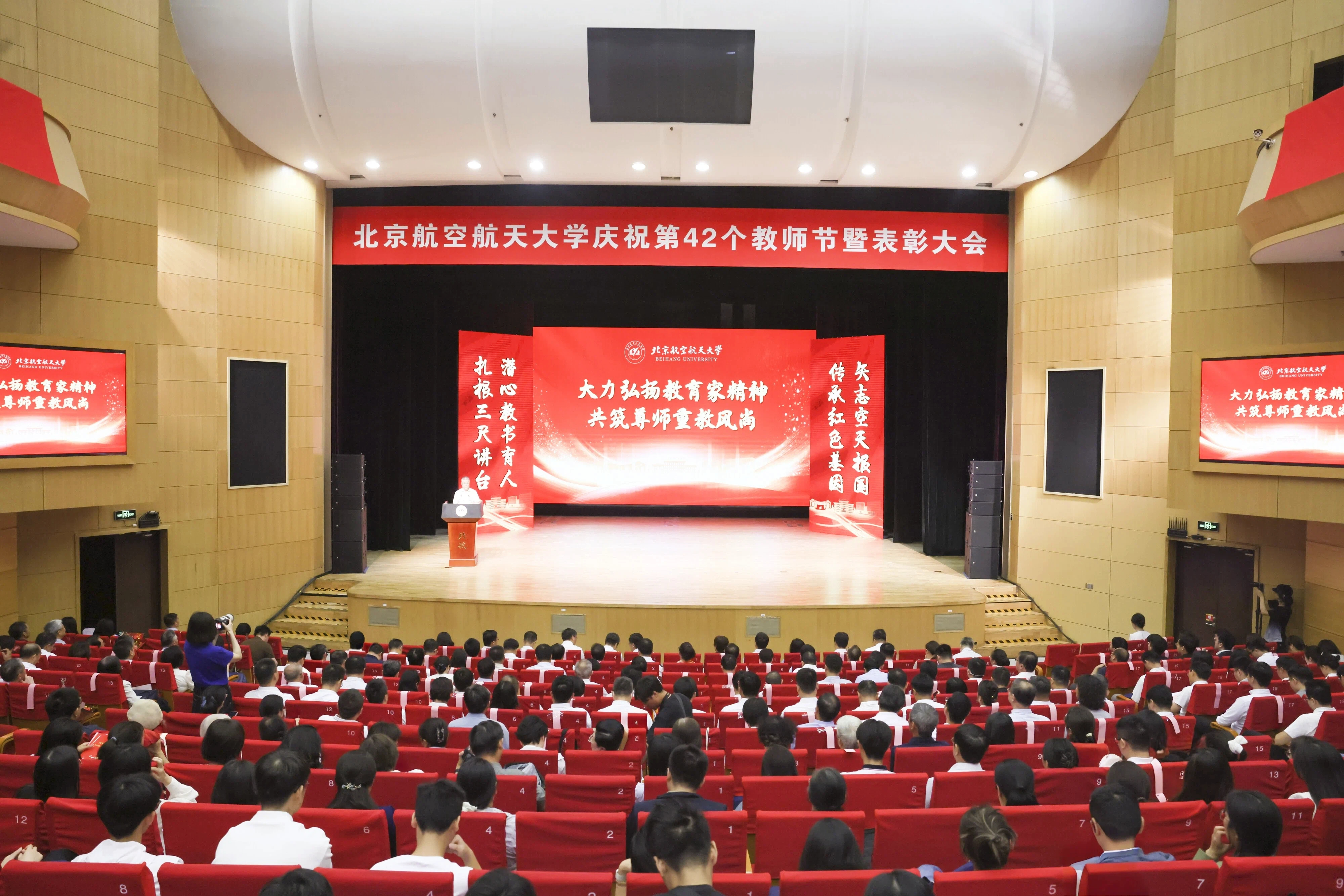 Beihang NewsBeihang celebrates 42nd Teachers' DayMore
 Beihang NewsBeihang's first student-designed human-powered aircraft completes test flightMore
 Beihang NewsBeihang leaders engage in dialogue with new undergraduate and graduate student representativesMore
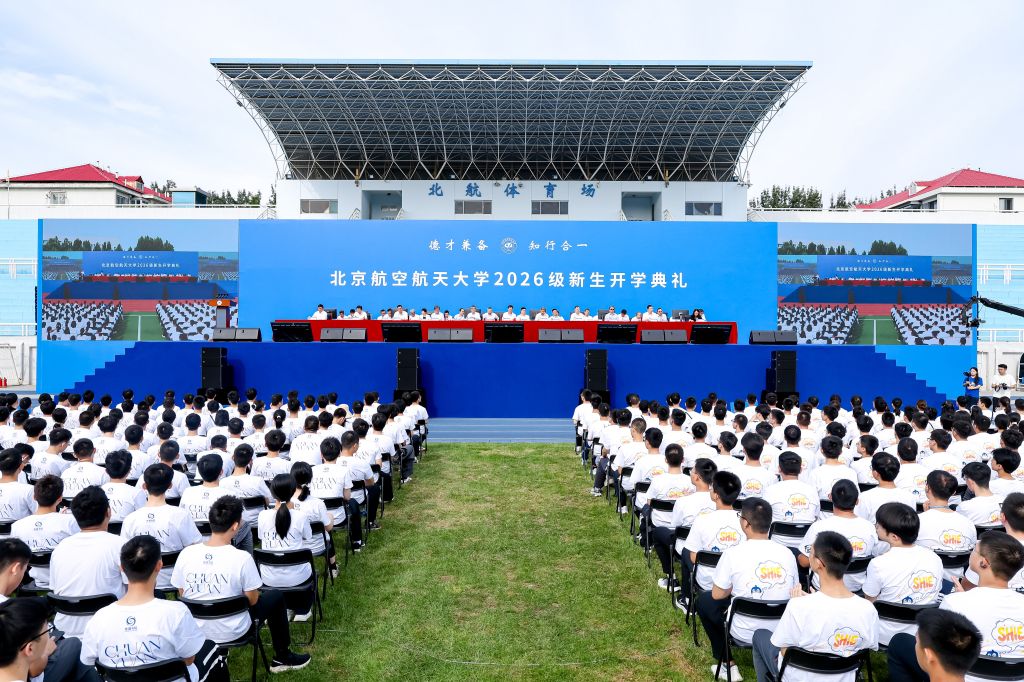 Beihang NewsBeihang University holds 2026 opening convocation to welcome new studentsMore
 Beihang NewsBeihang University welcomes 9,022 new graduate studentsMore
 Beihang NewsProfessor Yu Shui wins Best Screenplay Award at 21st Changchun Film FestivalMore