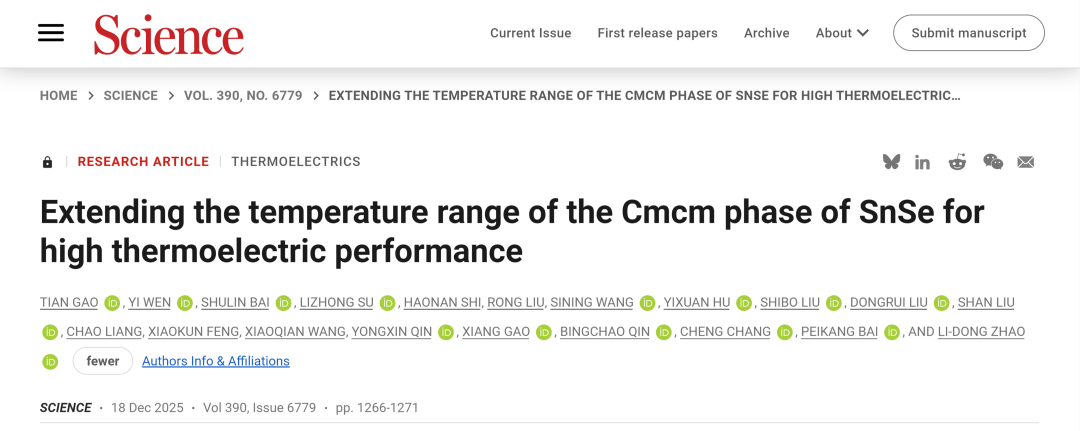
On December 19, 2025, the prestigious journal Science published the latest advances achieved by Professor Zhao Lidong's research group from the School of Materials Science and Engineering of Beihang University in the field of thermoelectric materials and devices.
Their study, titled "Extending the temperature range of the Cmcm phase of SnSe for high thermoelectric performance," boosts two-dimensional phonon and three-dimensional charge transports (2D phonon/3D charge transports) and extends the high thermoelectric performance (ZT~3.0) from a single temperature point (748 K) to a wide temperature range of ~250 kelvin (673–923 K) via a high solid solution of high-symmetry PbSe phase in n-type SnSe crystals. Building on its outstanding thermoelectric performance over a broad-temperature-range, a power generation efficiency of ~19.1% has been achieved. This work demonstrates the great potential of n-type SnSe crystals in the field of thermoelectric power generation.
Gao Tian (Ph.D. candidate enrolled in 2025), Associate Professor Wen Yi, and Bai Shulin (Ph.D. candidate enrolled in 2023) are the co-first authors of this work. Professor Su Lizhong, Professor Chang Cheng, and Professor Zhao Lidong serve as corresponding authors. The School of Materials Science and Engineering at Beihang University is the primary affiliation for the research. This is the third article published in Science in 2025 and the 14th publication in Science or Nature by Prof. Zhao Lidong's group since 2015.
Energy serves as a fundamental material basis for human survival and social development, yet over half of it is ultimately dissipated as waste heat, representing a significant inefficiency. Harnessing this vast thermal energy resource by converting it directly into electricity would have profound implications. Thermoelectric technology enables direct conversion between thermal and electrical energy—utilizing the Seebeck effect for power generation from temperature differences and the Peltier effect forthermoelectric cooling. It holds enormous potential for applications in critical fields such as power supply for deep-space exploration and thermal management of integrated circuits.
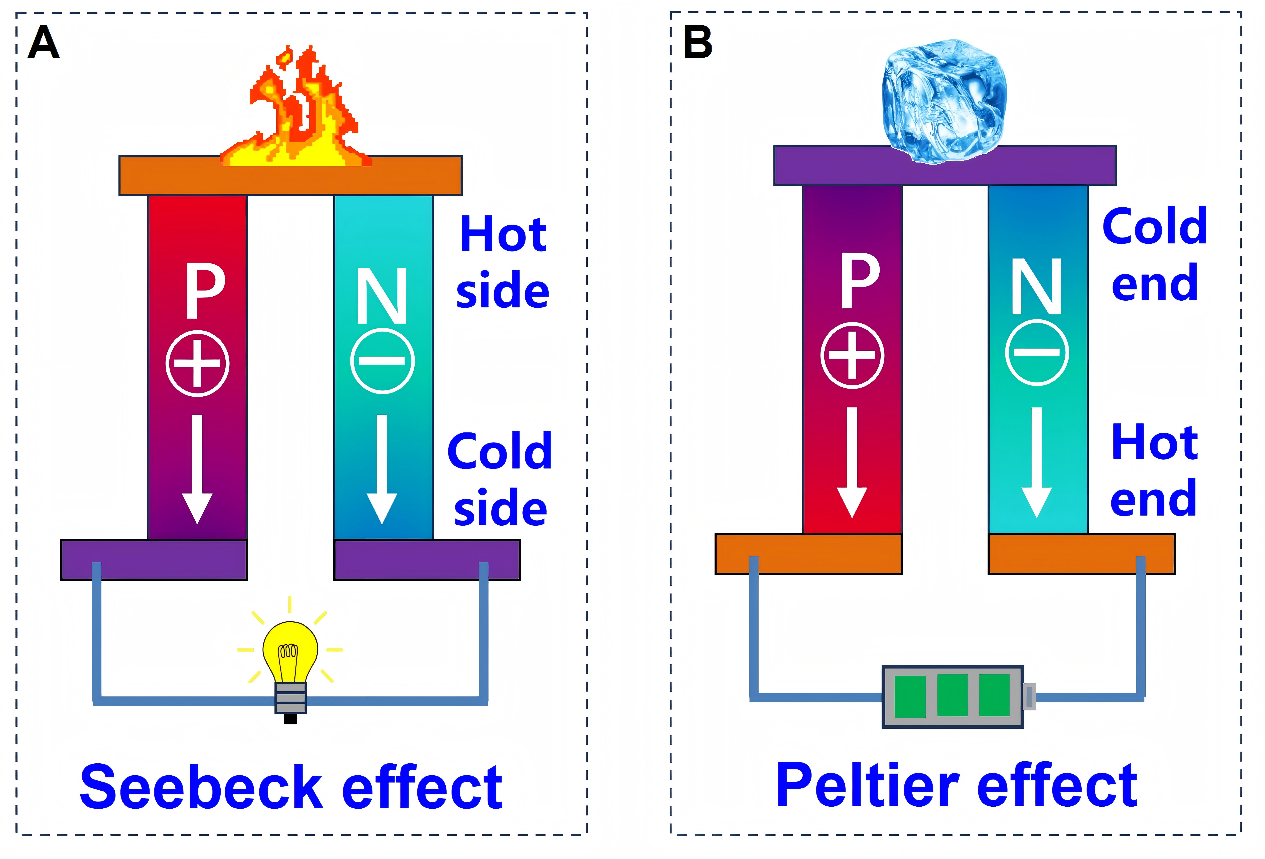
Fig.1 Thermoelectric effects: (A) Thermoelectric power generation model based on the Seebeck effect;(B) Thermoelectric cooling model based on the Peltier effect
The conversion efficiency of thermoelectric materials is primarily determined by their dimensionless figure of merit (ZT= (S2σ/κ)T). At a given temperature T, high-performance thermoelectric materials should possess a large Seebeck coefficient S (to generate a great thermoelectric voltage), high electrical conductivity σ (to reduce Joule heating losses), and low thermal conductivity κ (to maintain a large temperature gradient). However, the intricate coupling among these thermoelectric parameters limits the enhancement of ZT. To address the challenge of efficiently decoupling these parameters, the research group has proposed strategies such as developing intrinsically low thermal conductivity materials, synergistically manipulating multi-band structures, lattice plainification and grid-plainification. These approaches have led to new frameworks for screening wide-temperature-range thermoelectric power generation materials [Science 367 (2020) 1196-1197] and for designing novel cooling materials [Science 378 (2022) 832-833]. In frontier interdisciplinary research, the group collaborated with other groups and promoted deep integration across disciplines [Nature 632 (2024) 528-535, Science 389 (2025) 623-631].
The research group has long been dedicated to developing novel thermoelectric materials and high-efficiency power generation and cooling devices. Through screening studies, they identified SnSe crystals as possessing exceptional thermoelectric potential [Nature 508 (2014) 373-377]. Subsequently, the group continued to explore the unique properties of SnSe crystals, discovering that they exhibit excellent p-type thermoelectric transport performance along the in-plane direction. The research group has achieved exceptional near-room-temperature thermoelectric performance in p-type SnSe through multiple strategies, including multi-band activation [Science 351 (2016) 141-144], energy-momentum multi-band alignment [Science 373 (2021) 556-561], and lattice plainification [Science 380 (2023) 841-846], demonstrating their enormous potential as a thermoelectric cooling material. In contrast, SnSe crystals exhibit outstanding n-type thermoelectric transport performance along the out-of-plane direction. Effective electron doping has unveiled the 2D phonon/3D charge transports of n-type SnSe crystals [Science 360 (2018) 778-783], which was further boosted by phonon-electron decoupling to enhance the overall out-of-plane ZTv alues [Science 375 (2022) 1385-1389].

Fig. 2 (A) The 2D phonon/3D charge transports of n-type SnSe crystals along the out-of-plane direction: The layered structure of SnSe crystals suppresses phonon transport along the out-of-plane direction, while electrons achieve tunneling through overlapping charge density. Enhancing the lattice symmetry can intensity 2D phonon/3D charge transports of n-type SnSe crystals; (B) Comparison of the ZT values with state-of-the-art p-type thermoelectric materials;(C) Comparison of the power generation efficiency with advanced single-leg thermoelectric devices
The crystal structure of SnSe is Pnma phase below 800 K and transforming into the higher-symmetry Cmcm phase above 800 K. While previous research has predominantly focused on Pnma-phase SnSe crystals, the thermoelectric potential of the more symmetric Cmcm phase remains unexplored. Moreover, studies on thermoelectric devices based on the out-of-plane direction of n-type SnSe crystals remain scarce. This study focused on n-type–Cmcm SnSe crystals, broadening the temperature stability range of the Cmcm phase by alloying a high-symmetry phase (cubic PbSe). Concurrently, the enhanced local lattice symmetry of the n-type–Cmcm SnSe crystals substantially strengthens the "2D phonon/3D charge" transports: 1) Enhanced lattice symmetry reduces the deformation potential, optimizing the carrier mobility (μH) in the high-temperature Cmcm phase despite a considerable increase of the density-of-states effective mass (md*) and carrier concentration (nH), strengthening the 3D charge transport;2) Concomitant bond softening suppresses lattice thermal conductivity, intensifying the 2D phonon scattering of n-type-Cmcm SnSe crystals. As illustrated in Fig.2(B), an exceptional average thermoelectric figure of merit (ZTave) of approximately 3.0 is achieved over a broad temperature range from 673 K to 923 K. Furthermore, this study fabricated a thermoelectric device based on the n-type SnSe crystal to demonstrate the outstanding potential of n-type SnSe crystals, as shown in Figure 2(C), a single-leg device achieved a power-generation efficiency of ~19.1% at a temperature difference of 572 K.
This work was supported by the National Key Research and Development Program of China, the National Science Fund for Distinguished Young Scholars, the National Natural Science Foundation of China, the Tencent Xplorer Prize, etc. It also received support from the Space Application System of China Manned Space Program.
Professor Su Lizhong's group and Professor Bai Peikang's group from Taiyuan University of Science and Technology, and Researcher Gao Xiang's group from the Center for High Pressure Science and Technology Advanced Research also contribute to the research.
Link to the article: https://www.science.org/doi/10.1126/science.adt0831
Source: School of Materials Science and Engineering
Editor: Liu Tingting


 Beihang NewsBeihang celebrates 42nd Teachers' DayMore
 Beihang NewsBeihang's first student-designed human-powered aircraft completes test flightMore
 Beihang NewsBeihang leaders engage in dialogue with new undergraduate and graduate student representativesMore
 Beihang NewsBeihang University holds 2026 opening convocation to welcome new studentsMore
 Beihang NewsBeihang University welcomes 9,022 new graduate studentsMore
 Beihang NewsProfessor Yu Shui wins Best Screenplay Award at 21st Changchun Film FestivalMore