A research team led by Professor Zhao Weisheng and Professor Zhang Yue from the National Key Laboratory of Spintronics at Beihang University's Hangzhou International Innovation Institute has achieved a significant breakthrough in the field of noncollinear antiferromagnetic spintronics. The team has demonstrated, for the first time, a chirality-selected noncollinear antiferromagnetic state in high-quality Mn3Sn epitaxial thin films.

The findings, titled "Chirality-Selected Noncollinear Antiferromagnetic State," were published online in the prestigious journal Advanced Materials. Associate Professor Xu Shijie and Associate Professor Zhang Zhizhong from Hangzhou International Innovation Institute of Beihang University, along with Researcher Lou Wenkai and Dr. Sun Shuhan from the Institute of Semiconductors, Chinese Academy of Sciences, are co-first authors. Corresponding authors include Professor Zhao Weisheng and Professor Zhang Yue from Beihang University, Professor Zhang Xixiang from King Abdullah University of Science and Technology, and Professor Chang Kai from Zhejiang University. The Hangzhou International Innovation Institute of Beihang University is the primary affiliation for the research.
The topological noncollinear antiferromagnet (AFM) Mn3Sn exhibits a giant anomalous Hall conductance (AHC) originating from its nonvanishing Berry curvature. Conventionally, the two AHC states are regarded as time-reversal pairs coupled to the magnetic octupole moment, and their control has relied on reversing this moment by external magnetic fields or electric currents.
In the research, an alternative mechanism is demonstrated—the chirality-selected noncollinear antiferromagnetic state—in which the AHC polarity is defined by the vector spin chirality (VSC) of the Kagome lattice. By constructing Mn3Sn/Pt heterostructures, a Fert-Levy-type Dzyaloshinskii–Moriya interaction (DMI) is introduced that sets the lattice chirality. The induced DMI changes the VSC from counterclockwise (CCW) to clockwise (CW), resulting in a corresponding inversion of the AHC sign. This behavior is confirmed by symmetry analysis and atomistic simulations that link the polarity inversion to the competition between DMI energy and intrinsic anisotropy.

Fig. 1 Fert-Levy-type DMI modulates the vector spin chirality (VSC)

Fig. 2 Selection of the anomalous Hall state by VSC
These findings establish a chirality-defined route for controlling noncollinear antiferromagnetic order and highlight DMI engineering as a powerful means of tailoring Berry-curvature-driven transport in AFMs. It deepens the understanding of the nature of spin chirality in Weyl antiferromagnet Mn3Sn, and lays an important theoretical foundation for developing high-reliability, high-performance magnetic memory devices and other next-generation spintronic components for the post-Moore's Law era.
The work was supported by the National Key Research and Development Program of China, the National Natural Science Foundation of China, and other grants. Professor Chang Kai and Professor Lou Wenkai contributed detailed group theory analyses, and Truth Equipment Co., LTD provided equipment support for the sample growth.
Link to the article: https://doi.org/10.1002/adma.202516514
Editor: Lyu Xingyun


 Beihang NewsBeihang celebrates 42nd Teachers' DayMore
 Beihang NewsBeihang's first student-designed human-powered aircraft completes test flightMore
 Beihang NewsBeihang leaders engage in dialogue with new undergraduate and graduate student representativesMore
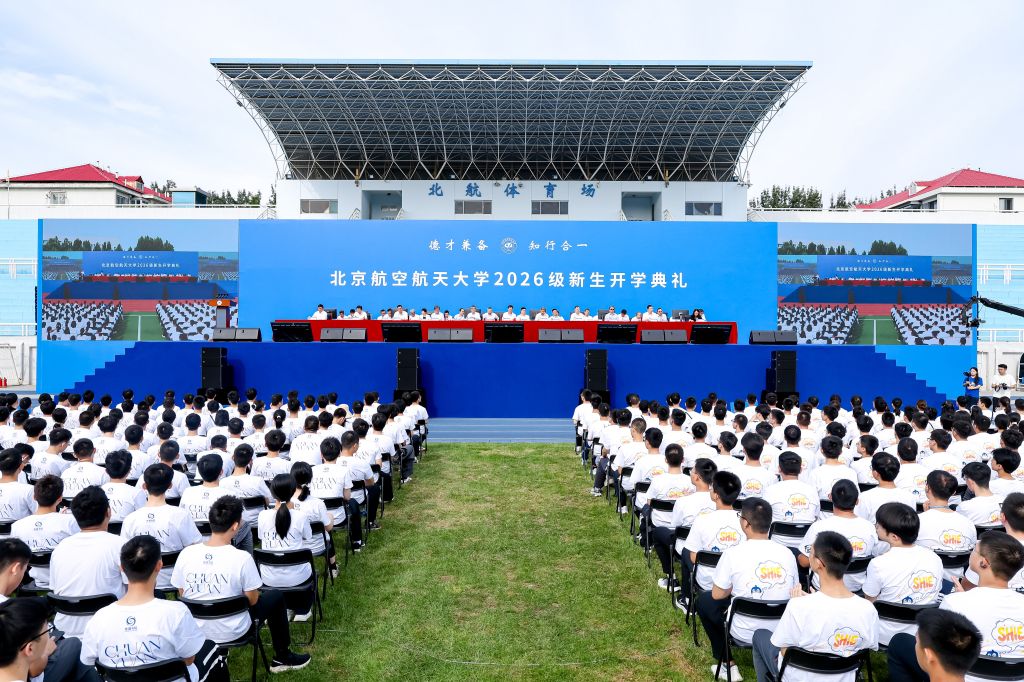 Beihang NewsBeihang University holds 2026 opening convocation to welcome new studentsMore
 Beihang NewsBeihang University welcomes 9,022 new graduate studentsMore
 Beihang NewsProfessor Yu Shui wins Best Screenplay Award at 21st Changchun Film FestivalMore