Accurate measurement of critical data for high-temperature aerospace components is essential for thermal protection design and structural health monitoring. Recently, a research team led by Academician Tao Zhi from the School of Energy and Power Engineering at Beihang University has made significant progress in the field of inkjet printing and laser sintering of high-temperature conformal thin-film sensors. Their findings have been published in the prestigious journal Nature Communications.
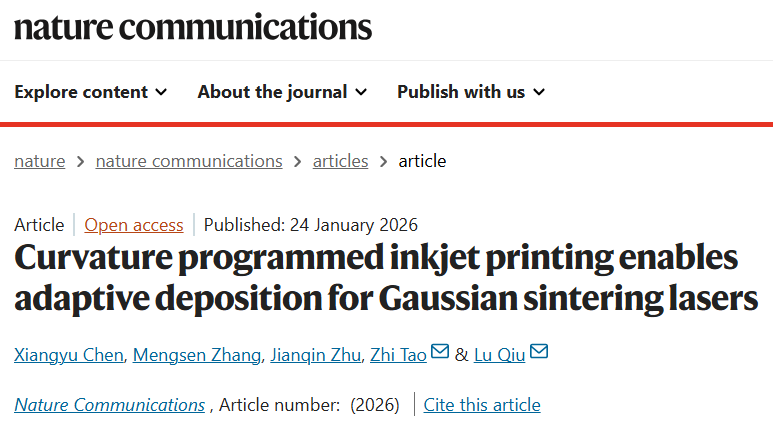
The study, titled "Curvature Programmed Inkjet Printing Enables Adaptive Deposition for Gaussian Sintering Lasers," introduces a novel thickness-matching strategy that aligns film geometry with the laser intensity profile. It provides a feasible pathway for the low-cost, scalable fabrication of high-performance high-temperature conformal circuits based on inkjet printing and offers new insights for optimizing laser sintering and melting technologies.
Research Highlights
The inherent Gaussian intensity distribution of laser beams causes critical issues such as ablation, spattering, and porosity during laser sintering and melting. Although modulating the intensity distribution by a beam shaper can alleviate these problems, it suffers from high cost, limited durability, and significant energy loss.
To address these challenges, the team proposes a thickness-matching strategy that aligns film geometry with the laser intensity profile. Mathematical analysis provides the optimal thickness distribution, while inkjet printing with computable parameters enables curved circuits with ideal profiles. The curved profile strategy demonstrates enhanced performance in both semiconducting and metallic circuits. For indium tin oxide (ITO) conductive glass, up to a 3.8-fold improvement in conductance and a 5.1% increase in transmittance are achieved compared with planar circuits, while for copper (Cu) conformal circuits, the electrical conductivity is improved by 160% compared with planar circuits. This work establishes a practical additive manufacturing route for high-performance conformal circuits.
Background on Inkjet-Printed High-Temperature Sensors
The study is part of the team's broader research direction—"inkjet-printed high-temperature conformal thin-film sensing technology for turbine blades." Conformal sensors, capable of seamlessly adhering to complex curved surfaces, offer a revolutionary solution for measuring critical data and monitoring the health of aerospace high-temperature components. Unlike traditional rigid sensors, they are lightweight, adaptable, and enable distributed sensing without disrupting aerodynamic flow or structural integrity.
Since 2018, the team has pioneered the development of inkjet-printed high-temperature conformal thin-film sensors for turbine blades. Over seven years of dedicated effort, they have established a full-chain technological framework encompassing functional nano-ink formulation, controlled deposition on 3D curved surfaces, laser sintering of nano-films, device integration, and high-temperature validation.
About the Research Team
Academician Tao Zhi's research team focuses on addressing key challenges in turbine blade cooling design, including data scarcity, model inaccuracy, and limited software intelligence. Their work spans advanced measurement and temperature field reconstruction for turbine blades, AI-aided design tools for thermal-fluid systems, and the development of high-efficiency cooling solutions for extreme environments. The team's contributions have supported the development of turbine blades for several key aerospace propulsion systems in China.
Link to the article: https://www.nature.com/articles/s41467-026-68613-y
Editor: Lyu Xingyun


 Beihang NewsBeihang celebrates 42nd Teachers' DayMore
 Beihang NewsBeihang's first student-designed human-powered aircraft completes test flightMore
 Beihang NewsBeihang leaders engage in dialogue with new undergraduate and graduate student representativesMore
 Beihang NewsBeihang University holds 2026 opening convocation to welcome new studentsMore
 Beihang NewsBeihang University welcomes 9,022 new graduate studentsMore
 Beihang NewsProfessor Yu Shui wins Best Screenplay Award at 21st Changchun Film FestivalMore