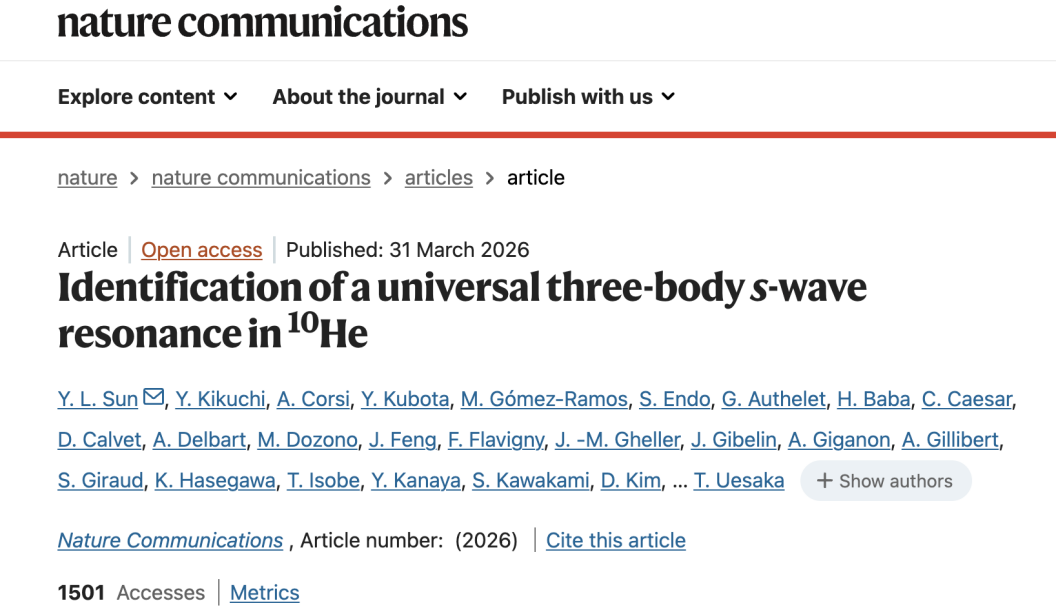
A research team led by Associate Professor Sun Yelei from the School of Physics at Beihang University, in collaboration with international partners, has identified for the first time a universal three-body s-wave resonance in a neutron-rich ¹⁰He nucleus.
The findings were published in Nature Communications under the title "Identification of a universal three-body s-wave resonance in ¹⁰He." This work fills a critical gap in the study of universal few-body phenomena in nuclear physics and opens a new avenue for research into strongly correlated quantum few-body systems.
Universality in physics describes the emergence of common features in vastly different systems. One fascinating example is the Efimov phenomenon where three-body resonantly interacting systems display universal properties. Efimov states have been observed in ultra-cold-atom systems, but their manifestation in nuclei remains elusive due to the long-range repulsive Coulomb interaction and the stringent requirement for at least two s-wave resonances in its subsystems. Recent theories propose another universality in three-body halos with only one s-wave resonance.
In the research, the authors report the identification of a precursor of this phenomenon in a neutron-rich ¹⁰He nucleus. With higher statistics and better sensitivities than previous experiments, they identify two low-lying 0+ states of ¹⁰He at ~ 1 MeV and ~ 2 MeV above its two-neutron decay threshold, and determine an s-wave scattering length of ~ − 3.5 fm between ⁸He and neutron. It is revealed that the lower energy state, the ground state of ¹⁰He, is a three-body state with only s-wave interactions among its subsystems. This state manifests as a resonance structure, which is a direct consequence of a universal long-range three-body repulsion. The work sheds new light on quantum halos with finite lifetimes, providing a path toward their unified understanding across various scales and fields.
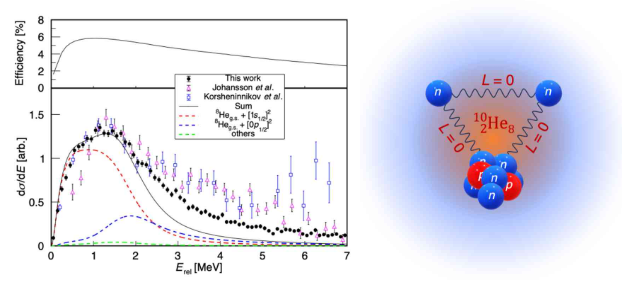
Figure 1. Three-body s-wave resonance structure of ¹⁰He
Sun Yelei is the first author and corresponding author of the paper. The collaboration includes 22 universities and research institutions worldwide, among which are the Technische Universität Darmstadt (Germany), Université Paris-Saclay (France), RIKEN Nishina Center (Japan), the University of Tokyo (Japan), Tokuyama University (Japan), the University of Electro-Communications (Japan), and the Universidad de Sevilla (Spain).
The work was supported by the National Natural Science Foundation of China, the Fundamental Research Funds for the Central Universities, and other grants.
Link to the article: https://www.nature.com/articles/s41467-026-71138-z
Editor: Lyu Xingyun


 Beihang News2026 Symposium on Excellent Engineer Training held in BeijingMore
 Beihang NewsProfessor Liu Mingjie's team publishes article in Science, revealing high-modulus toughening mechanism in nacreMore
 Beihang NewsWang Yunpeng appointed Secretary of the CPC Beihang University CommitteeMore
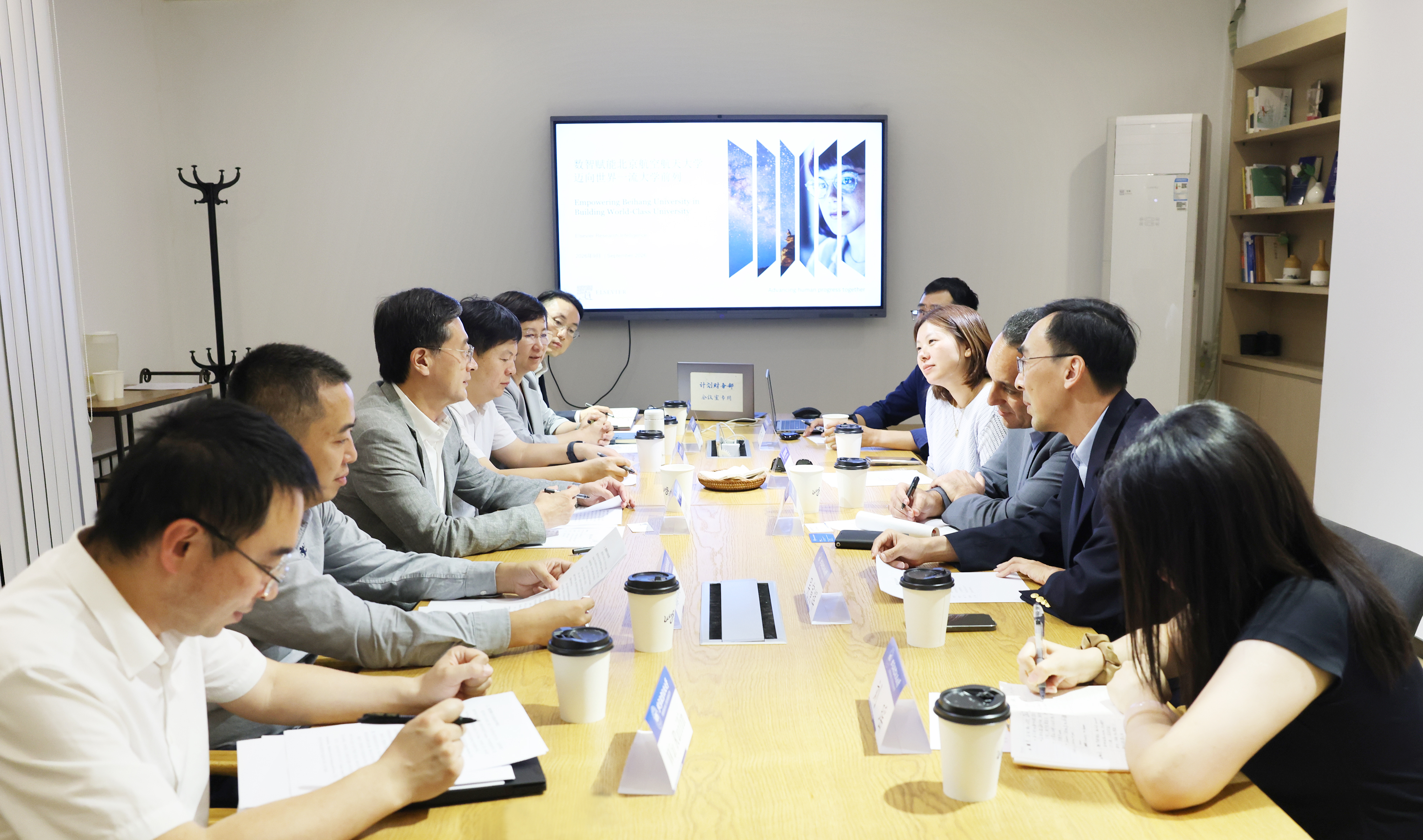 Beihang NewsElsevier Senior Vice President Said Taha visits Beihang UniversityMore
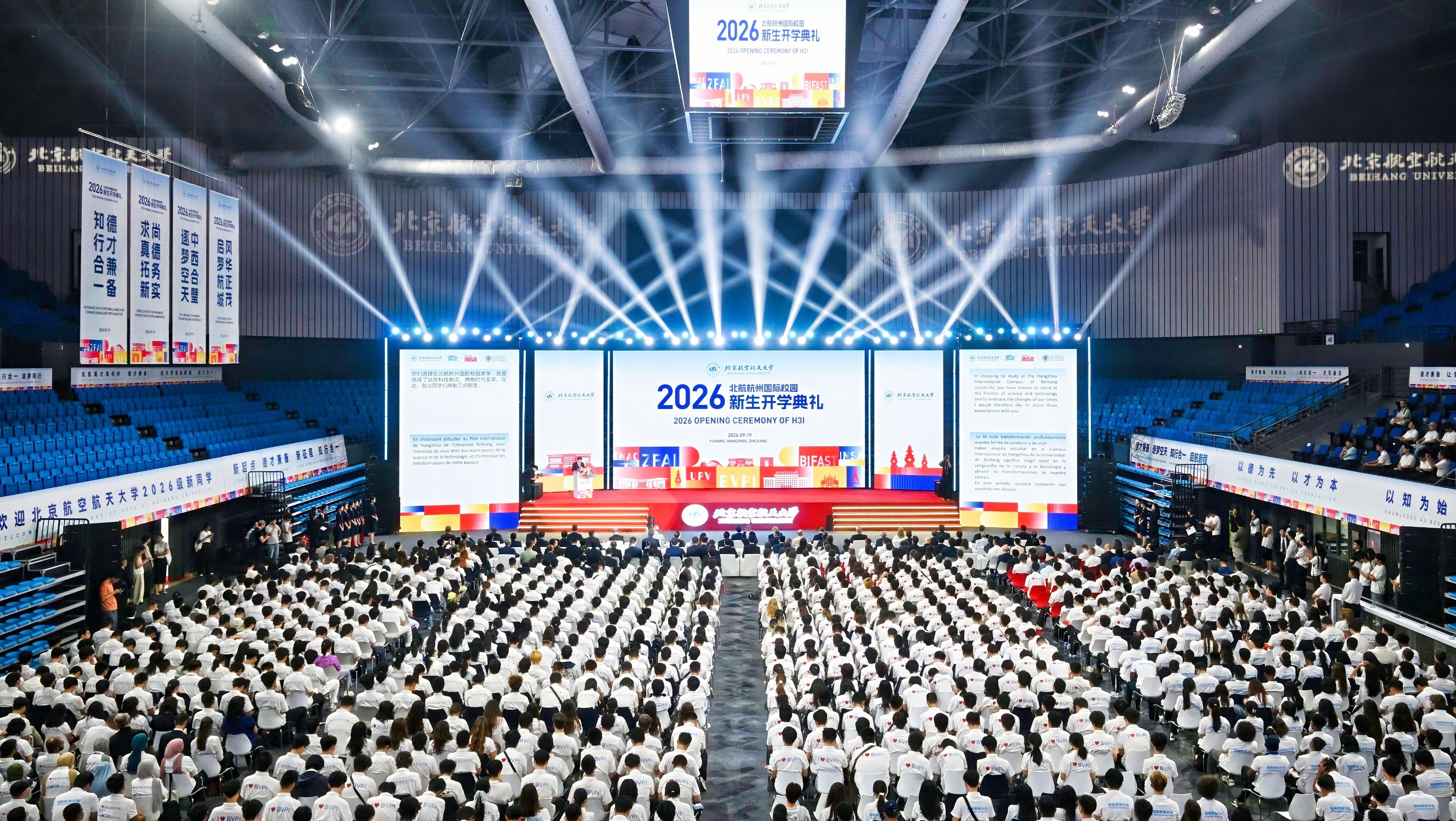 Beihang NewsPresident Wang Yunpeng visits Hangzhou to advance university-city integration and attends opening ceremony of H3IMore
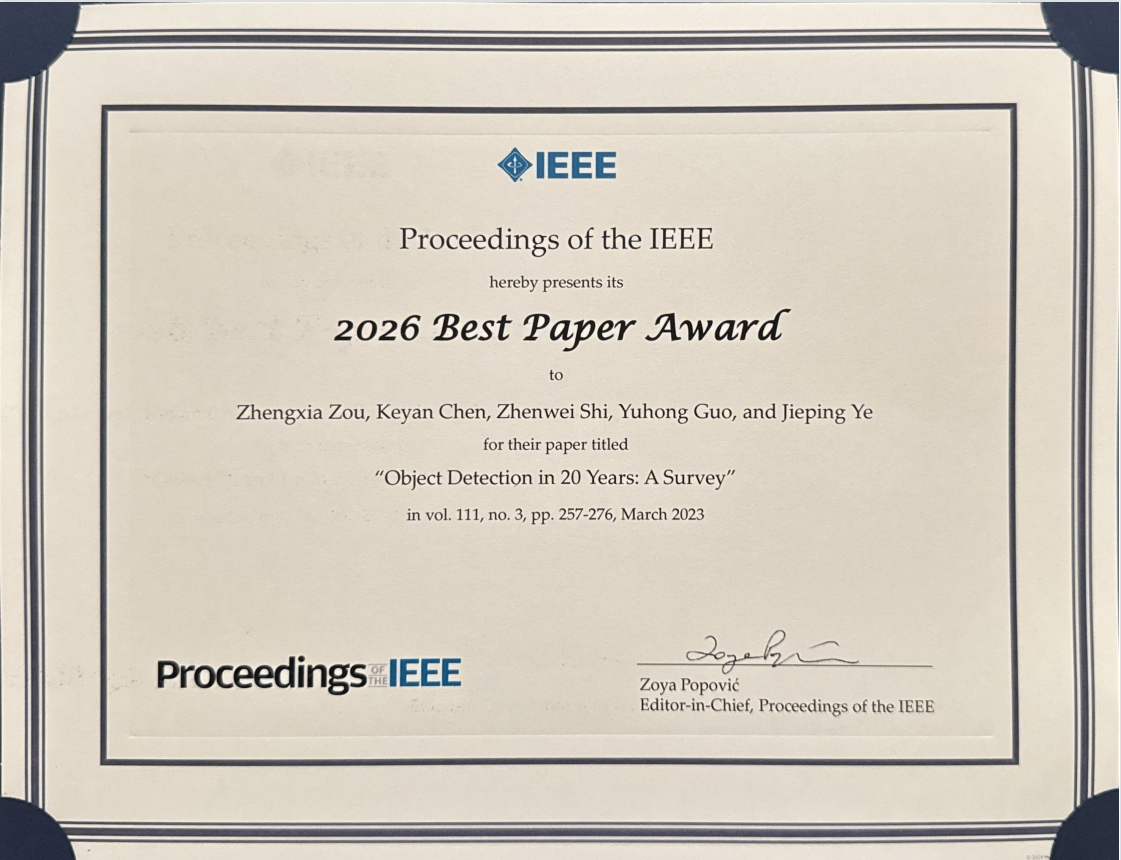 Beihang NewsBeihang team wins 2026 Best Paper Award from Proceedings of the IEEEMore