Geometrically frustrated spin systems offer an ideal platform for uncovering novel states of matter, such as quantum spin liquids and spin ices, and represent a key frontier in condensed matter physics. A research team led by Professor Kan Zhao from the School of Physics, Beihang University, in collaboration with researchers from the Institute of Physics and the Institute of Theoretical Physics of the Chinese Academy of Sciences (CAS), Southern University of Science and Technology (SUST), and Huazhong University of Science and Technology (HUST), has discovered field-driven Ising supercriticality and universal magnetocaloric effects in the spiral antiferromagnet Nd3BWO9.
This work extends the classical gas-liquid supercritical concept to frustrated quantum magnetic systems and opens a new pathway for ultra-low-temperature solid-state magnetic refrigeration. The related findings, titled "Ising Supercriticality and Universal Magnetocalorics in Spiral Antiferromagnet Nd3BWO9," were published in Physical Review Letters (PRL) and selected as an Editors' Suggestion.
Rare-earth magnets are particularly compelling, in which the interplay of geometric frustration and quantum fluctuations can give rise to a rich landscape of exotic spin states. Recently, a new family of rare-earth compounds with stacked kagome layers, RE3BWO9 (RE=Pr-Sm, Gd-Ho), featuring a hexagonal distorted kagome layered structure, serves as an important material platform for studying geometrically frustrated magnetism.
The research team had previously observed antiferromagnetic ordering and critical-behavior-induced giant magnetocaloric effects in the Gd3BWO9 system [Phys. Rev. Mater. 9, 094407 (2025)]. Nd3BWO9, which exhibits strong Ising anisotropy and strong spin frustration, displays a helical Ising antiferromagnetic spin structure and rich field-induced phase transitions, making it an ideal system for investigating field-driven magnetic transitions and critical phenomena. Using the flux method, the team grew large, high-quality single-crystal samples of Nd3BWO9 and performed detailed magnetic and thermodynamic measurements with the magnetic field applied along the c-axis.
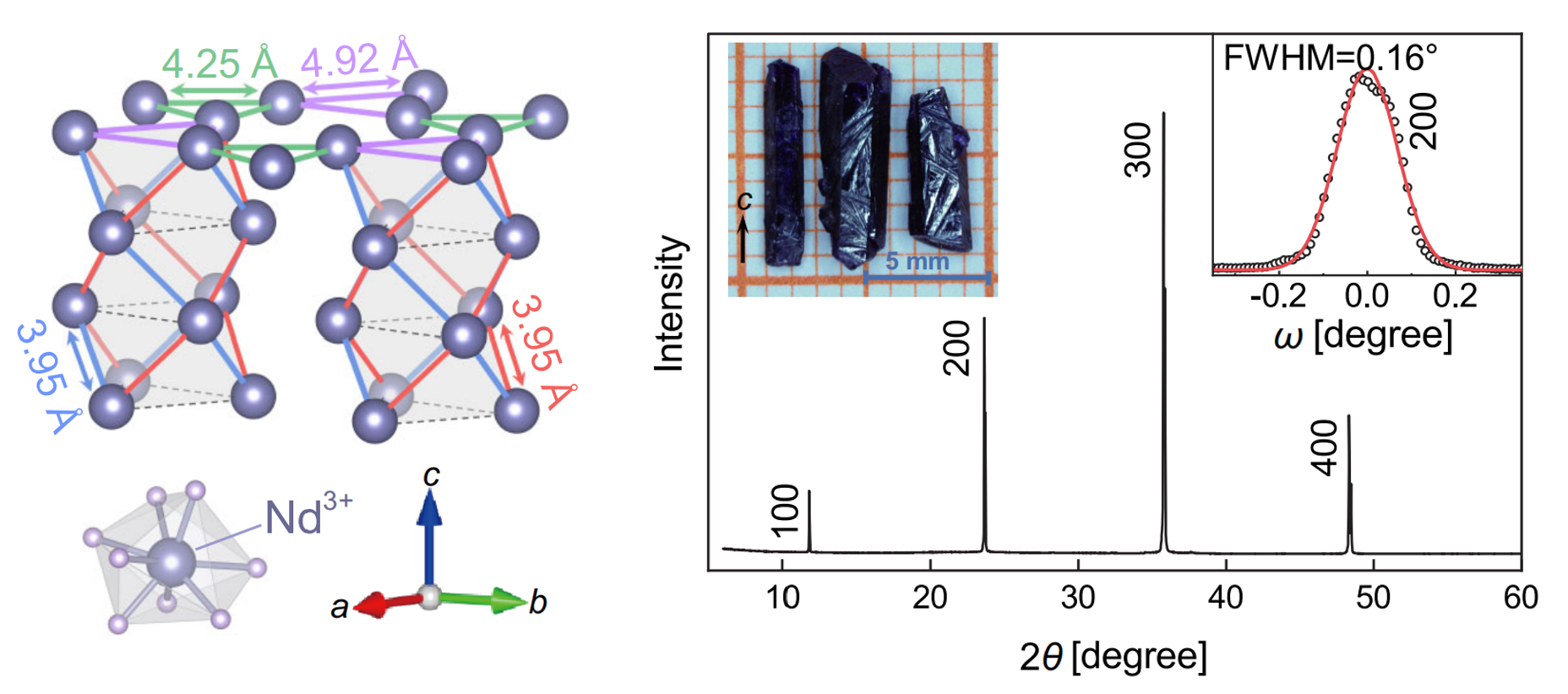
Fig.1 Crystal structure, single-crystal photograph, and X-ray diffraction pattern of Nd3BWO9
The team identified a field-driven phase transition line in the magnetic field-temperature phase diagram of Nd3BWO9, with a critical endpoint (CEP) corresponding to a critical field of approximately 1.04 T and a critical temperature of approximately 0.3 K. Above the CEP, an Ising supercritical regime emerges with crossover lines that follow a universal scaling law, as evidenced by the specific heat, magnetic susceptibility, and magnetocaloric measurements. Adiabatic demagnetization from 2 K and 4 T reaches a minimum temperature of 195 mK, via a self-cascading process that combines supercritical and topological cooling. Nd3BWO9 exhibits a high entropy density, and the supercritical magnetocaloric effect and self-cascade refrigeration mechanism demonstrated in the Ising antiferromagnet Nd3BWO9 provide new insights for magnetic refrigeration technology.
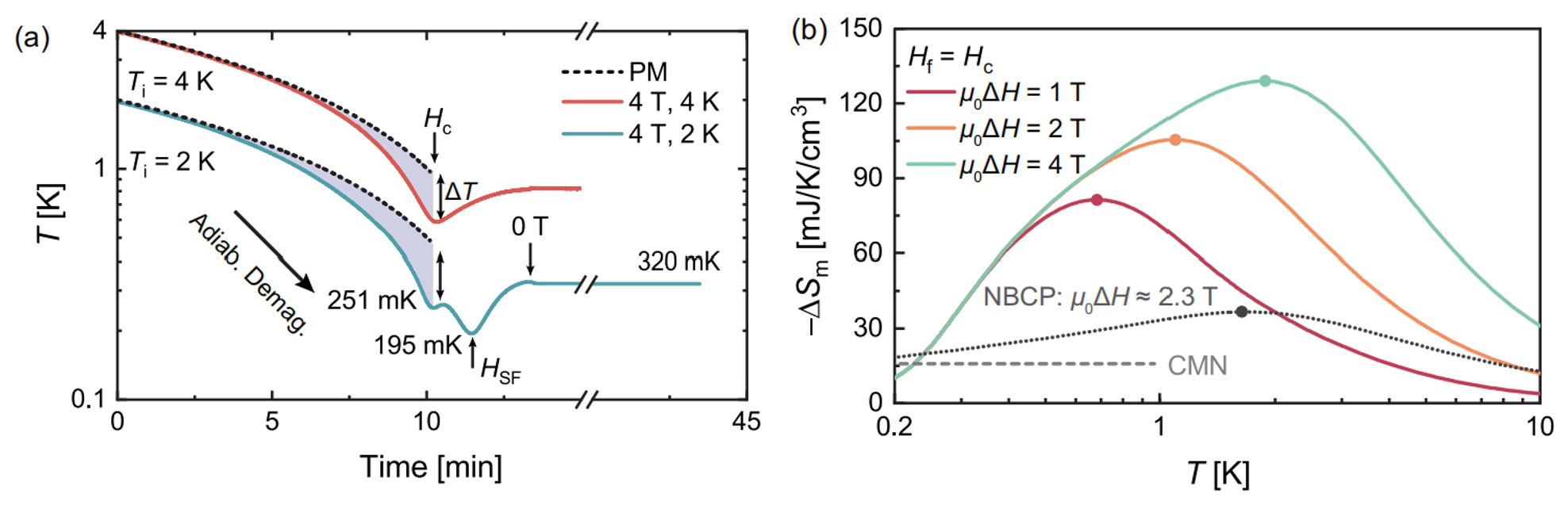
Fig.2 Adiabatic demagnetization curves and magnetic entropy change curves of Nd3BWO9 under Hc
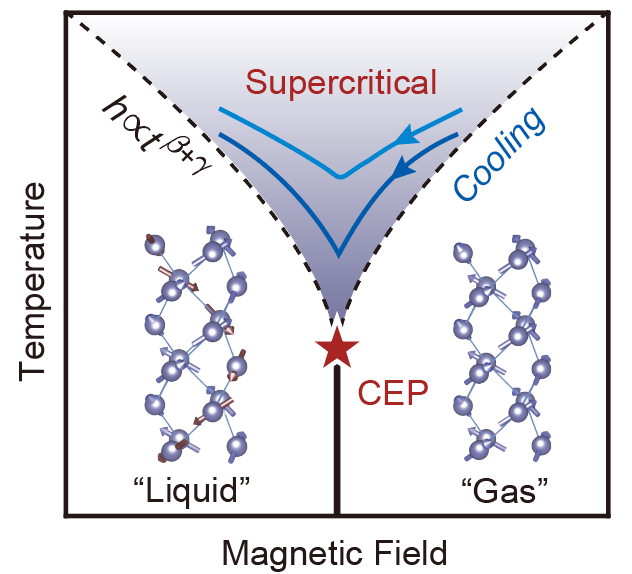
Fig.3 Schematic temperature–magnetic field phase diagram of the Ising antiferromagnet Nd3BWO9
The co-first authors of the paper are Liu Xinyang from the School of Physics and Peng Huanwu Collaborative Center for Research and Education, Beihang University; Lyu Enze from the Institute of Theoretical Physics, CAS; Cui Xueling from the School of Physics, Beihang University; and Ge Han from the Department of Physics, SUST. Professor Zhao Kan from the School of Physics, Beihang University; Associate Researcher Xiang Junsen from the Institute of Physics, CAS; Researcher Sun Peijie from the Institute of Physics, CAS; and Researcher Li Wei from the Institute of Theoretical Physics, CAS are the co-corresponding authors. Collaborators also include Professors Song Fangyuan and Tian Zhaoming from HUST, as well as Researcher Su Gang from the Institute of Theoretical Physics, CAS. This work was supported by the National Key Projects for Research and Development of China, the National Natural Science Foundation of China, the Beijing Natural Science Foundation, the Fundamental Research Funds for the Central Universities, and other funding sources, as well as the Analysis & Testing Center at Beihang University.
Article link: https://journals.aps.org/prl/abstract/10.1103/nqcw-pz8v
Editor: Liu Tingting


 Beihang NewsBeihang celebrates 42nd Teachers' DayMore
 Beihang NewsBeihang's first student-designed human-powered aircraft completes test flightMore
 Beihang NewsBeihang leaders engage in dialogue with new undergraduate and graduate student representativesMore
 Beihang NewsBeihang University holds 2026 opening convocation to welcome new studentsMore
 Beihang NewsBeihang University welcomes 9,022 new graduate studentsMore
 Beihang NewsProfessor Yu Shui wins Best Screenplay Award at 21st Changchun Film FestivalMore