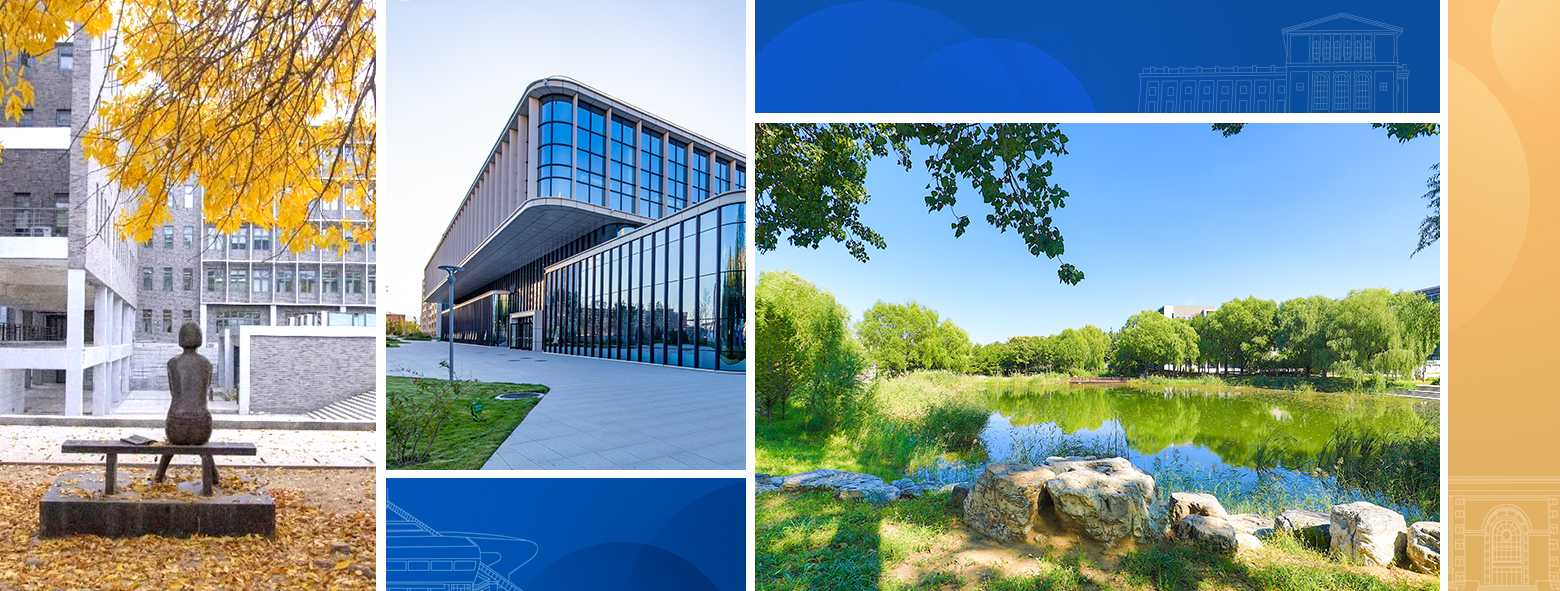
The School of Mathematical Sciences at Beihang University was established in December 2008, following its separation from the School of Science, and was officially inaugurated on June 1, 2009. This initiative was part of Beihang's strategic vision to build a world-class university featuring the comprehensive integration of "Science, Engineering, and Humanities" and the distinctive synergy of "Aeronautics, Astronautics, and Information." Over the decades, the School has cultivated numerous outstanding talents with a strong foundation in mathematics and science. Its establishment marked a significant transition for the mathematics discipline at Beihang—evolving from a teaching-focused unit in its early days to a research-oriented school that balances teaching and research. Today, the School stands as a critical force in training innovative talents and supporting Beihang's development into a world-class university.
School of Mathematical Sciences



Study
The School consists of four departments, including the Department of Fundamental Mathematics, the Department of Applied Mathematics, the Department of Computational Mathematics, and the Department of Statistics and Operations Research.
The School also houses several research institutes and laboratories, including MOE International Joint Laboratory, MOE Research Center for the Digitization of Education Equipment, and Beihang University International Research Center for Complex Systems and Scientific Computing.
The School has achieved significant milestones, including: approval of the MOE Applied Mathematics Innovation Team in 2010, approval of the "National Basic Discipline Top-notch Student Training Plan 2.0" for the Hua Luogeng Mathematics Top-notch Student Training Base, and establishment of "reform of the Training Model for Top Mathematics Students (Hua Luogeng Mathematics Experimental Class) Virtual Teaching and Research Office."
Since obtaining Beihang University's first doctoral program in Pure Mathematics (the first doctoral program in science at the university) in 2003 and establishing the Ministry of Education Key Laboratory of Mathematics, Information, and Behavior, the School of Mathematical Sciences has, after two decades of persistent effort, developed a comprehensive academic system. This system includes doctoral programs and postdoctoral research stations in both Mathematics and Statistics. The School has successfully attracted and cultivated numerous national-level academic leaders and young high-caliber talents. It emphasizes discipline development as its foundation, consolidates talent cultivation as its core mission, deepens administrative reforms, broadens its global perspective, actively pioneers new academic frontiers, and strives to establish peaks of excellence within its fields.
Guided by the development philosophy of "mainstream integration with distinctive features," the School leverages Beihang's strengths in the interdisciplinary integration of Aeronautics, Astronautics, and Information to focus on key challenges and core issues. It has successfully built several internationally influential academic teams and talent cultivation bases in interdisciplinary fields such as Computational Mathematics and Applied Mathematics. In alignment with the university's positioning and development strategy, the School has established six prominent research directions within Mathematics: Algebra and Geometry; Equations, Analysis, and Dynamical Systems; Scientific Computing; Operations Research and Optimization; Information Security and Computational Mathematics; and Information Mathematics and Intelligent Foundations. The Statistics discipline focuses on four distinctive areas: Mathematical Statistics, Applied Statistics, Biostatistics, and Financial Statistics. Each sub-discipline is led by esteemed academic leaders with deep expertise and rigorous attitude of scholarship.
The School remains committed to advancing the development of its disciplines, contributing to the nation's demand for high-quality talents in Mathematics and Statistics.
Talent cultivation is the School's highest priority. Adhering to the undergraduate education philosophy of "strengthening fundamentals, emphasizing practice, prioritizing quality, and fostering innovation," the School focuses on elite education, emphasizing rigorous training in mathematical theories and promoting the integration of Mathematics with Engineering and Technology. Its goal is to nurture high-caliber, versatile talents with solid mathematical foundations.
Key initiatives include:
• In 2009, the School established the "Hua Luogeng Class" in collaboration with the Academy of Mathematics and Systems Science, Chinese Academy of Sciences, to cultivate top mathematical talents.
• In 2020, the Mathematics and Applied Mathematics program was selected for China's Strengthening Basic Disciplines Program.
• In 2021, the Hua Luogeng Mathematics Experimental Class was included in the "Top-notch Student Training Program 2.0" for foundational disciplines, and the School introduced the "Two-Stage Dual-Line" integrated bachelor-to-doctorate training model for top students.
• In 2022, the Virtual Teaching and Research Office for the Hua Luogeng Mathematics Experimental Class was included in the first batch of national pilot programs for virtual teaching and research offices by the Ministry of Education and was recognized as a model virtual teaching and research office in 2023.
The School emphasizes the quality of graduate education, aligning its training with the latest international research trends, and has implemented reforms in teaching content and methods to encourage interdisciplinary innovation. It boasts a national-level teaching team and an innovative research team in applied mathematics recognized by the Ministry of Education. It offers eight national first-class undergraduate courses and three national exemplary courses. The School has earned one National Teaching Achievement First Prize, three Second Prizes, as well as three Beijing Municipal Teaching Achievement Special Prizes and three First Prizes.
Each year, the School enrolls approximately 110 undergraduate students, 65 master's students, and 35 doctoral students. Currently, it has 147 doctoral students, 132 master's students, and 316 undergraduates in residence. The School emphasizes cultivating high-caliber, multidisciplinary, and innovative talents. Undergraduate students have published high-quality research papers in prestigious mathematics journals such as Advances in Mathematics, Journal of Differential Equations, Pacific Journal of Mathematics, and Linear and Multilinear Algebra.
In recent years, a number of outstanding students have emerged, including:
- 24 recipients of the National Scholarship for Doctoral Students,
- 20 recipients of the National Scholarship for Master's Students,
- 2 winners of the Ministry of Education Academic Newcomer Award,
- 1 nominee for the Beijing Outstanding Doctoral Dissertation Award,
- 2 recipients of the Beijing Outstanding Graduation Design (Thesis) Award for Undergraduate Students,
- 4 winners of Beihang University's highest undergraduate honor, the Shen Yuan Medal (formerly the Gold Medal),
- 2 winners of the Beihang University May Fourth Youth Medal.
The School implements an integrated eight-year bachelor-to-doctoral training model for students in the Hua Luogeng Mathematics Experimental Class and the Strengthening Basic Disciplines Program. Approximately 35% of outstanding undergraduates from other majors are recommended each year for exemption from entrance exams to pursue master's or doctoral degrees. Additionally, around 10% of undergraduates opt to study abroad. The overall postgraduate enrollment rate for undergraduates exceeds 75%, with destinations including prestigious institutions such as École Normale Supérieure, the Max Planck Institute, the Chinese Academy of Sciences, Peking University, Tsinghua University, and Fudan University.
Graduates from the School possess a solid professional foundation, strong comprehensive abilities, and excellent adaptability, making them highly sought after by employers. The overall employment rate for undergraduates reaches 98% annually, while that of graduate students is 99%.
Faculty
The School boasts a robust faculty team of 80 full-time members, including 28 professors, 48 associate professors, and 4 lecturers. Among them, 39 are doctoral supervisors. The faculty includes nine recipients of national-level talent programs and three Beijing municipal teaching masters. Over 98% of the faculty hold doctoral degrees, and 70% have had at least one year of overseas academic experience, forming a team with rigorous academic standards, a well-balanced structure in terms of age, academic background, and expertise, and a high level of internationalization.

Research
The School of Mathematical Sciences at Beihang University prioritizes cutting-edge and forward-looking research, addressing critical national strategic needs. It proactively plans and undertakes large-scale, system-level projects, driving high-quality execution of major national initiatives. The School has established itself as a leading force in fundamental research within a high-level research university, focusing on organized research efforts aimed at addressing key national strategies and common industry challenges. In recent years, it has taken on significant projects such as the National Key Research and Development Programs, major projects funded by the National Natural Science Foundation of China, and initiatives under the Ministry of Science and Technology's Science and Technology Innovation 2030 Agenda. Over the past three years, the School has been awarded 66 national and provincial-level projects, with research funding amounting to nearly 70 million RMB.
Emphasizing a results-driven approach, the School has consistently produced original, pioneering, and impactful research outcomes. Both the quantity and quality of academic publications have seen significant growth, with faculty and students publishing extensively in leading international journals in mathematics and statistics. The School has earned numerous prestigious awards, including the National Technology Invention First Prize, the Ministry of Education Natural Science First Prize, and the Ministry of Education Technology Invention First Prize. In collaboration with external partners, the school has also received over ten provincial and ministerial natural science awards. Furthermore, the School has obtained more than 30 patents, reflecting its commitment to innovation and intellectual property protection.


International Cooperation
The School places great emphasis on domestic and international collaboration. It has co-founded two international academic journals, Mathematical Biosciences and Engineering and Mathematics in Computer Science, in partnership with the American Institute of Mathematical Sciences and Springer, respectively. The School also collaborates with Nobel laureate Samuel Ting's AMS research team on projects involving large-scale data modeling and analysis in space particle physics. Regular academic exchanges are held, with the School inviting distinguished scholars from around the world to conduct research and deliver lectures.
The School actively promotes international exposure for its students. In recent years, many have pursued doctoral degrees at world-renowned institutions such as École Normale Supérieure, Paris Polytechnic Institute, Stanford University, and the University of California, Berkeley. The School also organizes annual summer programs, fostering partnerships with institutions such as Hong Kong Polytechnic University and Novosibirsk State University in Russia.
The School's flagship academic series, the Beihang Mathematics Forum, represents its highest-level platform for academic exchange. This comprehensive lecture series invites leading mathematicians from China and abroad, as well as influential figures in Chinese mathematics, to deliver talks on the forefront of modern mathematical research. The forum aims to enhance academic exchange, stimulate scholarly engagement, promote scientific innovation, and provide a robust platform for academic interaction among students and faculty across the university.

-

Tel: +86-10-61716720
-

Email:qidan@buaa.edu.cn
-

Address:School of Mathematical Sciences, Beihang University, Changping District, Beijing 102206, P.R. China