Recently, the team led by Professor Zhao Weisheng at the School of Integrated Circuit Science and Engineering, Beihang University, has made significant progress in the field of orbitronics. To address the two major challenges in orbitronic material systems—low writing efficiency and limited engineering compatibility—the team designed a highly efficient and magnetic tunnel junction (MTJ)-compatible Ru/W orbital torque bottom electrode, and successfully achieved picosecond electrical switching of MTJs using orbital torque. Compared with conventional spin-orbit torque magnetic memory devices (SOT-MTJs), the orbital torque magnetic memory devices (OT-MTJs) exhibit significantly reduced writing voltage, highly uniform writing electrode resistance, and further potential for reduced area overhead. This work advances orbitronics research from fundamental physical mechanisms toward practical applications, and was published in the top journal Science Bulletin under the title "Giant orbital torque-driven picosecond switching in magnetic tunnel junctions."
Research Background
Spin-orbit torque magnetic random-access memory (SOT-MRAM) technology is gradually maturing and moving toward industrialization, but it still faces numerous serious bottlenecks. Currently, both academia and industry commonly use β-W as the SOT writing electrode. Although it offers relatively high SOT efficiency, it suffers from issues such as high resistivity and thickness limitations, leading to high power consumption and poor uniformity in SOT-MRAM, and also restricting further optimization of the SOT-MRAM cell area.
As a research hotspot in recent years, orbitronics utilizes effects such as the orbital Hall effect (OHE) and orbital Rashba effect (OREE) to achieve charge-to-orbital angular momentum conversion. Due to its strong effects and wide range of material choices, the orbital torque writing electrode is considered a key candidate for solving the technical bottlenecks of SOT-MRAM. However, information in MRAM is stored in the ferromagnetic layer dominated by spin magnetic moments, and orbital angular momentum cannot directly interact with such spin moments. It requires strong spin-orbit coupling (SOC) materials to achieve orbital-to-spin conversion. Currently, the relatively low orbital-to-spin conversion efficiency and the poor compatibility of orbital torque material systems with MTJ structures are two challenges for orbitronics transitioning from fundamental research to applications.
Research Highlights
To address these challenges, Professor Zhao's team designed a novel Ru/W orbital torque writing electrode. This structure greatly enhances the orbital-to-spin conversion efficiency, achieving a high equivalent spin (orbital) Hall conductivity (Fig. 1).
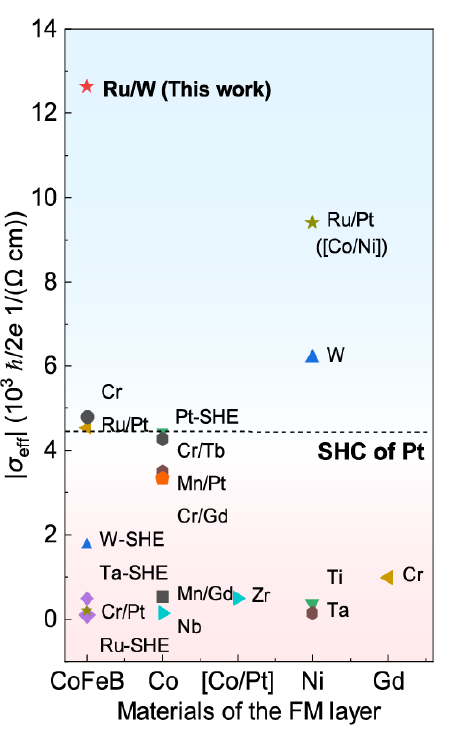
Fig. 1 Comparison of effective spin-orbit Hall conductivity σeff in Ru/W OT channel against other reported OT or SOT channels
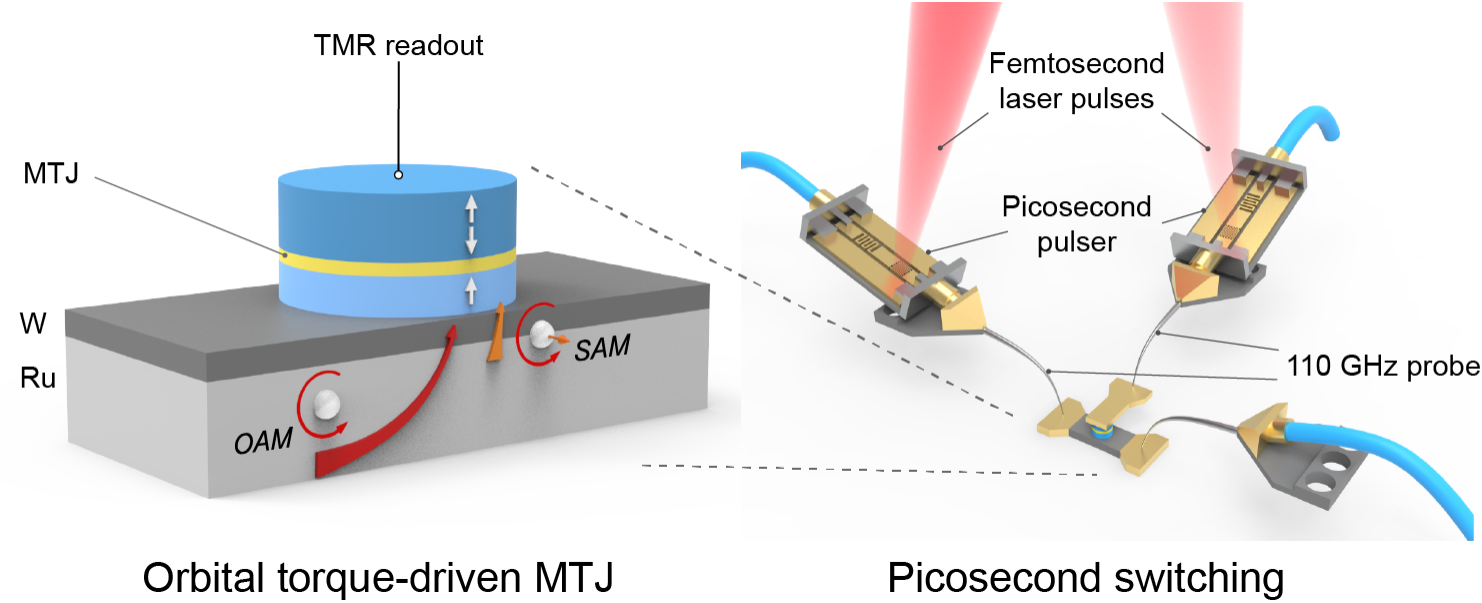
Fig. 2 Schematic of the OT-MTJ device and the experimental setup for picosecond switching
Based on the Ru/W orbital torque writing electrode, the team, in collaboration with Truth Memory Corporation (TMC), successfully fabricated high-performance MTJ devices (Fig. 2) using its 8-inch MRAM pilot line, confirming the excellent MRAM process compatibility of this material system. The researchers experimentally achieved switching of OT-MTJs by short pulses down to 28.7 ps, with picosecond-switching dynamics captured.
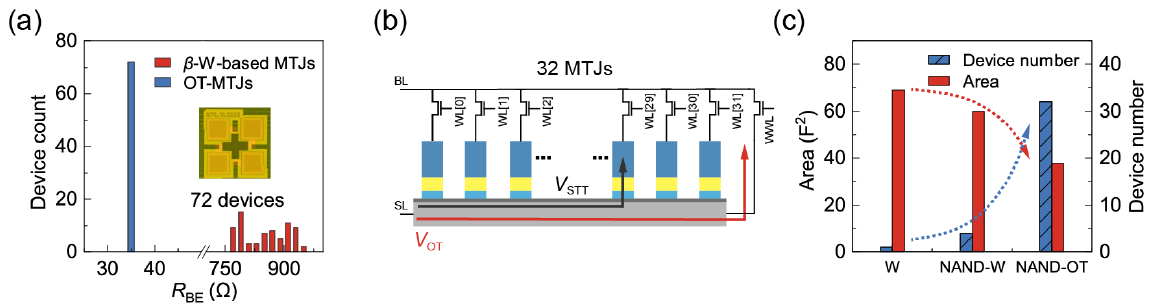
Fig. 3 Device uniformity and integration capability of OT-MTJs
Compared with conventional SOT-MRAM devices based on β-W electrodes, the orbital-torque-driven MTJs developed by Professor Zhao's team demonstrate outstanding device/array performance: the writing voltage is reduced to 1/5–1/8, and the bottom electrode uniformity is significantly improved (Fig. 3a), addressing the consistency challenge in large-area array manufacturing and enhancing chip yield. Furthermore, the orbital torque writing electrode provides high feasibility for NAND-like structures where multiple MTJ devices share a common writing electrode (Fig. 3b), enabling area reduction of up to 45% (Fig. 3c) and high-density storage integration.
This work not only validates a practical pathway for high-efficiency orbital torque and resolves two key bottlenecks in orbitronics, but also provides a novel technical route for the development of next-generation high-speed, high-density, low-power general-purpose magnetic memory chips.
Author Contributions
Postdoctoral Fellow Yao Yuxuan from the School of Integrated Circuit Science and Engineering, 2021 Ph.D. student Xiao Chen from the School of Integrated Circuit Science and Engineering, Postdoctoral Fellow Ning Xiaobai from the Hangzhou Innovation Institute, and Associate Professor Cai Wenlong from the School of Integrated Circuit Science and Engineering are co-first authors. Associate Professor Zhu Daoqian, CTO of TMC Liu Hongxi, and Professor Zhao Weisheng are co-corresponding authors. Beihang University is the primary affiliation. This work was supported by the National Key Research and Development Program of China, the National Natural Science Foundation of China, and the Beijing Municipal Natural Science Foundation.
Led by Professor Zhao Weisheng, the research team from the School of Integrated Circuit Science and Engineering has long focused on core research directions including SOT-MRAM mechanisms, materials, devices, and architectures. In recent years, the team has continuously produced high-impact results in top international journals and conferences such as Nature Electronics, Nature Communications, Physical Review Letters, and IEDM, forming a complete innovation chain from fundamental research to application verification in the field of magnetic memory. Founded in 2019, TMC has been deeply engaged in the field of spin-based memory chips, having built a comprehensive R&D system and independent process platform, holding multiple nationally certified core invention patents and the only 8-inch MRAM pilot line in China. The company has now signed an agreement with the Qingdao West Coast New Area and is constructing a next-generation memory chip production line.
Article link: https://doi.org/10.1016/j.scib.2026.07.019
Editor: Liu Tingting


 Beihang NewsBeihang celebrates 42nd Teachers' DayMore
 Beihang NewsBeihang's first student-designed human-powered aircraft completes test flightMore
 Beihang NewsBeihang leaders engage in dialogue with new undergraduate and graduate student representativesMore
 Beihang NewsBeihang University holds 2026 opening convocation to welcome new studentsMore
 Beihang NewsBeihang University welcomes 9,022 new graduate studentsMore
 Beihang NewsProfessor Yu Shui wins Best Screenplay Award at 21st Changchun Film FestivalMore