Professor Li Xiaoqiang's team from the School of Mechanical Engineering and Automation at Beihang University has made significant strides in the development of domestic industrial software for the aviation manufacturing sector. Their paper, titled "Fast simulation of incremental sheet metal forming by multi-tooling," was published in the Journal of Manufacturing Processes.
The study addresses the low computational efficiency of traditional single-tool simulations in Incremental Sheet Forming (ISF). By leveraging the localized deformation characteristics of the process, the new method reduces computation time by an order of magnitude.
Fast and precise numerical analysis is crucial for virtual process design in ISF to enable its effective industrial application. Reliable process simulation ensures a short lead-time advantage by guaranteeing the production of correct parts on the first attempt. Previous research shows that explicit finite element methods with mass or time scaling can reduce simulation time without compromising results. However, the simulation time remains significantly longer than the actual production time.
Keeping this in view, an approach of multi-tooling, which is rarely investigated, is focused on in this work to minimize the simulation time by utilizing the Abaqus software. The complete toolpath was split into equal segments, and one pair of tools was assigned to each segment. Instead of continuous movement in a single direction, as occurs in the case of single pair of tools, the tool was moving back and forth in the consecutive contours while moving simultaneously in the negative Z-direction in its designated segment. This concept was first trialed on the pyramid shape for sheet thickness variation, geometric precision, Mises stresses, equivalent strain, and forces. After verifying the model with the experimental results for some key quality attributes and simulation results based on single pair of tools (which was used as a reference computation as it represents the actual experiment), it was extended to a large industrial component with five pairs of tools in a double-sided incremental forming (DSIF) process and was compared with the reference computation.
The results acquired with multi-tools were in good agreement with experimental and reference computation while reducing the simulation time by more than 200%. The concept of multi-tooling, which is extensively studied in this work, can be easily implemented without adding a complex algorithm to the finite element model.
Building on these core technologies and through collaboration with C3P Engineering Software, the team has developed a suite of specialized finite element simulation software. This system includes modules for Skin Stretch Forming, Sheet Incremental Forming, Panel Peen Forming, and Tube Gas Blow Forming.
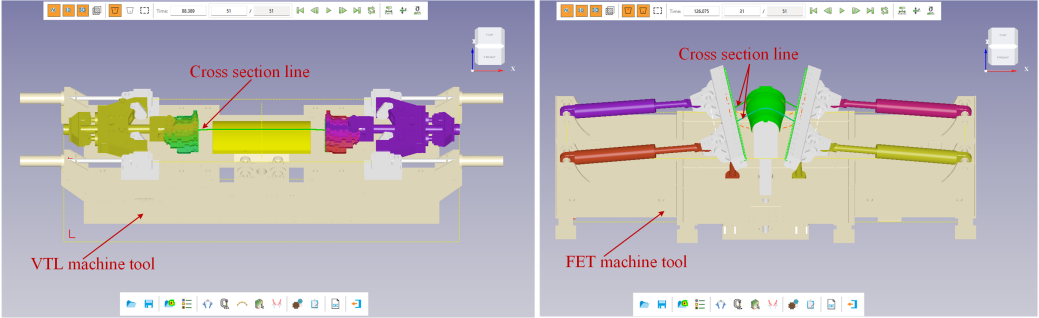
Skin Stretch Forming Simulation Software Interface
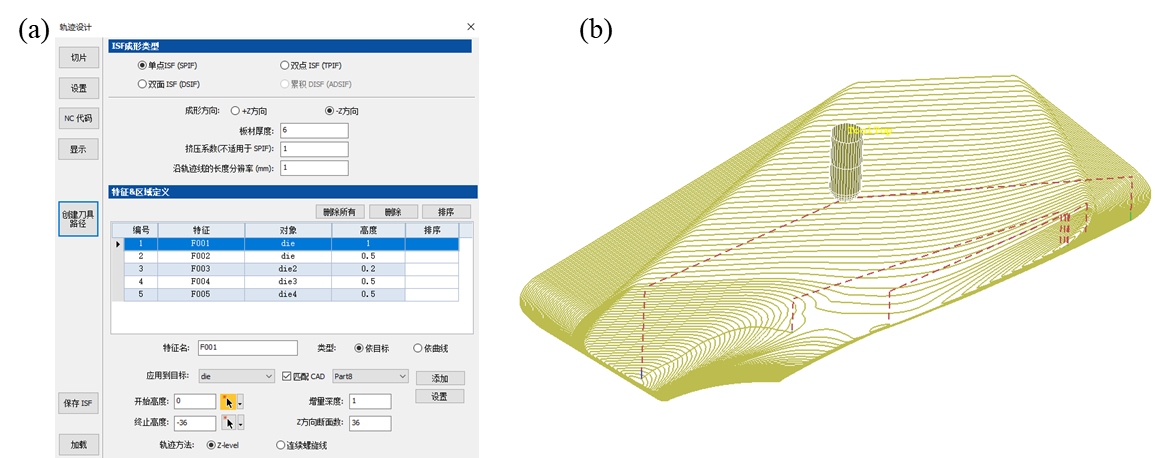
NC Incremental Forming Simulation Software Interface

Panel Peen Forming Simulation Software Interface
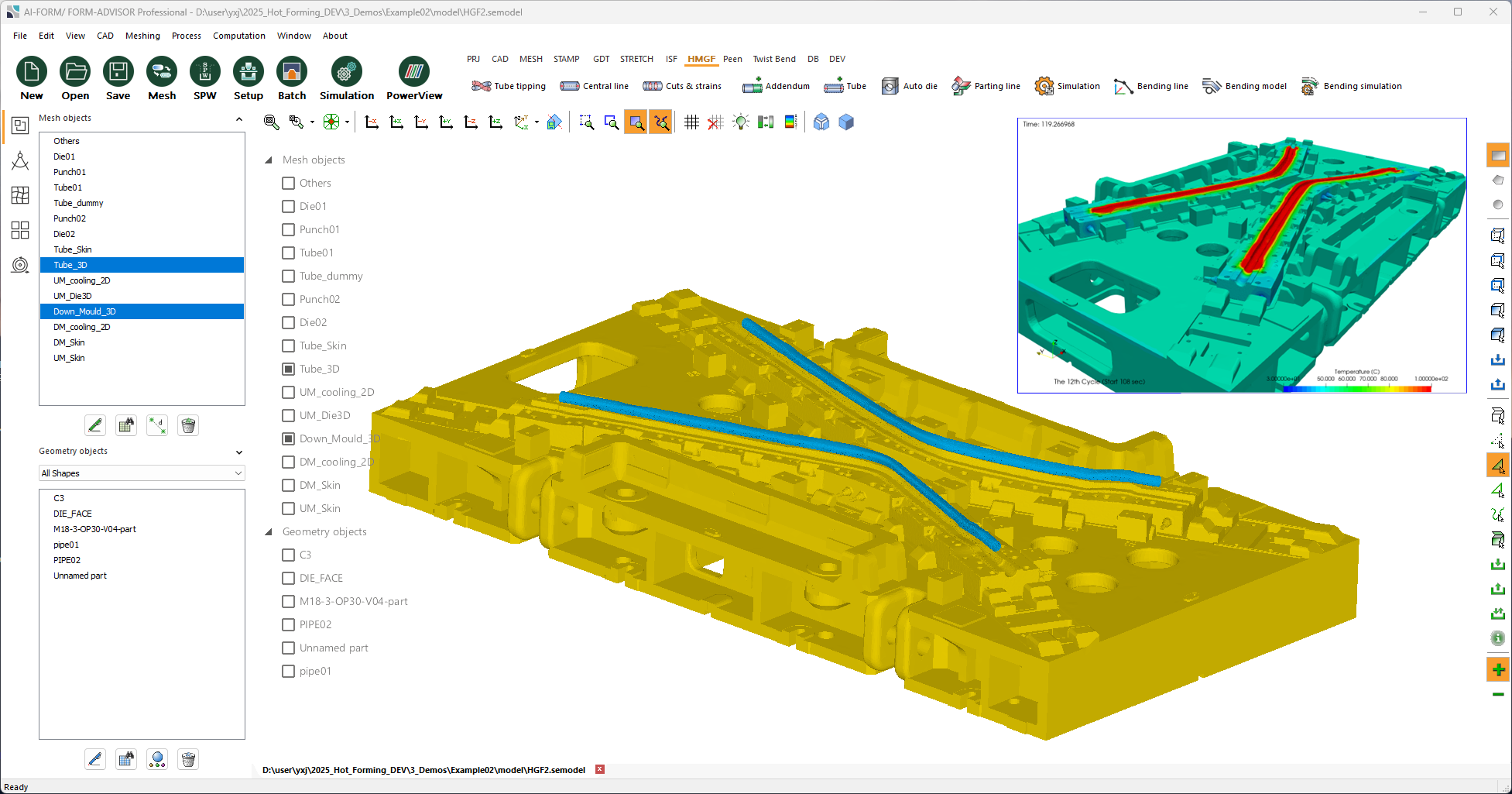
Tube Gas Blow Forming Simulation Software Interface
The software's impact is demonstrated by its global adoption, with applications in over twenty leading aerospace and industrial manufacturers worldwide. In recognition of this work, the Skin Stretch Forming Simulation Software was awarded the 2024 Second Prize for Scientific and Technological Progress in Mechanical Industry (Professor Li Xiaoqiang ranked second).
Link to the article: https://doi.org/10.1016/j.jmapro.2022.10.025
Editor: Lyu Xingyun


 Beihang News8th China Microelectronics Intelligent Conference convenes in BeijingMore
 Beihang NewsBeihang AI Knowledge Center debuts in MexicoMore
 Beihang News18th Enterprise Open Day successfully heldMore
 Beihang NewsProfessor Niu Jianwei elected as IEEE FellowMore
 Beihang NewsTen Beihang professors and alumni elected as CAS and CAE academiciansMore
 Beihang NewsProfessor Fan Ying named IAEE President-ElectMore