A research team led by Professor Wei Kai from the Quantum Science and Technology College and the Institute of Large-Scale Scientific Facility at Beihang University, in collaboration with partner institutions, has achieved a scientific breakthrough. The findings were published in the National Academy of Sciences (PNAS) on October 7, 2025, under the title "Search for a parity-violating long-range spin-dependent interaction."
The research utilized ultra-sensitive quantum spin measurement devices to precisely detect a potential "parity-violating interaction" in the universe, improving detection sensitivity by three orders of magnitude over previous methods and opening new pathways for exploring new physics beyond the Standard Model.
Parity-violating interactions mediated by exotic bosons could reveal physics beyond the Standard Model. The research develops a hybrid spin-resonance (HSR) atomic sensor with 700-fold vibration suppression, achieving three orders-of-magnitude sensitivity gain over prior limits. The measurements establish the strongest constraints on axial-vector couplings between nucleons (0.03–400 m range), resolving critical gaps in low-energy symmetry tests. By synchronizing nuclear-electron spin dynamics, this work advances quantum sensing for dark matter searches and exotic force detection, bridging atomic parity studies with new physics exploration through precision spin-interaction metrology.
High-sensitivity quantum sensors are a promising tool for experimental searches for beyond-Standard-Model interactions. Here, the research demonstrates an atomic comagnetometer operating under a resonantly-coupled hybrid spin-resonance (HSR) regime to probe P-odd, T-even interactions. The HSR regime enables robust nuclear-electron spin coupling, enhancing measurement bandwidth and stability without compromising the high sensitivity of spin-exchange relaxation-free magnetometers. To minimize vibration-related noise from velocity-modulated sources, the research team implements a multistage vibration isolation system, achieving a vibration-related noise reduction exceeding 700-fold, and establish new constraints on vector-boson-mediated parity-violating interactions, improving experimental sensitivity by three orders of magnitude compared to previous limits. The new constraints complement existing astrophysical and laboratory studies of potential extensions to the Standard Model.
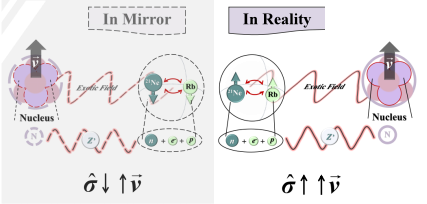
In the mirror-reflected framework, the spins exhibit inverted polarization compared to the physical reality, while the velocity does not, which leaves them parallel in reality and antiparallel in the mirror
After two years of debugging and testing, the research team collected over 100 hours of high-quality data. Analysis of this data set the most stringent experimental upper limit to date for a key coupling constant, improving detection sensitivity by three orders of magnitude compared to the previous international benchmark. This breakthrough not only significantly advances experimental constraints on parity-violating interactions but also covers a broad interaction range from 0.03 meters to 400 meters, filling a critical gap between astronomical observations and small-scale laboratory measurements. It provides indispensable experimental data for constructing a more complete physical picture.
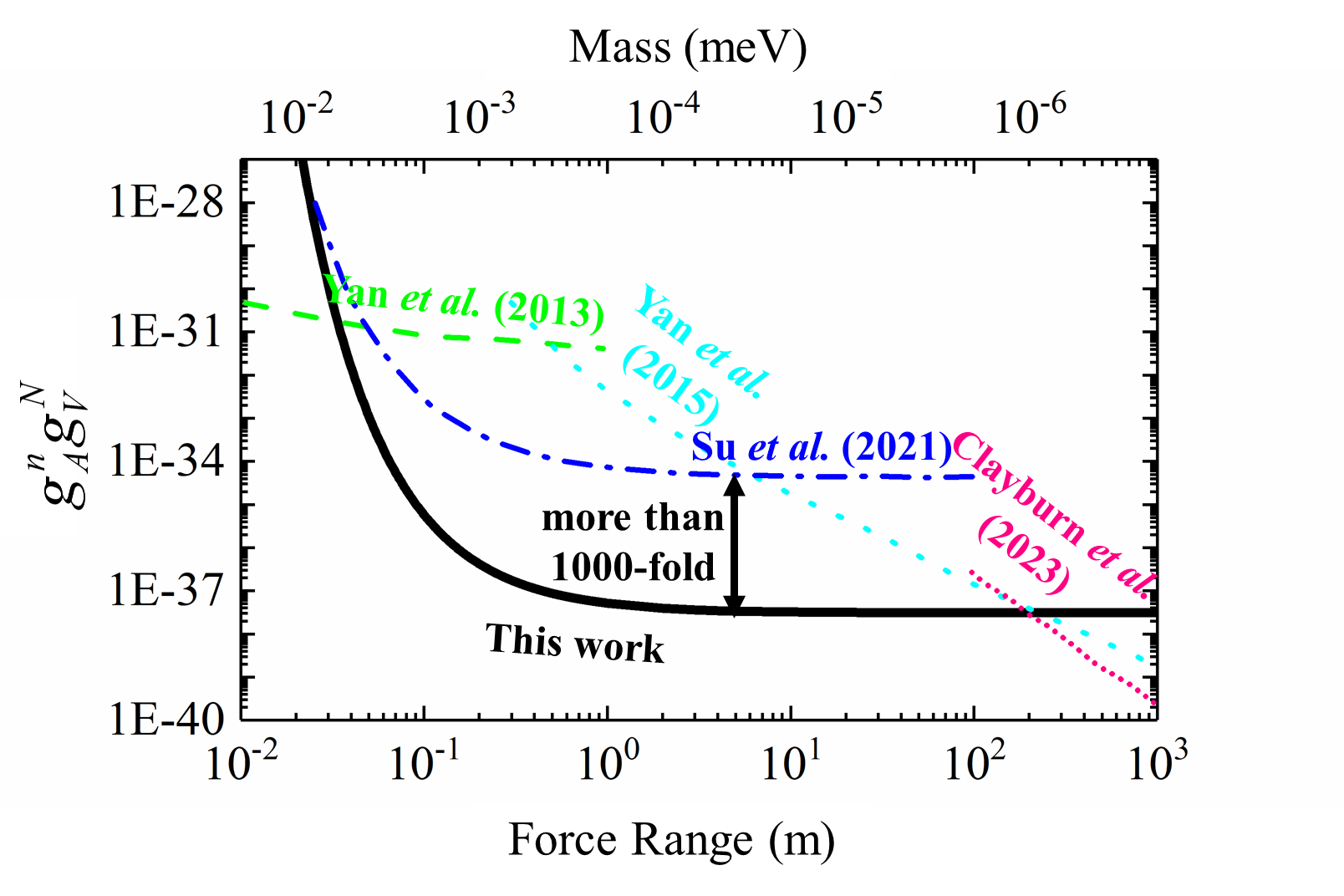
Measurement results of coupling coefficients at 95% confidence level, with comparisons to international peer studies
The first author of the paper is Heng Xing, a Ph.D. candidate at the Institute of Large-Scale Scientific Facility, Beihang University. The corresponding authors are Professor Wei Kai from the Institute of Large-Scale Scientific Facility, Beihang University and Assistant Professor Ji Wei from the School of Physics, Peking University. The research was guided by Professor Fang Jiancheng of Beihang University, and funded by the National Natural Science Foundation of China (NSFC), the Peking University Startup Fund, and the German Research Foundation (Deutsche Forschungsgemeinschaft, DFG).
Link to the article:https://www.pnas.org/doi/10.1073/pnas.2512538122
Editor:Liu Tingting


 Beihang News8th China Microelectronics Intelligent Conference convenes in BeijingMore
 Beihang NewsBeihang AI Knowledge Center debuts in MexicoMore
 Beihang News18th Enterprise Open Day successfully heldMore
 Beihang NewsProfessor Niu Jianwei elected as IEEE FellowMore
 Beihang NewsTen Beihang professors and alumni elected as CAS and CAE academiciansMore
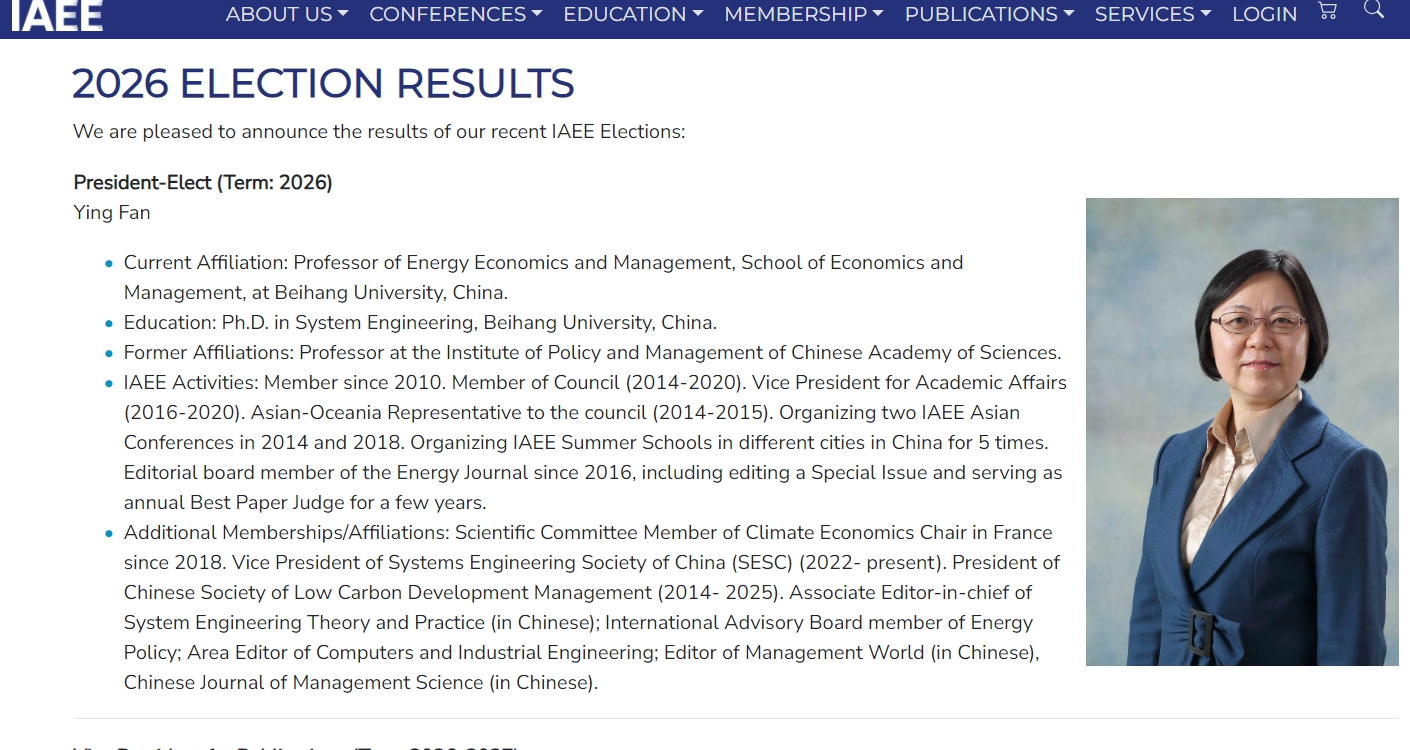 Beihang NewsProfessor Fan Ying named IAEE President-ElectMore