Recently, the research team led by Professor Wang Fan and Professor Zhong Xiaolan from the Nanophotonics Laboratory, School of Physics, Beihang University, has made significant progress in the field of energy conversion based on electron-ion modulation. The related findings, entitled "Photoenergy harvesting by ammonium molybdate soft hydrogel drops," have been published in Light: Science & Applications.
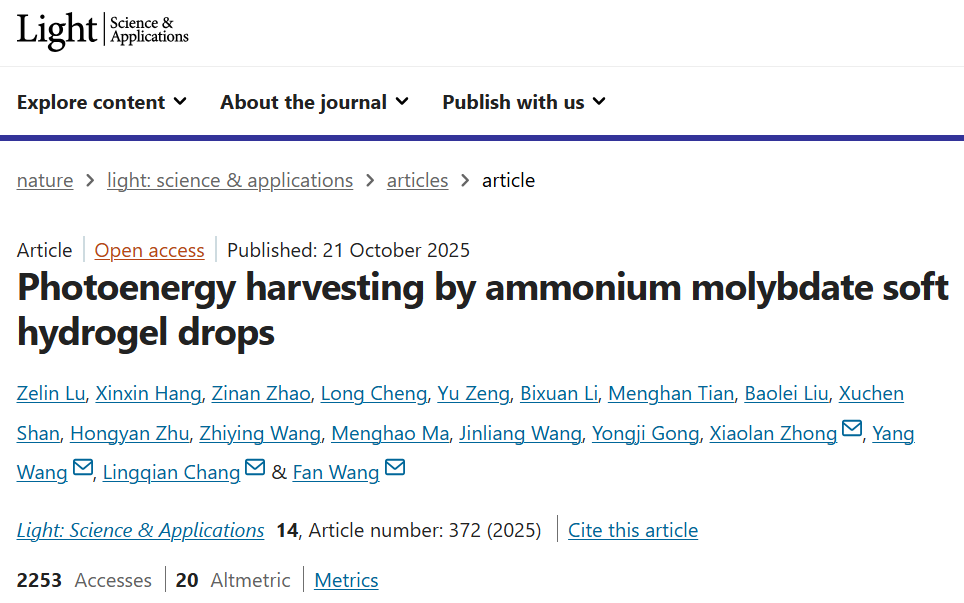
Photoenergy harvesting is promising to power Internet-of-Things (IoT) sensors, freeing the limitations of wired power sources or batteries, and enabling bio-integrated devices. However, existing photoenergy harvesting systems are restricted to solid or liquid configurations—limiting biocompatibility and space utilization—which makes obtaining flexible, biocompatible, light-harvesting devices a significant challenge.
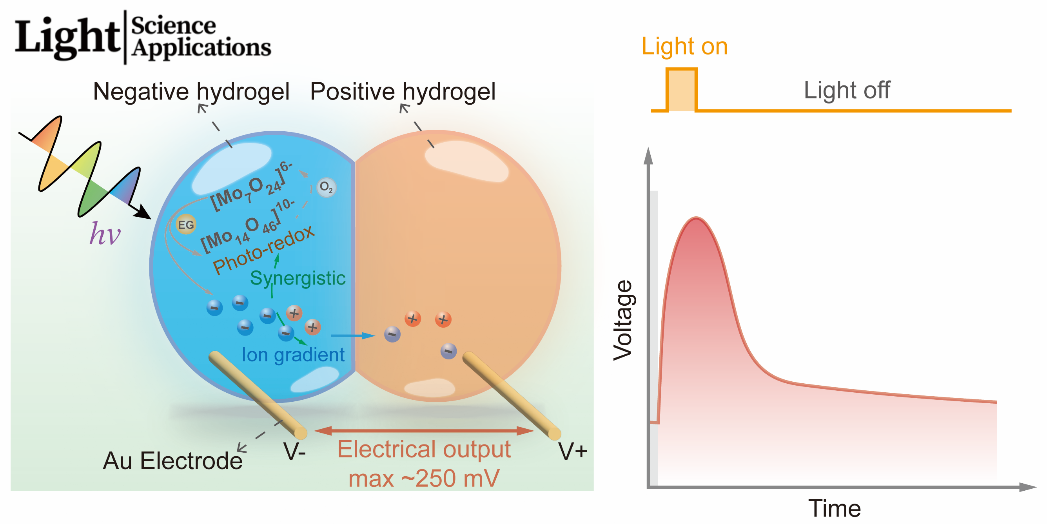
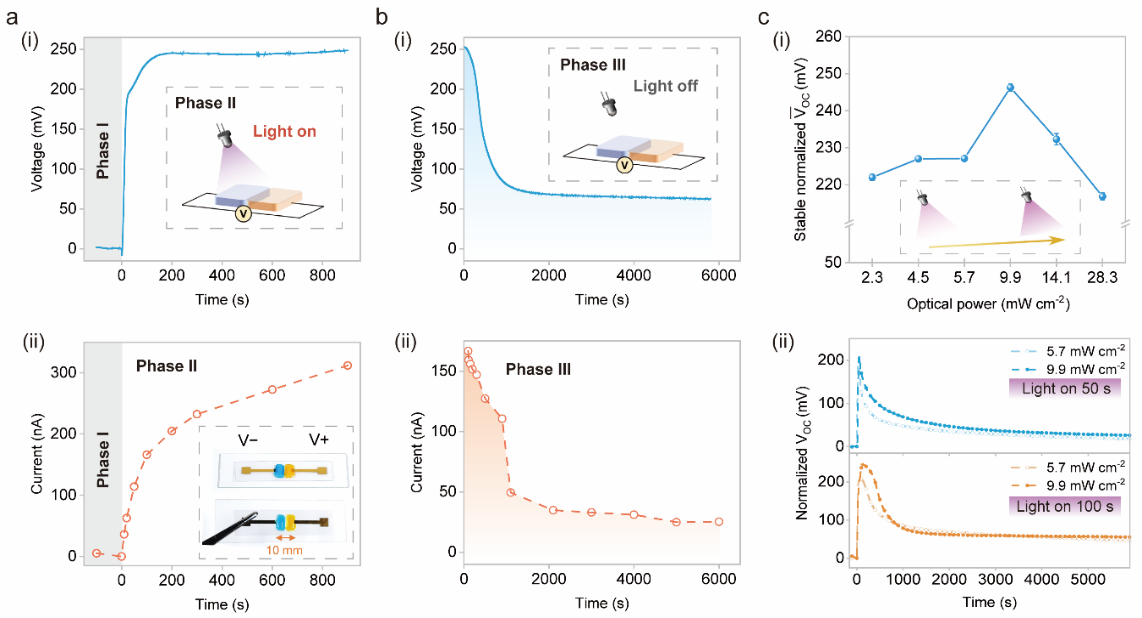
Inspired by energy conversion processes in natural biological systems, the research team has innovatively proposed an ion-hydrogel drops-based photoenergy harvesting device, offering a potential solution to this challenge. This technology generates electricity by utilizing light-induced ion gradients and changes in redox pairs, while the reversible hydrogel network enables the fabrication of arbitrary structures. Experimental results show that when exposed to excitation light, a photo-driven ammonium molybdate-hydrogel photoenergy harvester (PAPH) can generate an open-circuit potential of ~250 mV, and it can still obtain a considerable output power ranging from milliseconds to thousands of seconds after the termination of the initial illumination. The reversible hydrogel droplets network allows for the recovery and fabrication of arbitrary structures of the PAPH.
In collaboration with the team of Professor Chang Lingqian from the School of Biological Science and Medical Engineering, further research demonstrated that the scalable PAPH networks can regulate cell epithelial growth factor secretion and receptor expression on demand, stimulate cell proliferation, thereby facilitating biological tissue wound repair.
This ionic hydrogel opens a new avenue for flexible and biocompatible devices for photoenergy harvesting.
Zelin Lu, a Ph.D. student from the School of Physics, is the first author of the paper. Corresponding authors are Professor Zhong Xiaolan and Professor Wang Fan from the School of Physics, and Associate Professor Wang Yang and Professor Chang Lingqian from the School of Biological Science and Medical Engineering.
The research received support from the National Natural Science Foundation of China, the Beijing Natural Science Foundation, and others.
Link to the article: https://doi.org/10.1038/s41377-025-02016-4
Editor: Liu Tingting


 Beihang News8th China Microelectronics Intelligent Conference convenes in BeijingMore
 Beihang NewsBeihang AI Knowledge Center debuts in MexicoMore
 Beihang News18th Enterprise Open Day successfully heldMore
 Beihang NewsProfessor Niu Jianwei elected as IEEE FellowMore
 Beihang NewsTen Beihang professors and alumni elected as CAS and CAE academiciansMore
 Beihang NewsProfessor Fan Ying named IAEE President-ElectMore