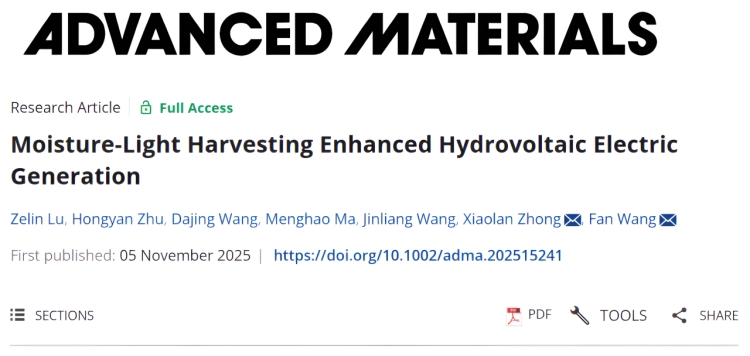
A research team led by Professors Wang Fan and Zhong Xiaolan from the School of Physics at Beihang University has achieved a significant breakthrough in energy conversion technology based on electron-ion modulation. Their work, titled "Moisture-Light Harvesting Enhanced Hydrovoltaic Electric Generation," has been published in the prestigious international journal Advanced Materials. The paper's first author is Lu Zelin, a doctoral student from the School of Physics, with Professors Zhong Xiaolan and Wang Fan serving as the corresponding authors.

Environmental energy conversion technologies hold immense potential in addressing the global energy crisis, offering viable solutions tomitigate the growing consumption of fossil fuels. Recently, emerging hydrovoltaic technology, which harvests electricity from ubiquitous atmospheric water vapor, has garnered widespread attention due to its clean and sustainable nature. However, the output power of individual devices remains limited, with most still operating in the range of tens of nanowatts (nW) to a few microwatts (µW). Moreover, traditional single-mode energy harvesters face challenges in environmental adaptability.
Inspired by multi-source energy synergy in ecosystems, the research team proposed a novel strategy combining hygroscopic polyelectrolyte material with light-responsive BiOBr nanosheets to create a moisture-light harvesting electric generator (MLEG). They utilized the PSS/AMPS-Na/PVA/BiOBr (PAPBO) composite as the flexible active layer, achieving highly efficient hydrovoltaic power output. Additionally, due to the incorporation of BiOBr, long-lived holes are generated through light harvesting, which further enhances the output performance through water oxidation.
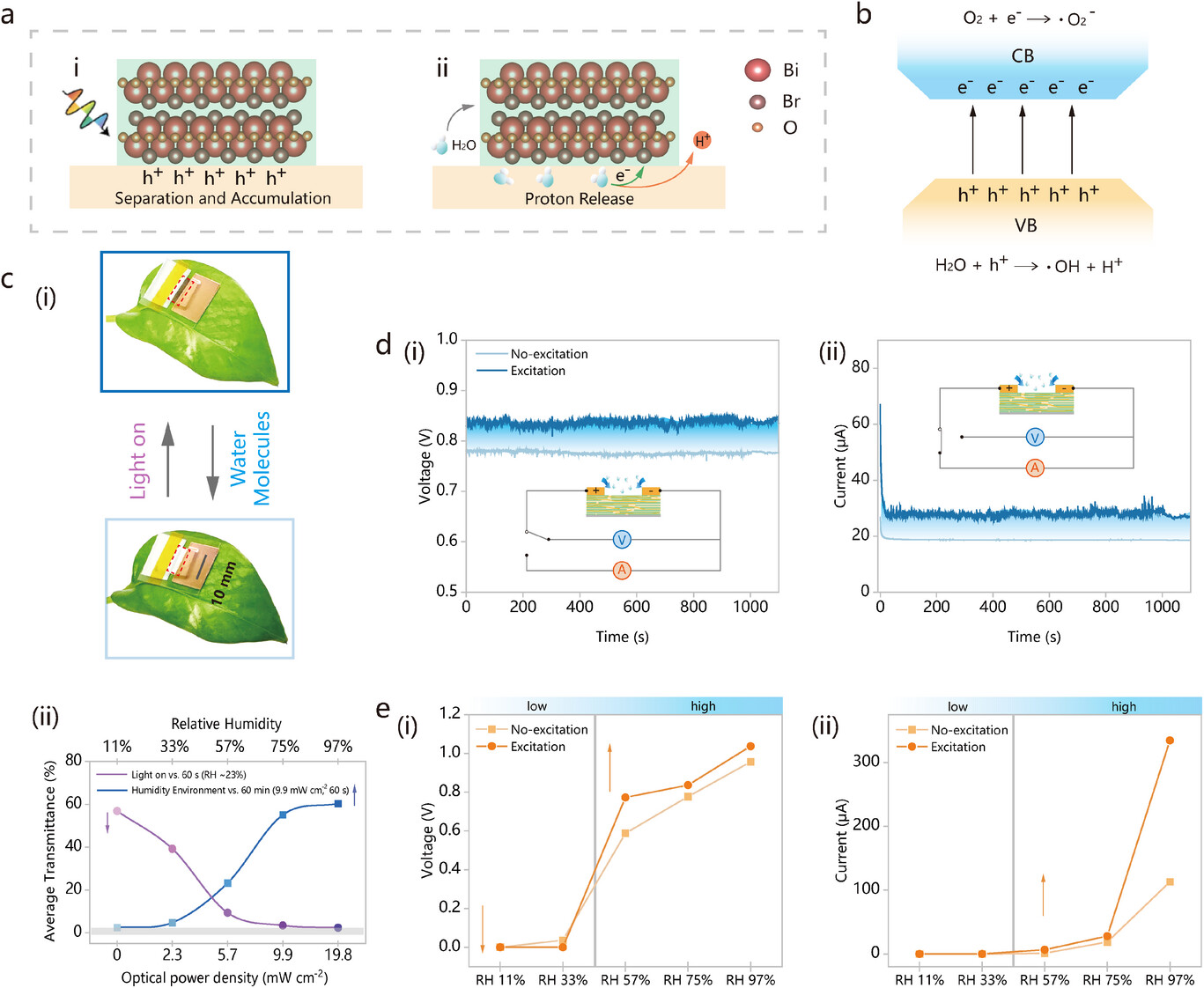
The light harvesting mechanism and enhanced performance of MLEG
When exposed to an environment with 75% relative humidity, a single MLEG delivers a substantial open-circuit voltage of 0.77 V and a short-circuit current of 18.73 µA. After the MLEG harvests light energy, the consumption of holes by water molecules generates additional hydrogen ions, resulting in a 60.98% increase in output power density (from 72.75 to 117.11 µW cm−2). The device can also function as a humidity sensor, responding to humidity levels from 10% to 100%.

The expansion and application prospects of MLEG
Beyond its core energy harvesting function, the MLEG showcases excellent scalability and application prospects. Its flexible, network-expandable design allows for customization in size and configuration to meet diverse needs. This makes it a promising candidate for applications such as self-powered electronic skins, health monitoring sensors, and environmental sensing systems.
This work presents a straightforward strategy for designing multi-environmental energy harvesting devices, enhances the understanding of light-responsive materials for boosting hydrovoltaic power generation, and contributes to the sustainable, green, and high-quality development of multifunctional hydrovoltaic technology.
This research was supported by the National Natural Science Foundation of China and the Beijing Natural Science Foundation.
Link to the full article: https://doi.org/10.1002/adma.202515241
Editor: Lyu Xingyun


 Beihang News8th China Microelectronics Intelligent Conference convenes in BeijingMore
 Beihang NewsBeihang AI Knowledge Center debuts in MexicoMore
 Beihang News18th Enterprise Open Day successfully heldMore
 Beihang NewsProfessor Niu Jianwei elected as IEEE FellowMore
 Beihang NewsTen Beihang professors and alumni elected as CAS and CAE academiciansMore
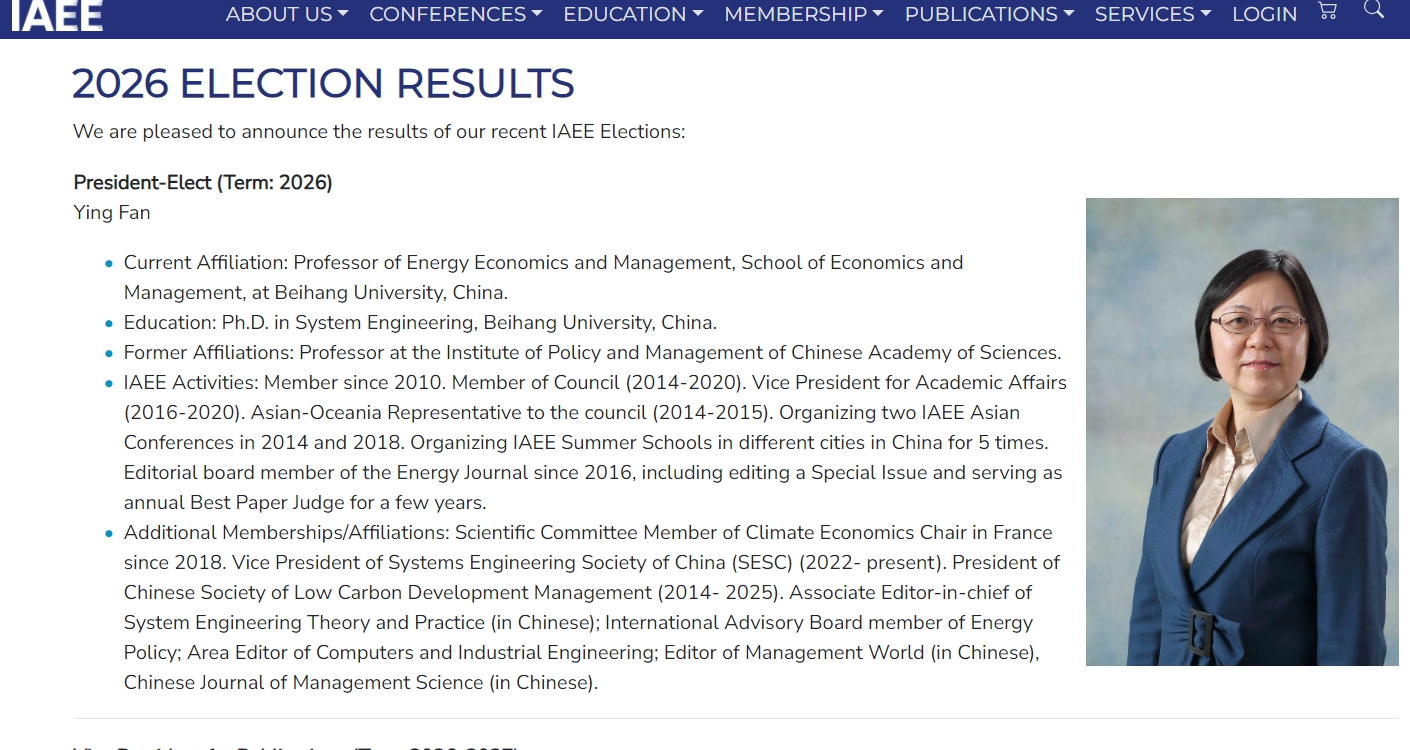 Beihang NewsProfessor Fan Ying named IAEE President-ElectMore