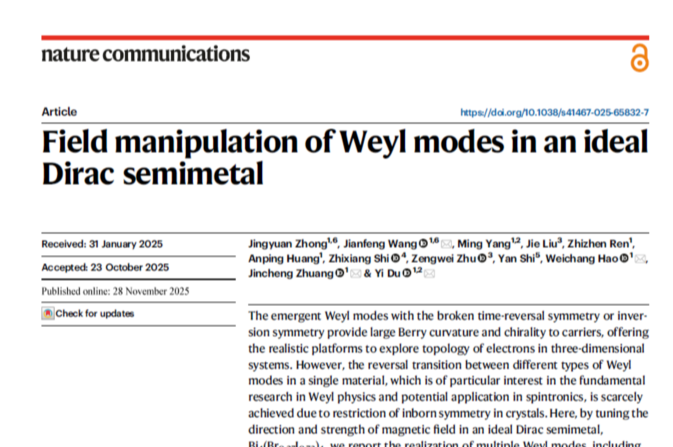
Recently, the Surface and Low-Dimensional Physics research group at the School of Physics, Beihang University, in collaboration with Huazhong University of Science and Technology, Southeast University, and other institutions, has made significant progress in realizing multiple Weyl modes. The related research findings were published online in Nature Communications on November 28, 2025, under the title "Field manipulation of Weyl modes in an ideal Dirac semimetal."
Symmetry and topology are symbiotic in condensed matter physics, and their interplay is a fundamental aspect classifying the different topological phases such as topological insulator, topological nodal point/line/surface semimetal, and topological crystalline insulator, etc. The topological phase transitions are expected to be generated when the symmetry of a system is broken by varying the ordering parameters or introducing the external perturbation. For example, Weyl physics can be induced by breaking inversion symmetry (IS) or time-reversal symmetry (TRS) in a Dirac semimetal, along with the abundant intriguing phenomena like anomalous Hall effect (AHE), unconventional thermal magnetic responses, negative magnetoresistivity (NMR) by chiral anomaly, and three-dimensional (3D) quantum Hall effect. Despite numerous Weyl materials revealed in non-centrosymmetric or magnetic systems so far a symmetry guideline for searching for various Weyl modes and designing their evolution is still unrevealed, which is crucial for the manipulation of Weyl fermion towards the chiral device application.
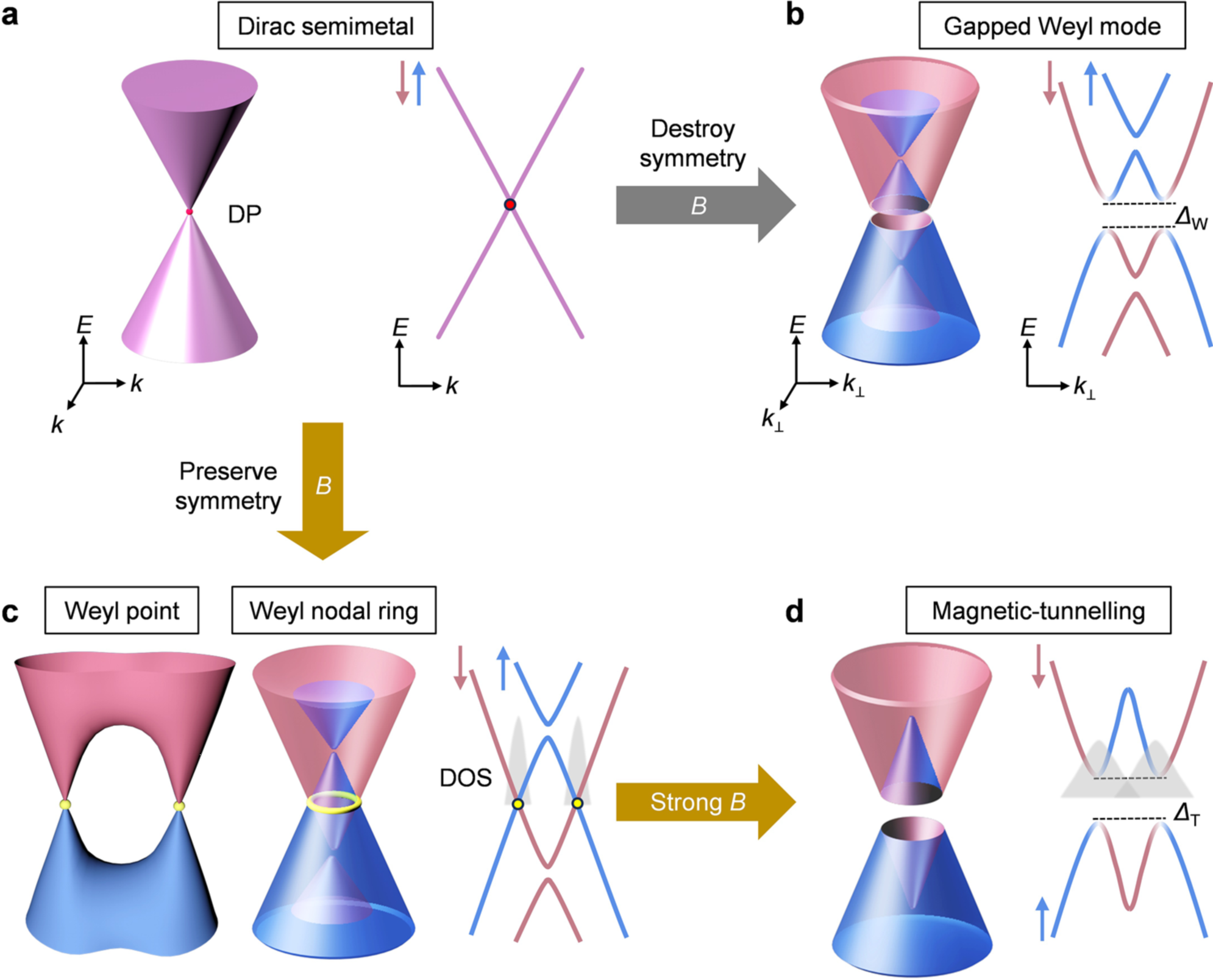
Multiple Weyl modes originated from magnetic field manipulation of a Dirac point
The emergent Weyl modes with the broken time-reversal symmetry or inversion symmetry provide large Berry curvature and chirality to carriers, offering the realistic platforms to explore topology of electrons in three-dimensional systems. However, the reversal transition between different types of Weyl modes in a single material, which is of particular interest in the fundamental research in Weyl physics and potential application in spintronics, is scarcely achieved due to restriction of inborn symmetry in crystals.
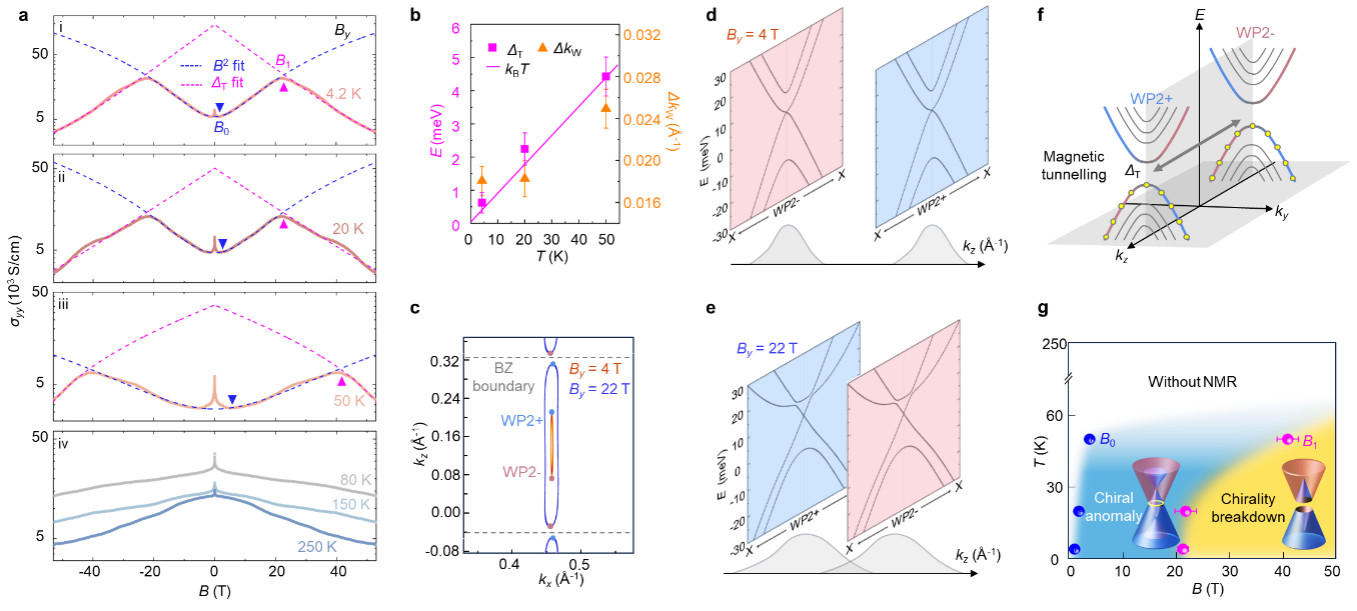
Magnetic tunneling with chirality breakdown
By tuning the direction and strength of magnetic field in an ideal Dirac semimetal, Bi4(Br0.27I0.73)4, the researchers report the realization of multiple Weyl modes, including gapped Weyl mode, Weyl nodal ring, and coupled Weyl mode by the magnetoresistivity measurements and electronic structure calculations. Specifically, under a magnetic field with broken mirror symmetry, anomalous Hall effect with step feature results from the large Berry curvature for the gapped Weyl mode. A prominent negative magnetoresistivity is observed at low magnetic field with preserved mirror symmetry and disappears at high magnetic field, which is correlated to the chiral anomaly and its annihilation of Weyl nodal ring, respectively. The findings reveal distinct Weyl modes under the intertwined crystal symmetry and time-reversal breaking, laying the foundation of manipulating multiple Weyl modes in chiral spintronic network.
Ph.D. student Zhong Jingyuan and Associate Professor Wang Jianfeng from the School of Physics are co-first authors. Professor Du Yi, Associate Professor Zhuang Jincheng, Associate Professor Wang Jianfeng, and Professor Hao Weichang are co-corresponding authors. Beihang University is the sole corresponding institution.
This work received support from the National Natural Science Foundation of China, the National Key R&D Program of China, and the Fundamental Research Funds for the Central Universities.
Link to the article: https://www.nature.com/articles/s41467-025-65832-7
Editor: Liu Tingting


 Beihang News8th China Microelectronics Intelligent Conference convenes in BeijingMore
 Beihang NewsBeihang AI Knowledge Center debuts in MexicoMore
 Beihang News18th Enterprise Open Day successfully heldMore
 Beihang NewsProfessor Niu Jianwei elected as IEEE FellowMore
 Beihang NewsTen Beihang professors and alumni elected as CAS and CAE academiciansMore
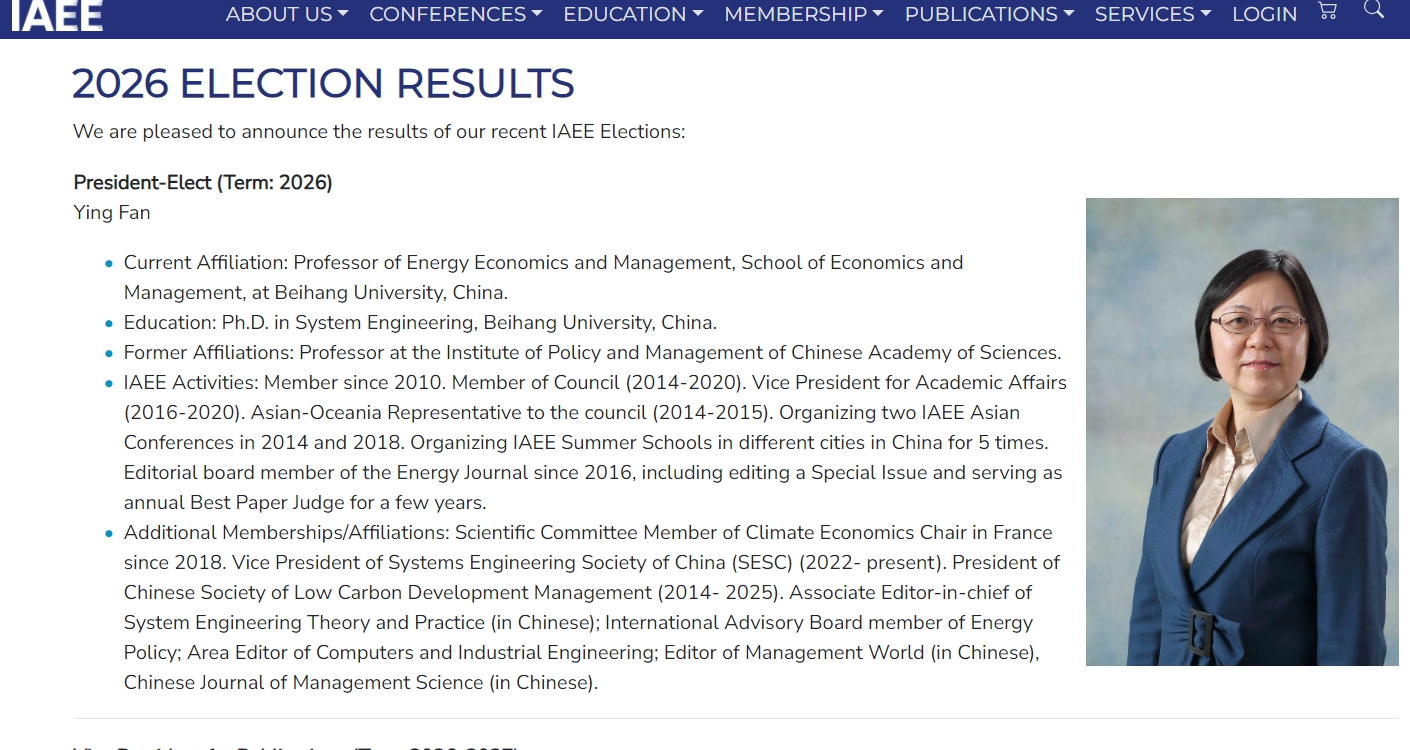 Beihang NewsProfessor Fan Ying named IAEE President-ElectMore